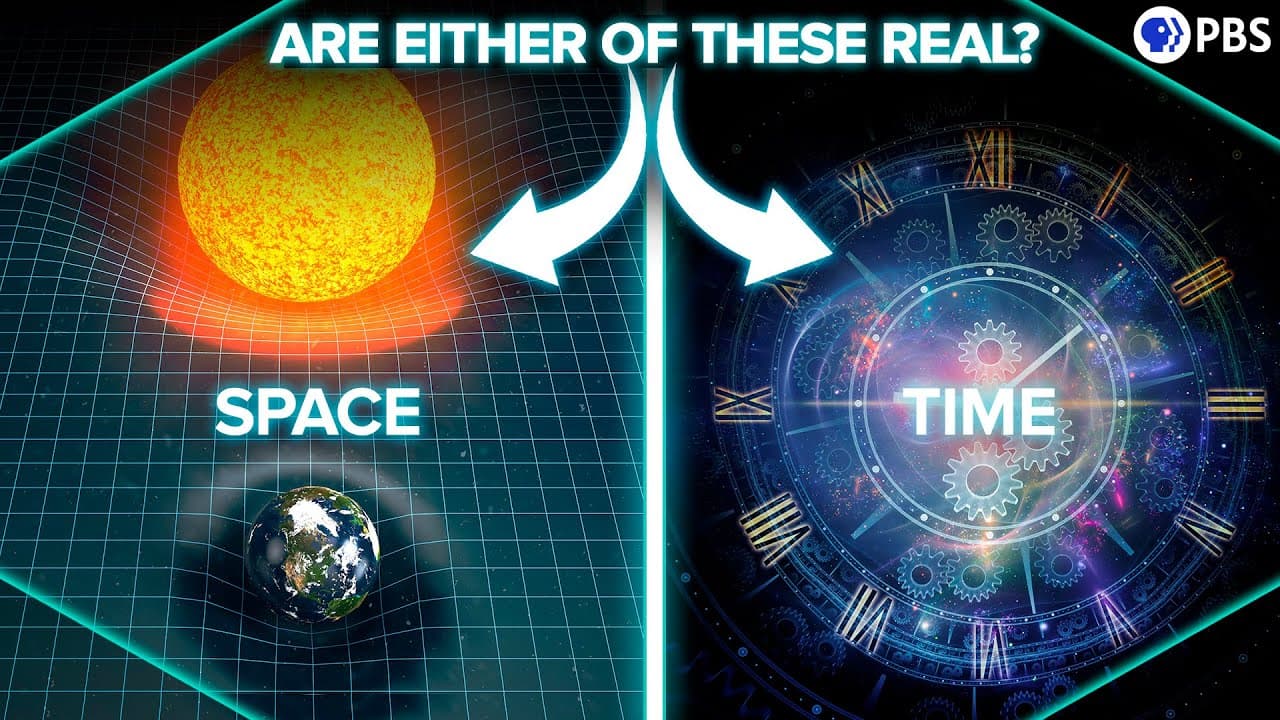
What If Space And Time Are NOT Real?
TL;DR
Space and time may not be fundamental concepts.
Transcript
Thank you to Brilliant for supporting PBS. Physics progresses by breaking our intuitions, but we are now at a point where further progress may require us to do away with the most intuitive and seemingly fundamental concepts of all—space and time themselves. Physics came into its modern form as a description of how objects move through space and tim... Read More
Key Insights
- Physics may need to abandon traditional notions of space and time to progress, as these concepts break down at extreme scales.
- Historically, space and time have been viewed either as relational (dependent on objects) or absolute (independent entities).
- Newton's view of absolute space and time was revolutionary but faced opposition from Leibniz, who saw them as relational.
- Einstein's relativity merged space and time into spacetime, showing that they are not absolute but influenced by mass and energy.
- Modern physics theories like string theory and loop quantum gravity suggest space and time might emerge from more fundamental entities.
- The Cartesian coordinate system revolutionized physics by allowing abstract numerical concepts to be represented spatially.
- Leibniz proposed that space might exist in the relationships between objects, not as a standalone entity.
- Einstein's theories suggest space is not empty but filled with fields, challenging the notion of it being an absolute void.
Install to Summarize YouTube Videos and Get Transcripts
Explore YouTube Video Summarizer or Get YouTube Transcript Extractor
Questions & Answers
Q: What is the main challenge physics faces regarding space and time?
The main challenge is that traditional concepts of space and time break down at very small scales and high energies, such as those encountered in quantum mechanics and general relativity. This conflict suggests that space and time may not be fundamental, requiring new theories to understand their true nature.
Q: How did the Cartesian coordinate system impact physics?
The Cartesian coordinate system, introduced by Rene Descartes, allowed for the representation of abstract numerical concepts in spatial terms. This system enabled the graphing of algebraic functions and the description of physical spaces, revolutionizing physics by providing a new tool for understanding and describing the universe.
Q: What was Newton's view on space and time?
Newton viewed space and time as absolute entities, existing independently of the objects within them. He believed in a universal clock for time and a master frame of reference for space, where objects could have an absolute position and velocity. This view was revolutionary but faced opposition from contemporaries like Leibniz.
Q: How did Einstein's theories change the understanding of space and time?
Einstein's theories of relativity merged space and time into a single entity known as spacetime. His work showed that space and time are not absolute but are influenced by mass and energy, leading to phenomena such as time dilation and the warping of spacetime. This challenged the Newtonian view and introduced a more dynamic understanding of the universe.
Q: What are some modern theories about space and time?
Modern theories like string theory, loop quantum gravity, and the holographic principle suggest that space and time may emerge from more fundamental elements. These theories propose that the dimensions we experience could be the result of interactions between these underlying entities, challenging the traditional view of space and time as fundamental constructs.
Q: What was Leibniz's perspective on space and time?
Leibniz viewed space and time as relational, meaning they are qualities that arise from the relationships between objects, rather than independent entities. He believed that space and time might be constructs of the mind, organizing objects separated by more abstract properties. His ideas contrast with Newton's absolute view and are gaining interest in modern physics.
Q: How does Einstein's view align with Leibniz and Newton?
Einstein's view is somewhat between Leibniz and Newton. While he recognized an extended structure that defines distances and durations, he rejected the idea of it being absolute and fundamental. Instead, he saw space as inseparable from the gravitational field, aligning more with Leibniz's relational view but acknowledging the substantial nature of spacetime.
Q: Why might space and time be considered constructs of the mind?
Space and time might be considered constructs of the mind because our brains could be organizing objects using these dimensions as a framework. Leibniz suggested that the experience of space and time might be subjective interpretations of more abstract properties, similar to how we perceive color as a frequency of light. This perspective is being explored as physics seeks to understand the true nature of reality.
Summary & Key Takeaways
-
Physics is at a crossroads where the fundamental concepts of space and time are being questioned. Historically, these have been seen as either relational or absolute, with Newton's ideas prevailing until Einstein's theories of relativity challenged them. Modern theories suggest space and time might emerge from more fundamental entities.
-
The Cartesian coordinate system allowed for a new way of representing space, influencing physics significantly. Einstein's relativity further transformed our understanding by merging space and time into spacetime, showing their interdependence and the influence of mass and energy on them.
-
Leibniz's ideas about space as relational and potentially a construct of the mind are gaining traction as modern physics explores theories that suggest space and time emerge from more fundamental elements. This challenges the traditional view of them as independent, absolute entities.
Read in Other Languages (beta)
Share This Summary 📚
Summarize YouTube Videos and Get Video Transcripts with 1-Click
Try YouTube Summary with ChatGPT & Claude or YouTube Transcript Generator
Explore More Summaries from PBS Space Time 📚
Summarize YouTube Videos and Get Video Transcripts with 1-Click
Try YouTube Summary with ChatGPT & Claude or YouTube Transcript Generator