Ancient Egypt | Early Civilizations | World History | Khan Academy
TL;DR
Ancient Egypt, located along the Nile River, was a civilization that emerged around 3,100 BCE and lasted for thousands of years, characterized by agriculture, specialization of labor, and complex societies.
Transcript
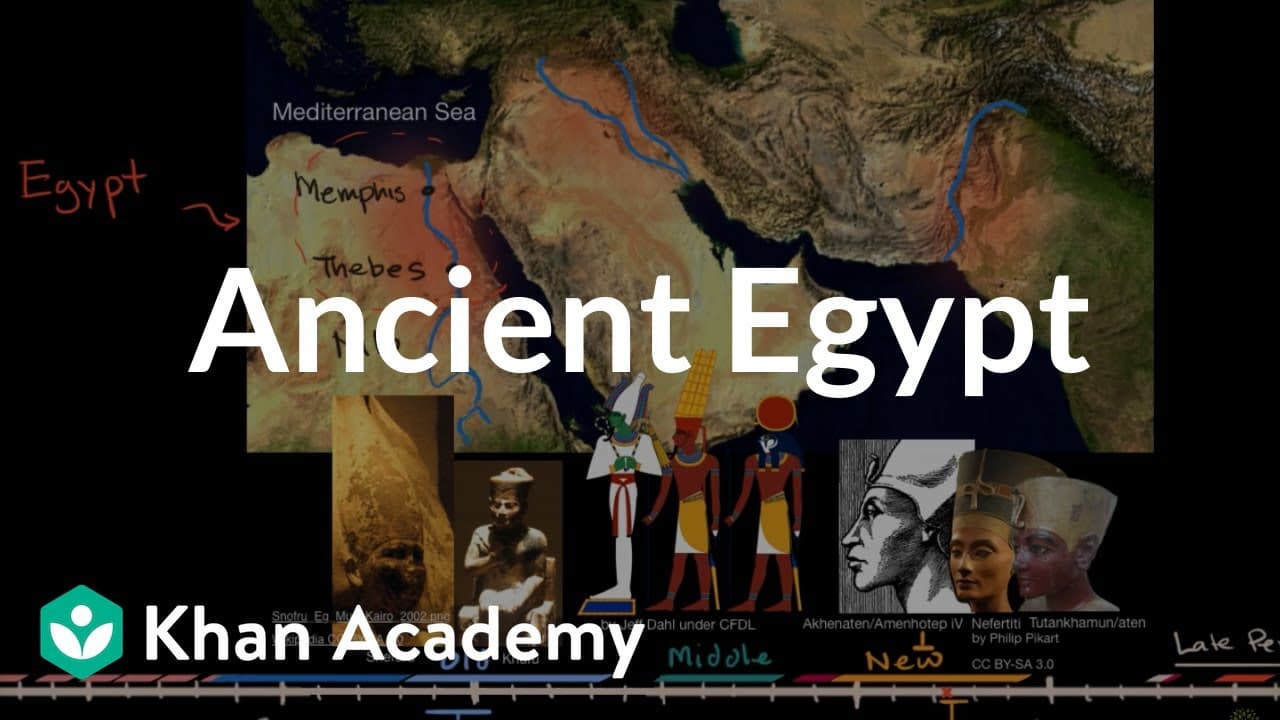
- [Narrator] In this video, we are going to give ourselves an overview of ancient Egypt, which corresponds geographically pretty closely to the modern day state of Egypt in northeast Africa. Now the central feature in both ancient Egypt and in modern Egypt is the Nile River that you see in blue right over here. And the Nile River is one of the grea... Read More
Key Insights
- 🇨🇫 The Nile River was central to the development and sustainability of ancient Egyptian civilization.
- 🖐️ Agriculture played a crucial role in the growth and complexity of ancient Egyptian society.
- ✍️ Hieroglyphics and the Rosetta Stone provided insights into ancient Egyptian writing and culture.
- 🥶 Ancient Egypt had three kingdoms: old, middle, and new, with intermediate periods of fragmentation.
- 🇪🇬 Notable pharaohs in ancient Egypt include Amenhotep/Akhenaton, King Tut, and Ramses the Second.
- 🥺 The collapse of the new kingdom led to foreign rule, including the Greeks and Romans.
- 🤑 Ancient Egyptian civilization left behind iconic structures like the pyramids and a rich cultural legacy.
Install to Summarize YouTube Videos and Get Transcripts
Explore YouTube Video Summarizer or Get YouTube Transcript Extractor
Questions & Answers
Q: What is the significance of the Nile River in ancient Egypt?
The Nile River was vital for ancient Egypt as it provided fresh water, fertile soil through flooding, and allowed for the development of agriculture.
Q: How did agriculture impact ancient Egypt?
Agriculture allowed for higher population densities, specialization of labor, and the emergence of more complex societies in ancient Egypt.
Q: How do we know about ancient Egyptian civilization?
Deciphering hieroglyphics, the ancient Egyptian writing system, has provided valuable insights into their society. The Rosetta Stone, which contains translations in three different languages, helped historians decipher their writing.
Q: Who were some notable pharaohs in ancient Egypt?
Amenhotep/Akhenaton was known for his attempt at monotheism, King Tut is famous for his intact tomb, and Ramses the Second was a military powerhouse and ruler during the peak of ancient Egypt.
Summary & Key Takeaways
-
Ancient Egypt was centered around the Nile River, which provided fresh water, fertile soil, and was crucial for agriculture.
-
The Nile Valley saw human settlement as early as 6,000 BCE, leading to higher population densities, specialization of labor, and the emergence of a great civilization.
-
Ancient Egypt can be divided into three kingdoms, the old kingdom, middle kingdom, and new kingdom, with intermediate periods of fragmentation in between.
Read in Other Languages (beta)
Share This Summary 📚
Summarize YouTube Videos and Get Video Transcripts with 1-Click
Try YouTube Summary with ChatGPT & Claude or YouTube Transcript Generator
Explore More Summaries from Khan Academy 📚





Summarize YouTube Videos and Get Video Transcripts with 1-Click
Try YouTube Summary with ChatGPT & Claude or YouTube Transcript Generator