Worked example: recognizing function from Taylor series | Series | AP Calculus BC | Khan Academy
TL;DR
The video explains how to identify a function as a Taylor series or Maclaurin series by evaluating the function and its derivatives at zero.
Transcript
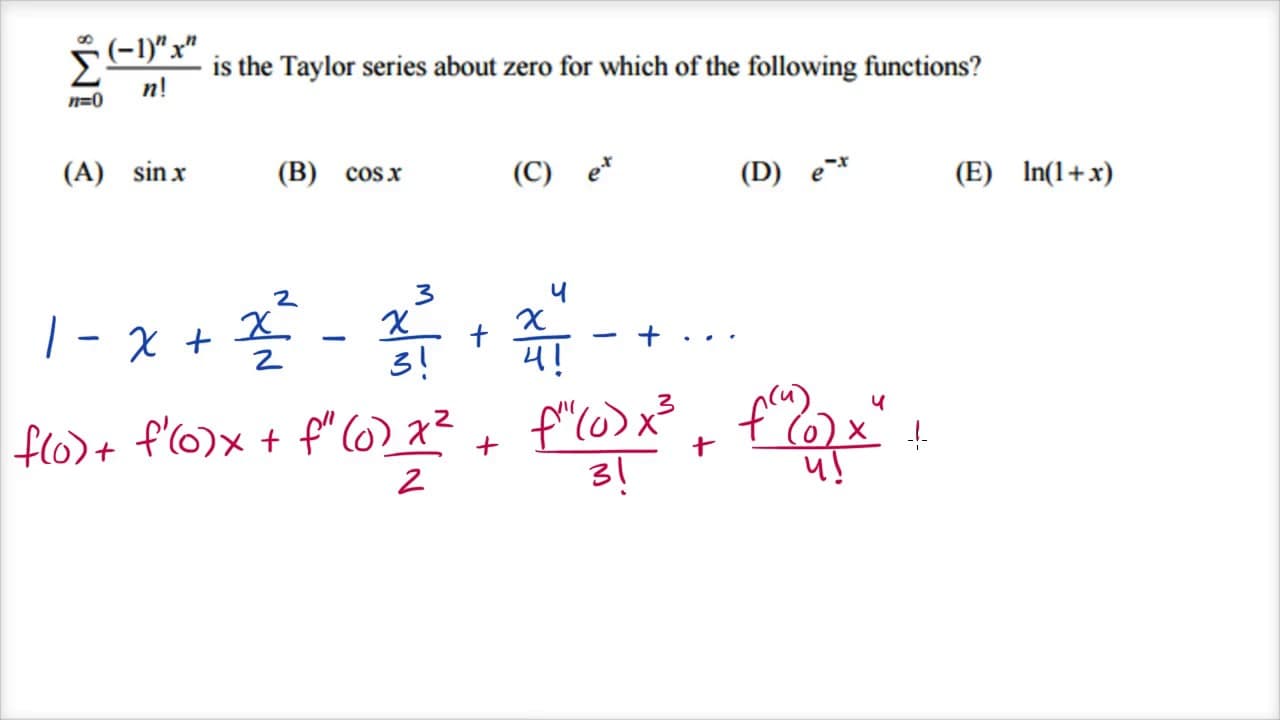
- [Instructor] So we're given this expression is the Taylor series about zero for which of the following functions and they give us some choices here. So let's just think a little bit about this series that they gave us. So if we were to expand it out, let's see, when n is equal to zero, it'd be negative one to the zero power which is one times x t... Read More
Key Insights
- 😥 The Taylor series and Maclaurin series are expansions of a function around a specific point.
- 😥 The general form of a Taylor or Maclaurin series involves evaluating the function and its derivatives at that specific point.
- 0️⃣ By comparing the coefficients in the given series to the coefficients determined by evaluating derivatives at zero, we can identify the Taylor or Maclaurin series about zero.
- 0️⃣ Evaluating the function and its derivatives at zero helps us determine the coefficients in the series and verify if a given function is a Taylor or Maclaurin series about zero.
- 🟰 Eliminating choices that do not satisfy the constraint that f(0) should be equal to one helps narrow down the options.
- 👨💼 The sine function and the natural logarithm of one plus zero do not meet the constraint of f(0) = 1.
Install to Summarize YouTube Videos and Get Transcripts
Explore YouTube Video Summarizer or Get YouTube Transcript Extractor
Questions & Answers
Q: How can we determine if a function is a Taylor series or Maclaurin series about zero?
To determine if a function is a Taylor or Maclaurin series about zero, we need to ensure that the function and its derivatives at zero satisfy the constraints mentioned in the video. Specifically, the function at zero should be equal to one, the first derivative at zero should be -1, the second derivative at zero should be 1, and so on.
Q: What is the general form of a Taylor or Maclaurin series about zero?
The general form of a Taylor or Maclaurin series about zero is f(0) + f'(0)x + f''(0)x^2/2! + f'''(0)x^3/3! + ... Here, f(0) represents the value of the function at zero, f'(0) represents the value of the first derivative at zero, f''(0) represents the value of the second derivative at zero, and so on.
Q: How can we eliminate some of the choices using the given constraints?
By evaluating the given functions at zero, we can eliminate choices that do not satisfy the constraint that f(0) should be equal to one. For example, the sine function evaluated at zero is zero, which does not meet the constraint. Similarly, the natural logarithm of one plus zero is zero, which also does not meet the constraint.
Q: Why do we evaluate the derivatives at zero to determine the Taylor or Maclaurin series about zero?
Evaluating the derivatives at zero helps us identify the coefficients of each term in the series. By comparing the coefficients in the given series to the coefficients determined by evaluating the derivatives at zero, we can determine if the function is a Taylor or Maclaurin series about zero.
Summary & Key Takeaways
-
The video introduces the concept of Taylor series and Maclaurin series expansion around zero.
-
The general form of a Taylor series or Maclaurin series is discussed, which involves evaluating the function and its derivatives at zero.
-
By comparing the given series to the general form, the video demonstrates how to identify which function is the Taylor series or Maclaurin series about zero.
Read in Other Languages (beta)
Share This Summary 📚
Summarize YouTube Videos and Get Video Transcripts with 1-Click
Try YouTube Summary with ChatGPT & Claude or YouTube Transcript Generator
Explore More Summaries from Khan Academy 📚



Summarize YouTube Videos and Get Video Transcripts with 1-Click
Try YouTube Summary with ChatGPT & Claude or YouTube Transcript Generator