How To Find The Domain and Range of a Quadratic Function
TL;DR
Learn how to find the domain and range of quadratic functions by analyzing their graphs and understanding transformations.
Transcript
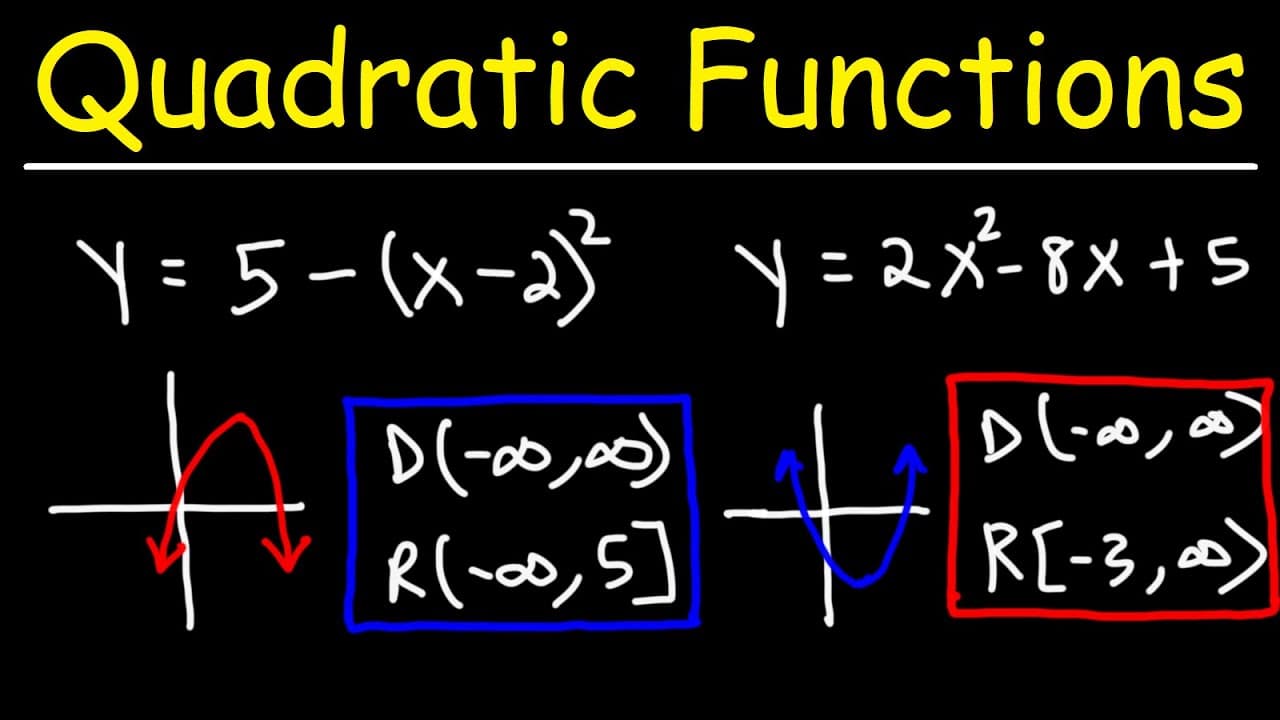
in this video we're going to talk about how to find the domain and range of a quadratic function so let's start with the parent function y is equal to x squared what is the domain and range of that function it really helps if you can draw the graph if you can see the graph it's very easy to determine the domain and range now when finding the domain... Read More
Key Insights
- 🧡 Quadratic functions have a domain of all real numbers and a range that depends on the direction of the opening of the graph.
- ✖️ Multiplying a quadratic function by a negative sign reflects it over the x-axis, changing the range.
- 🧡 Transformations of quadratic functions affect the vertex position but not the domain, while the range may shift accordingly.
- 🧡 Factoring quadratic functions helps in identifying the vertex and finding the domain and range.
- ☺️ The vertex formula can be used to find the x-coordinate of the vertex, which determines the domain and range.
Install to Summarize YouTube Videos and Get Transcripts
Explore YouTube Video Summarizer or Get YouTube Transcript Extractor
Questions & Answers
Q: How do you find the domain and range of a quadratic function?
To find the domain, look at the X values of the graph, which range from negative infinity to positive infinity. The range is determined by the Y values of the graph, going from zero to positive infinity (inclusive).
Q: What happens to the domain and range when a quadratic function is multiplied by a negative sign?
Multiplying a quadratic function by a negative sign reflects the graph over the x-axis. The domain remains the same, but the range changes to go from negative infinity to zero (inclusive).
Q: How do transformations affect the domain and range of a quadratic function?
Transformations, such as shifting the graph up/down or left/right, affect the vertex position but not the domain. However, the range may shift depending on the direction of the shift.
Q: Can you find the domain and range of a quadratic function in standard form?
Yes, by using the vertex formula (-B/2A), you can find the x-coordinate of the vertex. Substituting this x-coordinate into the equation gives the y-coordinate, allowing you to determine the vertex and the corresponding domain and range.
Summary & Key Takeaways
-
Quadratic functions have a domain of all real numbers and a range that goes from zero to positive infinity.
-
When the quadratic function is multiplied by a negative sign, it reflects over the x-axis, resulting in a range from negative infinity to zero.
-
Transformation of quadratic functions can change the vertex, but the domain remains the same while the range varies depending on the shift.
-
Quadratic functions can also be written in standard form, and the domain and range can be found using the vertex formula.
-
Factoring quadratic functions helps in finding the x-intercepts, which allows us to determine the vertex and the corresponding range.
Read in Other Languages (beta)
Share This Summary 📚
Summarize YouTube Videos and Get Video Transcripts with 1-Click
Try YouTube Summary with ChatGPT & Claude or YouTube Transcript Generator
Explore More Summaries from The Organic Chemistry Tutor 📚
Summarize YouTube Videos and Get Video Transcripts with 1-Click
Try YouTube Summary with ChatGPT & Claude or YouTube Transcript Generator