Products
Features
YouTube Video Summarizer
Summarize YouTube videos
Web & PDF Highlighter
Highlight web pages & PDFs
Chat with PDF
Ask any PDF questions with AI
Ask AI Clone
Chat with your highlights & memories
Audio Transcriber
Transcribe audio files to text
Glasp Reader
Read and highlight articles
Kindle Highlight Export
Export your Kindle highlights
Idea Hatch
Hatch ideas from your highlights
Integrations
Obsidian Plugin
Notion Integration
Pocket Integration
Instapaper Integration
Medium Integration
Readwise Integration
Snipd Integration
Hypothesis Integration
Apps & Extensions
Chrome Extension
Safari Extension
Edge Add-ons
Firefox Add-ons
iOS App
Android App
Discover
Discover
Ideas
Discover new ideas and insights
Articles
Curated articles and insights
Books
Book recommendations by great minds
Posts
Essays and notes from readers
Quotes
Inspiring quotes collection
Videos
Curated videos and summaries
Explore Glasp
Glasp Newsletter
Weekly insights and updates
Glasp Talk
Interview series with great minds
Glasp Blog
Latest news and articles
Glasp Use Cases
Learn how others use Glasp
Build & Support
Glasp API
Access Glasp's API for developers
MCP Connector
Connect Glasp to Claude & ChatGPT
Community
Glasp Reddit Community
Students
Student discount and benefits
FAQs
Frequently Asked Questions
AboutPricing
DashboardLog inSign up

Recursion relation for the solution
July 31, 2017
by
MIT OpenCourseWare
YouTube video player
Recursion relation for the solution

TL;DR

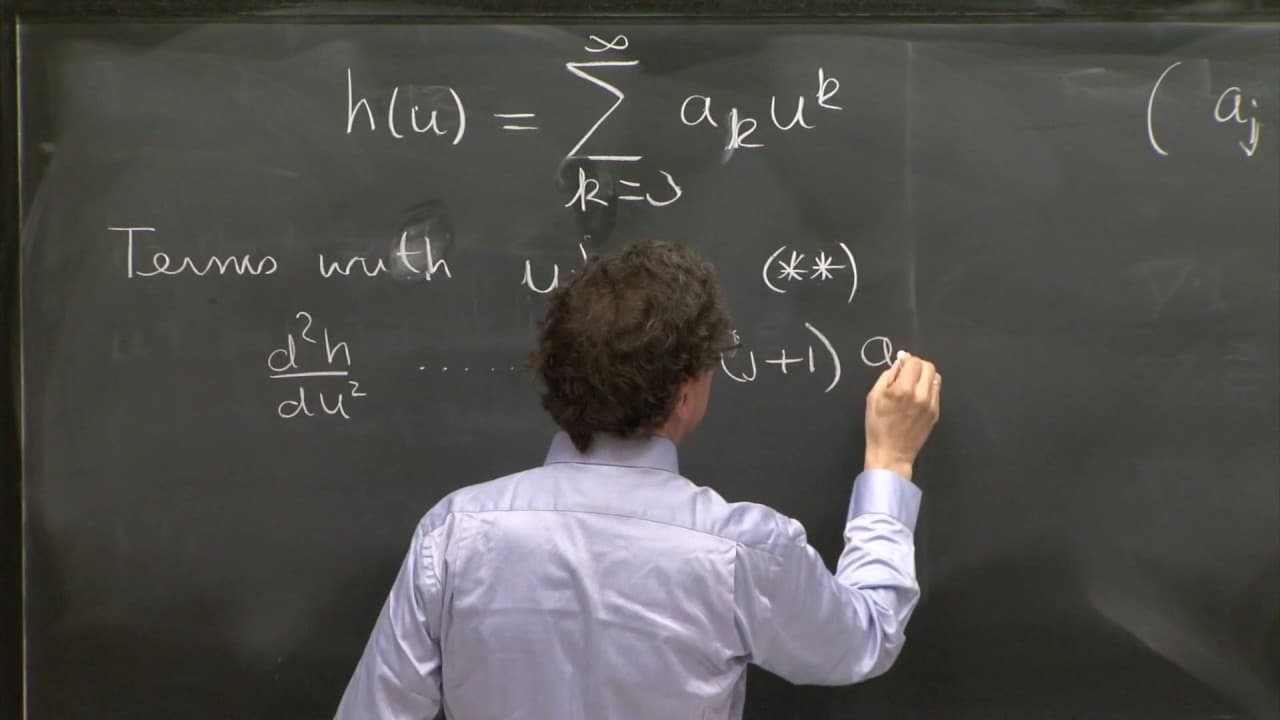
This video explains how a differential equation for energy eigenstates is simplified and solved using recursion relations.

Transcript

PROFESSOR: This was a differential equation for the energy eigenstates phi. Supposed to be normalizable functions. We looked at this equation and decided we would first clean out the constant. We did that by replacing x by a unit-free coordinate u. For that we needed a constant that carries units of length, and that constant is given by this combin... Read More

Key Insights

  • ❓ The differential equation for energy eigenstates can be simplified by redefining variables and constants.
  • ⚾ The simplified equation is solved using a recursive method based on initial conditions.
  • 👻 Polynomial solutions are possible when the exponential factor allows it.
  • 🦕 Even and odd solutions can be obtained based on different initial conditions.
  • 👻 The recursion relation allows for the calculation of coefficients in the polynomial solution.
  • 0️⃣ The process involves finding the values of the function and its derivative at zero.
  • 😑 The solutions to the simplified differential equation are expressed as a sum of powers of the rescaled coordinate.

Install to Summarize YouTube Videos and Get Transcripts

Explore YouTube Video Summarizer or Get YouTube Transcript Extractor

Questions & Answers

Q: What is the purpose of redefining variables in the differential equation?

Redefining variables allows for the removal of constants and simplification of the equation, making it easier to solve.

Q: How do the energy eigenstates depend on the peculiar values of energies?

The energy eigenstates have normalizable solutions only when the energies are such that the exponential factor in the equation allows for a polynomial solution.

Q: What is the significance of the recursion relation in solving the differential equation?

The recursion relation provides a method to calculate the coefficients of the polynomial solution by relating them to previous coefficients in a predictable manner.

Q: How many initial conditions are required to solve the differential equation?

Two initial conditions are needed: the value of the function and the derivative of the function at zero.

Summary & Key Takeaways

  • The video discusses the process of simplifying a differential equation for energy eigenstates by redefining variables and constants.

  • The equation is transformed into a simpler differential equation for a rescaled coordinate.

  • The simplified equation is then solved using a recursive method, which requires specifying initial conditions.


Read in Other Languages (beta)

English

Share This Summary 📚

Summarize YouTube Videos and Get Video Transcripts with 1-Click

Download browser extensions on:

Try YouTube Summary with ChatGPT & Claude or YouTube Transcript Generator

Explore More Summaries from MIT OpenCourseWare 📚
Student Video: 2D Brillouin Zones thumbnail
Student Video: 2D Brillouin Zones
MIT OpenCourseWare
MIT OpenCourseWare at 20 thumbnail
MIT OpenCourseWare at 20
MIT OpenCourseWare
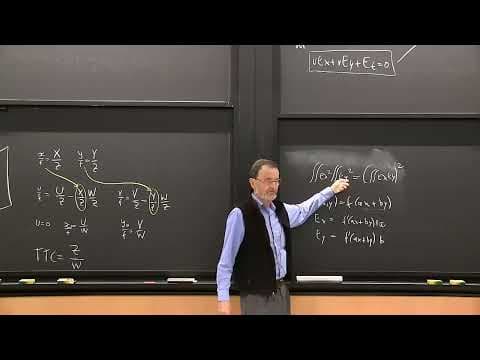
Lecture 4: Fixed Optical Flow, Optical Mouse, Constant Brightness Assumption, Closed Form Solution thumbnail
Lecture 4: Fixed Optical Flow, Optical Mouse, Constant Brightness Assumption, Closed Form Solution
MIT OpenCourseWare
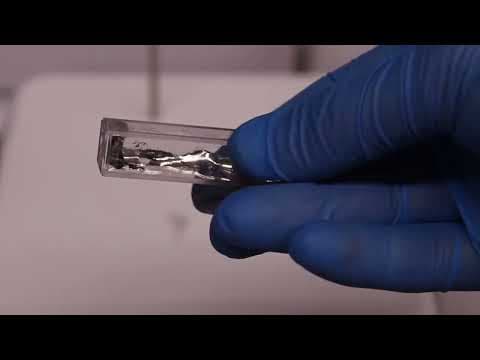
Supplemental Video: Gallium-Indium Eutectic Demo thumbnail
Supplemental Video: Gallium-Indium Eutectic Demo
MIT OpenCourseWare
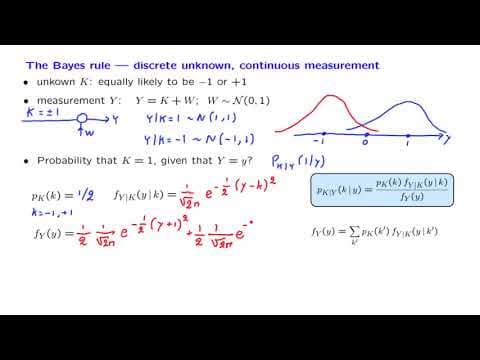
L10.10 Detection of a Binary Signal thumbnail
L10.10 Detection of a Binary Signal
MIT OpenCourseWare
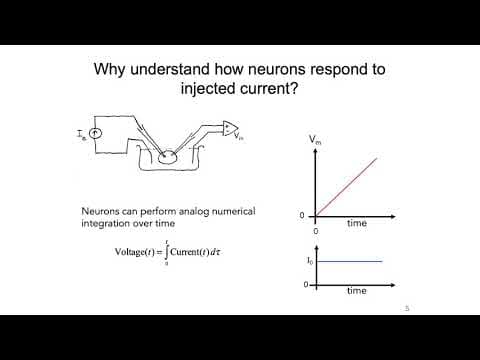
2: Resistor Capacitor Circuit and Nernst Potential - Intro to Neural Computation thumbnail
2: Resistor Capacitor Circuit and Nernst Potential - Intro to Neural Computation
MIT OpenCourseWare

Summarize YouTube Videos and Get Video Transcripts with 1-Click

Download browser extensions on:

Try YouTube Summary with ChatGPT & Claude or YouTube Transcript Generator

Apps & Extensions

  • Chrome Extension
  • Safari Extension
  • Edge Add-ons
  • Firefox Add-ons
  • iOS App
  • Android App

Key Features

  • YouTube Video Summarizer
  • Web & PDF Summarizer
  • Web & PDF Highlighter
  • Chat with PDF
  • Ask AI Clone
  • Audio Transcriber
  • Glasp Reader
  • Kindle Highlight Export
  • Idea Hatch

Integrations

  • Obsidian Plugin
  • Notion Integration
  • Pocket Integration
  • Instapaper Integration
  • Medium Integration
  • Readwise Integration
  • Snipd Integration
  • Hypothesis Integration

More Features

  • APIs
  • MCP Connector
  • Blog & Post
  • Embed Links
  • Image Highlight
  • Personality Test
  • Quote Shots

Company

  • About us
  • Blog
  • Community
  • FAQs
  • Job Board
  • Newsletter
  • Pricing
Terms

•

Privacy

•

Guidelines

© 2026 Glasp Inc. All rights reserved.