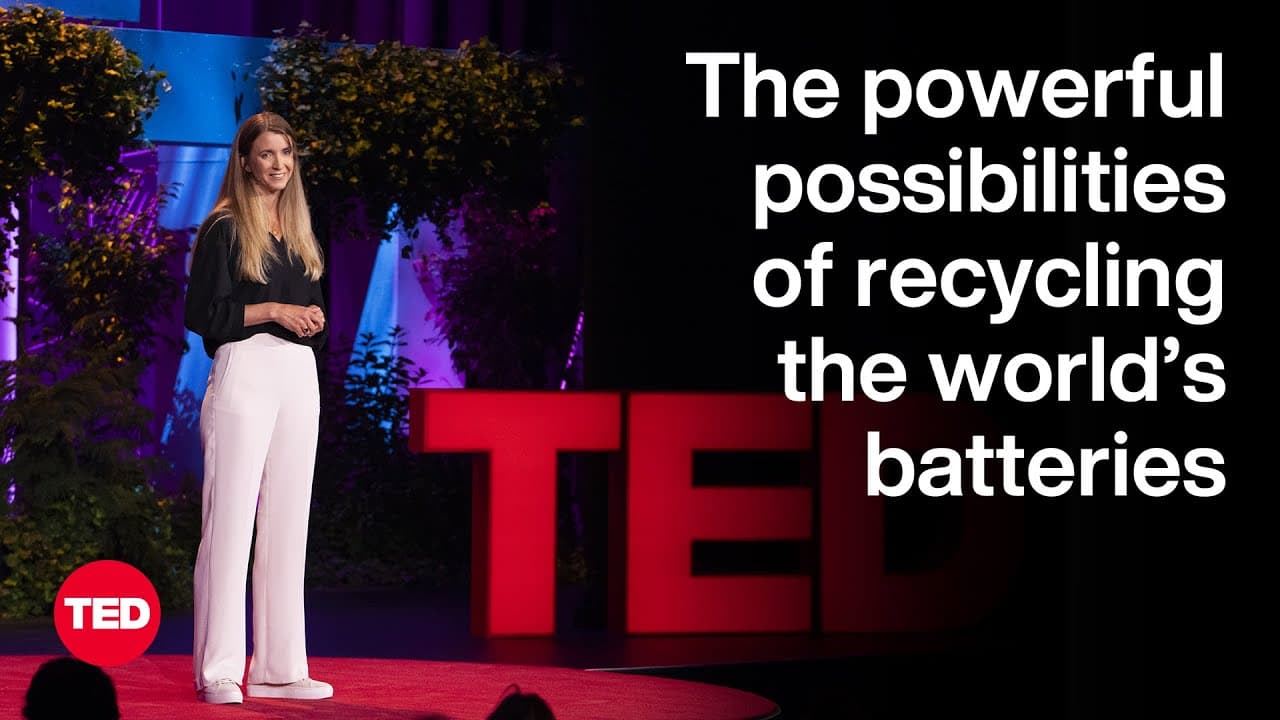
The Powerful Possibilities of Recycling the World's Batteries | Emma Nehrenheim | TED
TL;DR
This content explores the importance of responsible battery manufacturing and recycling in the transition to electric vehicles and clean energy.
Transcript
So the world is going electric. And batteries will do for electrification what the refrigerator did for food, because batteries will allow us to move clean energy through time and through space. And we don't have a problem with the availability of energy on this planet. We have a problem with getting this energy to where we need it, and when we nee... Read More
Key Insights
- 🌍 The world is transitioning to electric vehicles, with batteries playing a crucial role in enabling clean energy transportation.
- 🔄 The fossil fuel industry has operated on a linear model of extract, use, and discard, leading to environmental crises. It's important to learn from past mistakes and approach battery manufacturing differently.
- ⚡️ Battery factories require large amounts of energy to produce, but their carbon footprint can be significantly reduced by sourcing energy from renewables.
- ⛏️ Batteries are made from minerals like nickel, cobalt, and lithium, and adopting sustainable mining and recycling practices can further reduce their carbon footprint.
- ♻️ Northvolt has developed a circular battery economy that involves recycling batteries at the end of their life cycle and using the extracted materials for new production.
- 🚗 It's not just about recycling batteries; it's about building a circular economy for all industries involved in the energy transition, including wind turbines and solar panels.
- ⛏️ Responsible mining is essential, and accountability and traceability systems should be in place to ensure that materials can be used repeatedly.
- 💼 Transitioning to sustainable practices is not only environmentally beneficial but also economically profitable, as materials retain their value throughout their lifetime.
Install to Summarize YouTube Videos and Get Transcripts
Explore YouTube Video Summarizer or Get YouTube Transcript Extractor
Questions & Answers
Q: What are batteries capable of doing for electrification?
Batteries will allow clean energy to be transported through time and space, enabling the world to shift towards electric power for various applications.
Q: What is the main problem with energy availability on the planet?
The main problem is not the availability of energy but rather the challenge of delivering energy to the required locations and at the necessary times.
Q: What mistakes have been made in the past that have contributed to the climate and environmental crisis?
Historically, the extraction and utilization of fossil fuels, such as oil, without considering the long-term consequences, have led to the current environmental crisis.
Q: What are the two key aspects to understand about battery manufacturing?
Firstly, batteries require significant amounts of energy for production. Secondly, they are made from minerals that involve global mining, refining, and processing, along with complex supply chains.
Q: How can the carbon footprint of battery manufacturing be reduced?
By putting battery factories under renewable energy grids, two-thirds of the carbon footprint can be slashed. However, the remaining third, predominantly from the supply chain, still needs to be addressed.
Q: What minerals are batteries made from, and how can their carbon footprint be reduced?
Batteries are made from minerals such as nickel, cobalt, and lithium. By implementing sustainable mining practices and emphasizing recycling, it is possible to significantly reduce the carbon footprint associated with these minerals.
Q: Can the elements used in batteries be recycled?
Yes, because metals are elements, they can be returned to their elemental form and reused. At Northvolt, a recycling process has been developed where batteries are fully discharged, components are separated, and the metals are extracted for reuse.
Q: What is the importance of a circular battery economy?
Moving towards a circular battery economy allows for the continuous use and reuse of battery materials, which is in contrast to the linear model of extracting, using, and discarding. This approach contributes to both environmental sustainability and economic profitability.
Summary & Key Takeaways
-
Batteries will allow for the widespread use of clean energy, but if battery manufacturing is not done correctly, it could contribute to the climate crisis.
-
Battery production requires large amounts of energy and minerals, which can have a significant carbon footprint if not sourced and produced sustainably.
-
Recycling batteries and creating a circular battery economy is crucial for reducing the environmental impact of the electric vehicle industry and other renewable energy industries.
Read in Other Languages (beta)
Share This Summary 📚
Summarize YouTube Videos and Get Video Transcripts with 1-Click
Try YouTube Summary with ChatGPT & Claude or YouTube Transcript Generator
Explore More Summaries from TED 📚




Summarize YouTube Videos and Get Video Transcripts with 1-Click
Try YouTube Summary with ChatGPT & Claude or YouTube Transcript Generator