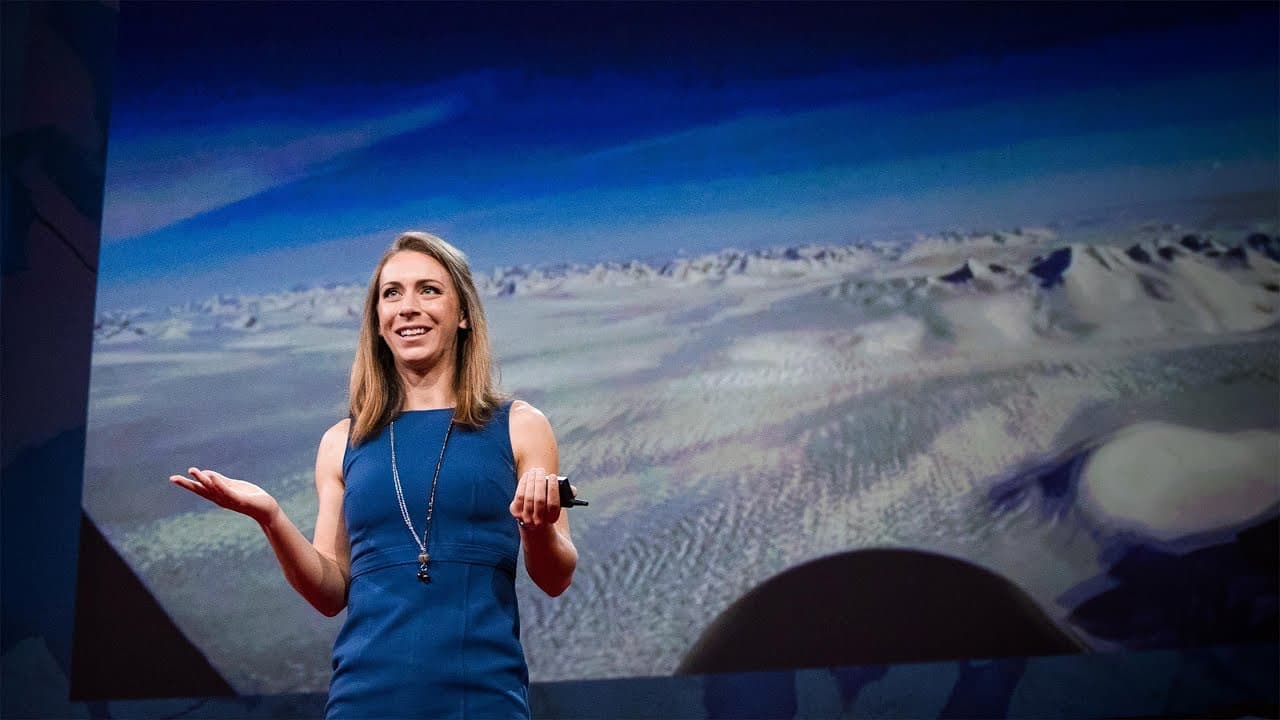
What's hidden under the Greenland ice sheet? | Kristin Poinar
TL;DR
This content discusses the hidden mysteries and impact of the Greenland ice sheet on sea level rise.
Transcript
When was I was 21 years old, I had all this physics homework. Physics homework requires taking breaks, and Wikipedia was relatively new, so I took a lot of breaks there. I kept going back to the same articles, reading them again and again, on glaciers, Antarctica and Greenland. How cool would it be to visit these places and what would it take to do... Read More
Key Insights
- 🔎 Glaciology: Advancements in technology, such as flying airplanes and satellites, have revolutionized glaciology and provided valuable observations about ice sheets and their dynamics.
- 🌍 Impacts of Climate Change: The Greenland ice sheet has experienced significant mass loss since 2002, contributing to rising sea levels. This rate of mass loss is faster than previously believed possible.
- 🌊 Hidden Water: Hidden underneath the Greenland ice sheet are channels of liquid water, similar in size to the Grand Canyon. This water is insulated by the surrounding ice, staying in liquid form year after year.
- 📡 Radar Technology: Radar technology has been instrumental in revealing the bedrock under the ice sheet and detecting the presence of liquid water hidden beneath the ice.
- ✈️ Airborne Observations: Airplanes and satellites provide a wealth of observations about the size and changes in ice sheets over time. Monthly observations since 2002 have revealed the seasonal cycle of melting and gaining ice.
- ⚙️ Numeric Modeling: Numeric models, based on equations adapted from engineering principles, are used to predict how crevasses filled with water can fracture and contribute to sea level rise.
- 💡 Power of Math: Math, particularly numeric modeling, plays a crucial role in understanding and predicting real processes in the world, such as ice cracking and ice sheet dynamics.
- 🌊 Sea Level Rise: Understanding the mysteries hidden within the Greenland ice sheet, such as the flow of aquifer water, is important in predicting and planning for future sea level rise, which can have significant impacts on coastal communities.
Install to Summarize YouTube Videos and Get Transcripts
Explore YouTube Video Summarizer or Get YouTube Transcript Extractor
Questions & Answers
Q: What did the speaker learn about the Greenland ice sheet from Wikipedia?
The speaker learned from Wikipedia that the Greenland ice sheet is massive, the size of Mexico, and its ice is two miles thick from top to bottom.
Q: How are airplanes and satellites revolutionizing glaciology?
Airplanes and satellites are revolutionizing glaciology by providing a wealth of observations about ice sheets that are continually revealing new hidden facts. These observations, captured since 2002, have helped scientists understand the size, seasonal changes, and overall mass loss of the Greenland ice sheet.
Q: What has been the rate of mass loss for the Greenland ice sheet since 2002?
Since 2002, the Greenland ice sheet has lost so much ice that, if the melted water were piled up on Australia, it would drown the country knee-deep. This mass loss exceeded what glaciologists would have anticipated 50 years ago.
Q: How does radar help reveal hidden features of the Greenland ice sheet?
Radar is able to reveal hidden features of the Greenland ice sheet because ice is entirely transparent to radar waves. By using radar, scientists have been able to image the bedrock, which lies beneath the ice, and discover channels, cracks, and other formations that allow ice and water to flow from Greenland into the ocean.
Q: How does the ice aquifer under the Greenland ice sheet form?
The ice aquifer under the Greenland ice sheet forms when melted snow trickles downward and collects in huge pools. The piled-up snow acts as an insulating layer, keeping the water hidden and preserved in liquid form within the ice sheet year after year.
Q: Can the water from the aquifer find a way out to reach the global ocean?
Yes, the water from the aquifer can find a way out to reach the global ocean. Cracks in the Greenland ice sheet, which have been identified near the aquifer, can serve as potential pathways for the water to flow towards the bedrock and eventually reach the ocean.
Q: How does the speaker study the ice dynamics of the Greenland ice sheet?
The speaker studies the ice dynamics of the Greenland ice sheet by utilizing numeric models that run on supercomputers. By adapting engineering equations to describe how ice cracks and fractures under stress, the speaker can simulate and understand the behavior of crevasses filled with water from the aquifer.
Q: What are glaciologists trying to uncover about the Greenland ice sheet?
Glaciologists are trying to uncover the mysteries hidden inside the Greenland ice sheet, including whether the aquifer water is making the ice sheet flow faster into the ocean. By studying these processes, scientists aim to better predict and plan for the potential sea level rise that the ice sheet holds.
Summary
In this video, the speaker discusses the hidden mysteries of the Greenland ice sheet and the importance of understanding its dynamics in relation to sea level rise. The speaker describes how radar technology and numeric models have helped reveal the presence of liquid water hidden inside the ice sheet and how this water can flow through cracks and crevasses to reach the ocean. The speaker emphasizes the need for further research and modeling to better predict and plan for future sea level rise.
Questions & Answers
Q: What did the speaker learn about glaciers and ice sheets from Wikipedia?
When the speaker was younger, they learned from Wikipedia that glaciers and ice sheets, particularly the Greenland ice sheet, are enormous and contain vast amounts of ice. They also learned that the ice sheet is in constant motion, flowing downhill towards the ocean, and that it experiences seasonal cycles of melting and snowfall.
Q: How has technology revolutionized the study of glaciology?
The speaker explains that the capability to fly airplanes and satellites over the ice sheets has revolutionized glaciology. Satellites provide a wealth of observations about the ice sheets, revealing new hidden facts continuously. For example, satellites have been monitoring the size of the Greenland ice sheet since 2002, providing valuable data on changes in mass over time.
Q: What has been the overall rate of mass loss for the Greenland ice sheet since measurements began in 2002?
The overall rate of mass loss for the Greenland ice sheet has been astonishingly high since measurements began in 2002. The ice sheet has lost so much ice that if all the melted water were piled up on the smallest continent, Australia, it would be knee-deep in water.
Q: How do radar imaging techniques contribute to studying the Greenland ice sheet?
Radar is a useful tool for studying the Greenland ice sheet because it can penetrate through the ice and reveal the underlying bedrock. Ice is transparent to radar, allowing researchers to map out the hills, valleys, and channels that exist beneath the ice sheet. This has helped identify channels the size of the Grand Canyon that channel ice and water off of Greenland and into the ocean.
Q: How was the existence of a glacier aquifer under the Greenland ice sheet discovered?
The glacier aquifer, a pool of liquid water hidden beneath the ice sheet, was discovered quite recently. It formed when snow melted during the summer and seeped downward, creating large puddles that were then insulated by the snow above. It was previously unknown that such a significant amount of liquid water could remain hidden in the ice sheet for an extended period of time.
Q: What could potentially allow the water in the glacier aquifer to reach the ocean?
Cracks, or crevasses, in the ice sheet could provide a pathway for the water in the glacier aquifer to reach the bedrock and ultimately flow into the ocean. When cracks fill with water, the weight of the water causes them to deepen. This process is similar to how fracking works to extract natural gas from deep within the earth.
Q: How does the speaker investigate the behavior of crevasses filled with water from the glacier aquifer?
The speaker uses numeric modeling, which involves writing equations that describe the behavior of crevasses filled with water. These equations are adapted from existing engineering equations for how materials fracture under stress. The numeric model allows the speaker to understand and predict how the crevasses may fracture and allow water to reach the bedrock and ocean.
Q: What are some potential implications of the aquifer water reaching the base of the ice sheet?
If the aquifer water reaches the base of the ice sheet, it raises the question of whether it can influence the flow of the ice itself. In areas where the ice already flows fast, the presence of water at the base is common. However, in areas where the ice flows slower, water at the base is less common. Understanding the impact of the aquifer water on ice flow can provide insights into future sea level rise.
Q: Why is it important to uncover the mysteries hidden inside the Greenland ice sheet?
Uncovering the mysteries hidden inside the Greenland ice sheet is crucial for better planning and preparation for future sea level rise. While the amount of ice lost from Greenland since 2002 is significant, it only represents a fraction of what the ice sheet holds. By gaining a deeper understanding of ice dynamics, researchers can narrow the uncertainties surrounding projections of future sea level rise and allow communities to plan accordingly.
Q: What is the role of glaciologists and scientists in regards to sea level rise?
As glaciologists and scientists, it is their responsibility to reduce uncertainties and provide more accurate predictions regarding the amount and rate of sea level rise. Communities around the world need this information to plan and adapt to the rising sea levels that are inevitable in the next several decades.
Takeaways
The Greenland ice sheet holds immense power and plays a significant role in future sea level rise. Through advanced technologies such as radar imaging and numeric modeling, researchers have discovered hidden liquid water under the ice sheet and are beginning to understand its impact on ice dynamics. These investigations are crucial for narrowing the uncertainties surrounding future sea level rise predictions and ensuring that communities can adequately prepare for the changes that lie ahead.
Summary & Key Takeaways
-
The speaker had a fascination with glaciers and visited Greenland to study ice dynamics and hidden water inside the ice sheet.
-
Advances in technology, such as satellites and radar, have revolutionized glaciology and provided new insights into the melting of the Greenland ice sheet.
-
Numeric models and mathematical equations can help understand and predict ice cracking and the flow of water from the aquifer to the ocean, contributing to sea level rise.
Read in Other Languages (beta)
Share This Summary 📚
Summarize YouTube Videos and Get Video Transcripts with 1-Click
Try YouTube Summary with ChatGPT & Claude or YouTube Transcript Generator
Explore More Summaries from TED 📚





Summarize YouTube Videos and Get Video Transcripts with 1-Click
Try YouTube Summary with ChatGPT & Claude or YouTube Transcript Generator