What Happens To Quantum Information Inside A Black Hole?
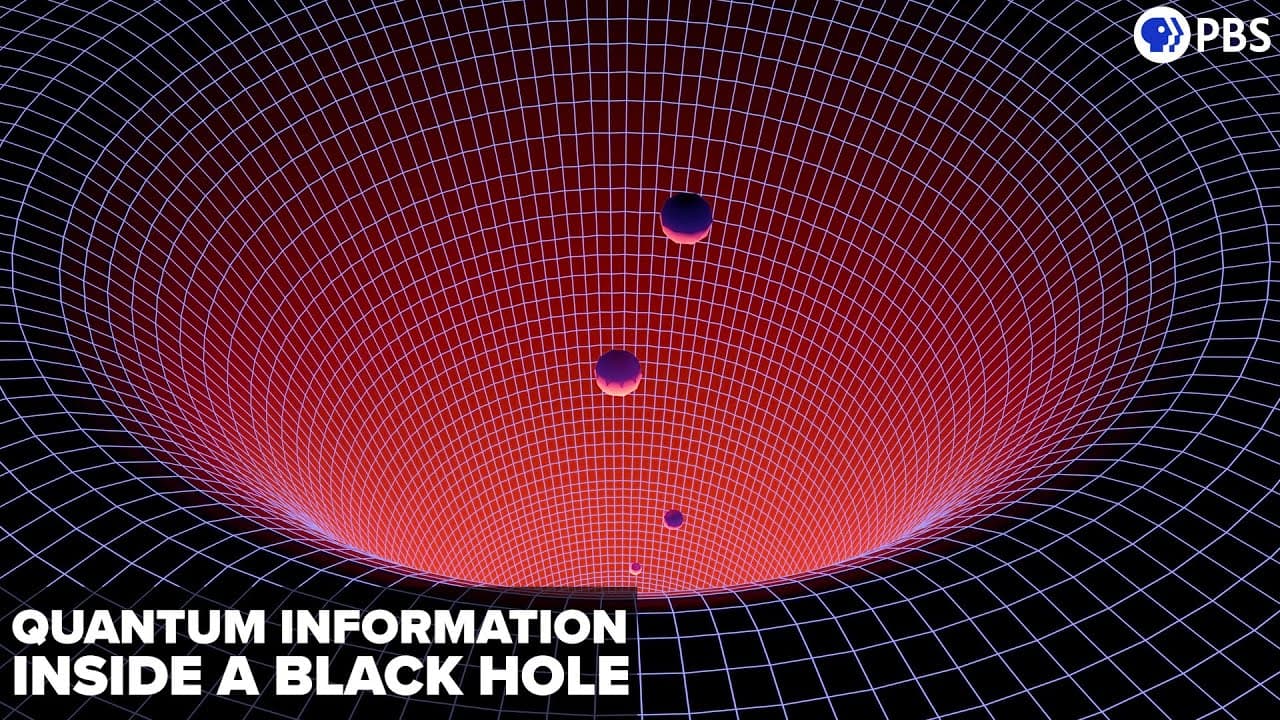
TL;DR
Explores the fate of quantum information in black holes.
Transcript
Before we get started, we wanted to let you know there’s some new limited edition Merch for sale at the Merch store. Meet Alice and Bob, famous explorers of the abstract landscape of theoretical physics. Heroes of the gerdankenexperiment—the thought experiment—whose life mission is to find contradictions in the deepest layers of our theories and s... Read More
Key Insights
- Alice and Bob, thought experiment heroes, explore black holes to understand spacetime and quantum entanglement.
- Quantum information may be preserved on the event horizon, challenging our understanding of physics.
- The holographic principle suggests space information is stored on its boundary, hinting at a holographic universe.
- Quantum entanglement might be the key to understanding the fabric of space, connecting particles through mutual information.
- The ER=EPR conjecture suggests a link between entanglement and wormholes, offering insights into spacetime structure.
- Alice's journey into a black hole demonstrates the effects of gravitational time dilation and the potential for information scrambling.
- Hawking radiation, a product of black holes, may hold clues to the preservation of quantum information.
- The paradox of information duplication or deletion challenges the principles of unitarity and the equivalence principle in physics.
Install to Summarize YouTube Videos and Get Transcripts
Explore YouTube Video Summarizer or Get YouTube Transcript Extractor
Questions & Answers
Q: What is the role of Alice and Bob in the experiment?
Alice and Bob are fictional characters used in thought experiments to explore complex topics in theoretical physics. In this video, they are used to investigate the preservation of quantum information in black holes. Alice takes the adventurous role of entering a black hole, while Bob observes from a safe distance, allowing the exploration of different perspectives on quantum information and spacetime.
Q: How does the holographic principle relate to black holes?
The holographic principle suggests that all the information contained within a volume of space can be represented on its boundary. In the context of black holes, this principle implies that the information about objects falling into a black hole may be stored on its event horizon. This idea challenges traditional notions of space and offers a potential explanation for how quantum information might be preserved, despite the seemingly destructive nature of black holes.
Q: What is the significance of the ER=EPR conjecture?
The ER=EPR conjecture posits a deep connection between quantum entanglement (EPR) and Einstein-Rosen bridges, or wormholes (ER). This suggests that entangled particles might be connected through spacetime tunnels, offering a new perspective on the nature of space and the potential for information transfer across vast distances. This conjecture has significant implications for our understanding of quantum mechanics and general relativity, potentially unifying these two fundamental theories.
Q: How does gravitational time dilation affect Alice's descent into the black hole?
As Alice approaches the event horizon of the black hole, gravitational time dilation causes time to appear to slow down from Bob's perspective. However, Alice experiences time normally due to the equivalence principle, which states that local physics in freefall is indistinguishable from that in the absence of gravity. This discrepancy highlights the complex nature of time near black holes and the challenges in reconciling different observational frames in general relativity.
Q: What happens to Alice's qubit as she enters the black hole?
Alice's qubit, representing a piece of quantum information, appears to fall into the black hole from her perspective, merging with the singularity. However, from Bob's perspective, the qubit seems to freeze at the event horizon, eventually becoming part of the Hawking radiation. This duality presents a paradox in quantum mechanics, challenging the principles of unitarity and the no-cloning theorem, as it suggests the qubit exists in two states simultaneously.
Q: Why is the preservation of quantum information important?
Quantum information preservation is crucial because it underpins the principles of quantum mechanics, such as unitarity, which ensures that probabilities remain consistent over time. The potential loss or duplication of information in black holes challenges these fundamental principles, leading to paradoxes that question our understanding of physics. Resolving these issues could provide insights into the nature of reality and the unification of quantum mechanics with general relativity.
Q: What is Hawking radiation, and why is it significant?
Hawking radiation is the theoretical emission of particles from black holes, resulting from quantum effects near the event horizon. It suggests that black holes are not entirely black but emit radiation, leading to their eventual evaporation. This radiation is significant because it may contain information about the matter that fell into the black hole, offering a potential solution to the information paradox and insights into the interplay between quantum mechanics and gravity.
Q: How does the video address the information paradox?
The video explores the information paradox by illustrating the conflicting perspectives of Alice and Bob regarding the fate of quantum information in black holes. It highlights the challenges of preserving unitarity and the equivalence principle, as well as the potential for information to be encoded in Hawking radiation. By examining these contradictions, the video sets the stage for future discussions on resolving the paradox and understanding the fundamental nature of spacetime.
Summary & Key Takeaways
-
Alice and Bob explore black holes to understand quantum information preservation, challenging conventional physics through thought experiments. The journey highlights gravitational time dilation and information scrambling at the event horizon, suggesting a holographic universe.
-
Quantum entanglement and the holographic principle may unlock the secrets of spacetime, with implications for wormholes and the ER=EPR conjecture. Alice's descent into a black hole illustrates the complexities of quantum information and its potential preservation in Hawking radiation.
-
The paradox of quantum information challenges the principles of unitarity and the equivalence principle, questioning the fate of information in black holes. The exploration suggests new avenues for understanding spacetime and the fundamental nature of reality.
Read in Other Languages (beta)
Share This Summary 📚
Summarize YouTube Videos and Get Video Transcripts with 1-Click
Try YouTube Summary with ChatGPT & Claude or YouTube Transcript Generator
Explore More Summaries from PBS Space Time 📚
Summarize YouTube Videos and Get Video Transcripts with 1-Click
Try YouTube Summary with ChatGPT & Claude or YouTube Transcript Generator