Trapezoidal Rule
TL;DR
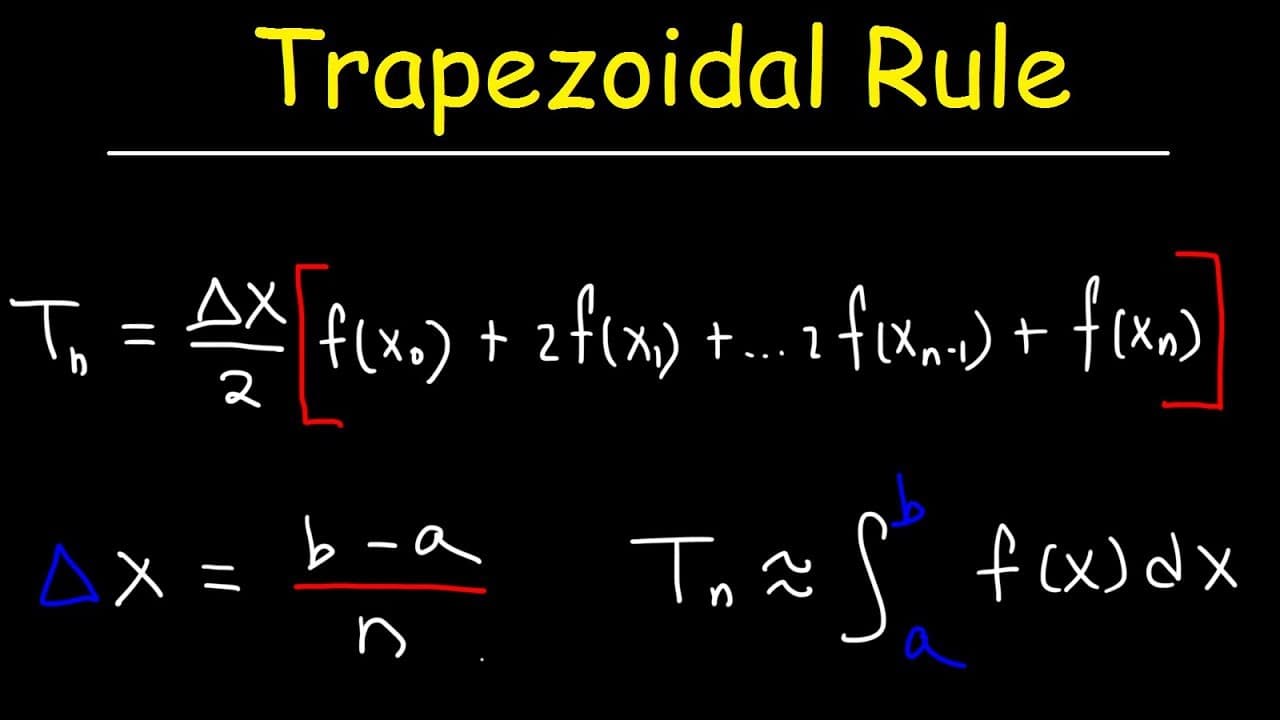
The trapezoidal rule is a method of estimating definite integrals to find the area under a curve.
Transcript
in this lesson we're gonna go over a specific numerical integration method known as the trapezoidal rule the trapezoidal rule allows you to estimate the value of a definite integral which represents the area under a curve so let's say if we have the curve y is equal to x squared and we wish to estimate the area under the curve from 0 to 10 use the ... Read More
Key Insights
- 🗂️ The trapezoidal rule estimates the area under a curve by dividing it into trapezoids.
- 😥 It differs from Riemann sums and the midpoint rule by using all the points for calculation.
- ✖️ The formula for the trapezoidal rule involves multiplying the y-values by corresponding coefficients.
- 😚 The trapezoidal rule provides a close approximation to the exact value of the area under the curve.
- ⌛ It can be used to solve accumulation problems by estimating the amount accumulated over time.
- 💦 The trapezoidal rule works well for a variety of functions but may perform better for smooth curves.
- 💳 The accuracy of the trapezoidal rule improves as the number of sub-intervals increases.
Install to Summarize YouTube Videos and Get Transcripts
Explore YouTube Video Summarizer or Get YouTube Transcript Extractor
Questions & Answers
Q: How does the trapezoidal rule differ from Riemann sums and the midpoint rule?
Unlike Riemann sums and the midpoint rule, the trapezoidal rule uses all the points, not just a subset of points, for calculating the area under the curve.
Q: What is the formula for the trapezoidal rule?
The formula is Delta X/2 * (f(X0) + 2f(X1) + 2f(X2) + ... + 2*f(Xn-1) + f(Xn)), where Delta X is the width of each sub-interval and f(X) represents the y-values of the curve.
Q: How does the trapezoidal rule estimate the area under a curve?
The trapezoidal rule approximates the area by dividing the curve into trapezoids and calculating the sum of their areas.
Q: How close is the trapezoidal rule approximation to the exact value?
In the example provided, the trapezoidal rule estimation of the area under the curve was 340, while the exact value was 333.3. Thus, the trapezoidal rule provides a reasonably accurate approximation.
Summary & Key Takeaways
-
The trapezoidal rule is used to estimate the area under a curve by dividing it into trapezoids.
-
The formula for the trapezoidal rule involves multiplying the sum of the y-values by the width of each sub-interval.
-
The trapezoidal rule provides a good approximation of the exact value of the definite integral.
Read in Other Languages (beta)
Share This Summary 📚
Summarize YouTube Videos and Get Video Transcripts with 1-Click
Try YouTube Summary with ChatGPT & Claude or YouTube Transcript Generator
Explore More Summaries from The Organic Chemistry Tutor 📚

Summarize YouTube Videos and Get Video Transcripts with 1-Click
Try YouTube Summary with ChatGPT & Claude or YouTube Transcript Generator