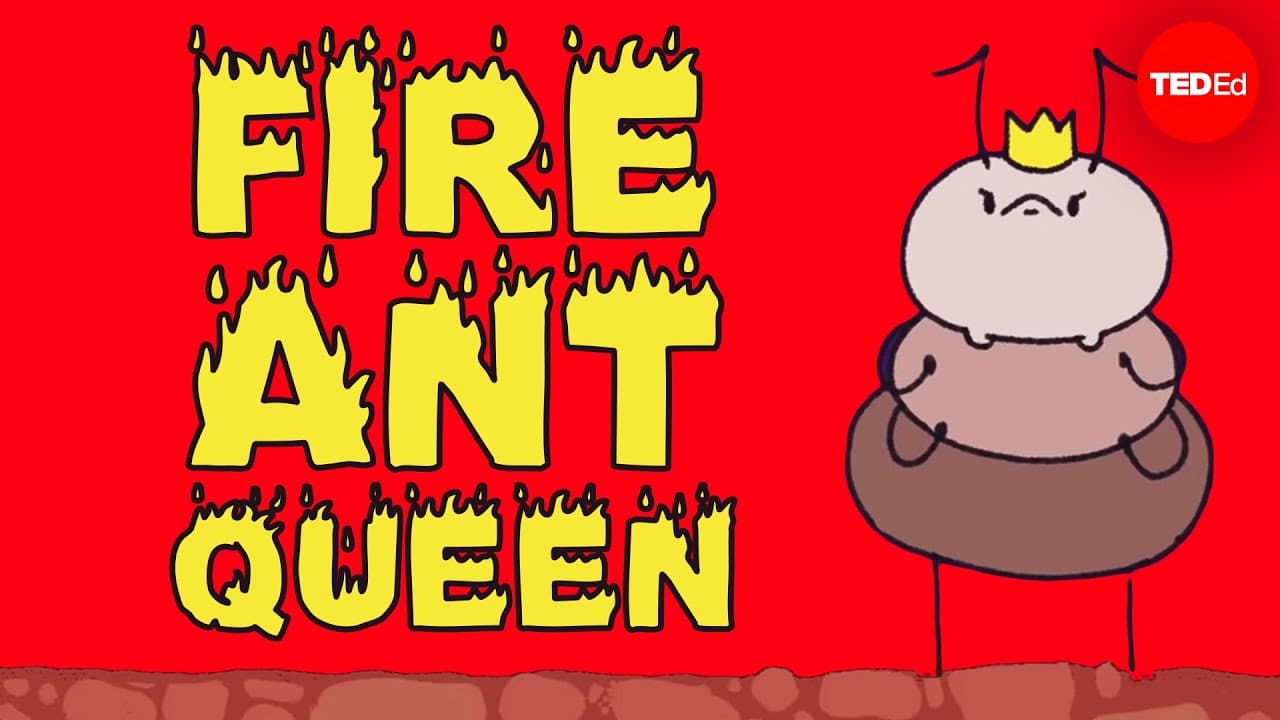
Mating frenzies, sperm hoards, and brood raids: The life of a fire ant queen - Walter R. Tschinkel
TL;DR
Fire ants undergo a complex life cycle involving nuptial flights, colony establishment, brood-raiding conflicts, and reproductive cycles to ensure survival and dominance.
Transcript
It’s June, just after a heavy rainfall, and the sky is filling with creatures we wouldn’t normally expect to find there. At first glance, this might be a disturbing sight. But for the lucky males and females of Solenopsis invicta, otherwise known as fire ants, it’s a day of romance. This is the nuptial flight, when thousands of reproduction-capa... Read More
Key Insights
- 🏍️ Fire ants undergo a complex life cycle involving mating, colony establishment, brood-raiding conflicts, reproductive cycles, and colony demise.
- 🥺 Fire ant queens play a crucial role in colony establishment, reproduction, and leading the colony to dominance.
- 🤰 Worker ants in fire ant colonies carry out various tasks essential for colony survival, including foraging, defending, and tending to the queen and brood.
- ❤️🔥 Brood-raiding conflicts between fire ant colonies involve workers stealing offspring to ensure their colony's growth and dominance.
- 😀 Fire ant colonies exhibit resilience in facing challenges like floods by forming living rafts to carry the queen to safety.
- 🥶 Colonies reach peak population, produce fertile alates for mating, and eventually dwindle as the queen's sperm runs out and old workers die off.
- ❤️🔥 The genetic legacy of fire ant queens lives on through the production of new colonies and the continued spread of genes through mating cycles.
Install to Summarize YouTube Videos and Get Transcripts
Explore YouTube Video Summarizer or Get YouTube Transcript Extractor
Questions & Answers
Q: How do fire ants establish a new colony after a nuptial flight?
After mating, a fire ant queen lands and establishes a new colony by digging a nest, laying eggs, and raising worker ants to support her.
Q: What role do workers play in a fire ant colony?
Workers forage for food, defend the nest, tend to the queen and brood, and engage in conflicts such as brood-raiding to ensure the colony's survival.
Q: How does the colony produce fertile alates for mating?
Once the colony reaches a population of about 23,000 workers, it shifts to producing fertile alate males and females who engage in annual mating flights to continue the genetic legacy.
Q: What happens to a fire ant colony when the queen's reign ends?
When the queen runs out of sperm and workers die off, the colony dwindles and eventually gets taken over by a neighboring colony, marking the end of the queen's reign but not her genetic legacy.
Summary & Key Takeaways
-
After a nuptial flight, a fire ant queen establishes a colony by laying eggs and raising workers within a complex hierarchy.
-
The colony engages in brood-raiding conflicts with neighboring ant colonies to ensure its survival and dominance.
-
The cycle repeats with the colony reaching peak population, producing fertile alates for mating, and eventually succumbing to age and neighboring colonies.
Read in Other Languages (beta)
Share This Summary 📚
Summarize YouTube Videos and Get Video Transcripts with 1-Click
Try YouTube Summary with ChatGPT & Claude or YouTube Transcript Generator
Explore More Summaries from TED-Ed 📚





Summarize YouTube Videos and Get Video Transcripts with 1-Click
Try YouTube Summary with ChatGPT & Claude or YouTube Transcript Generator