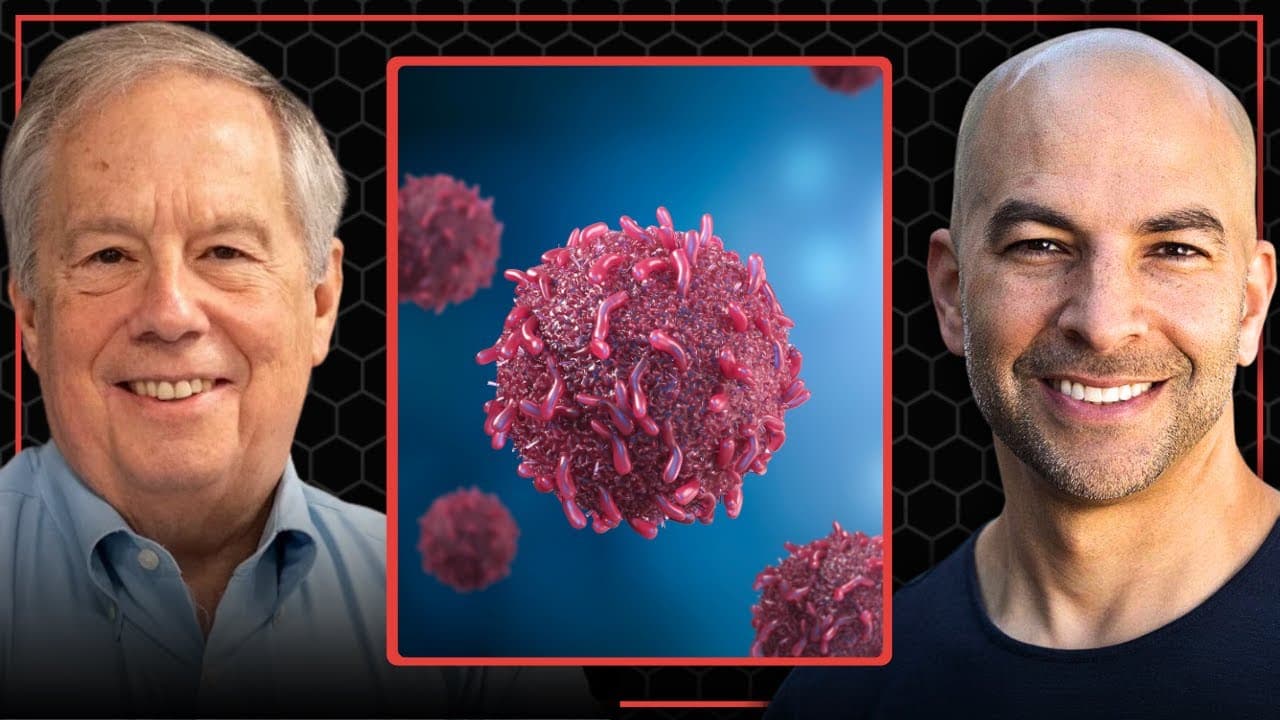
What causes cancer to spread and metastasize? | Peter Attia and Robert Gatenby
TL;DR
Explores why certain cancers metastasize to specific organs.
Transcript
I want to talk about another uh feature of of cancer which is um what I call The Source sync uh trade-off right so I'm sure you've thought a lot about this uh I I endlessly thought about this and and really never came up with a great Insight um there are some cancers so so let's start from first principles there aren'... Read More
Key Insights
- Certain cancers, like brain and primary hepatic cancer, can be fatal without spreading, while others need to metastasize to be deadly.
- Breast, prostate, pancreatic, and colon cancers often metastasize to specific organs like bones, liver, and lungs.
- Cancer cells do not plan metastasis; their spread is more opportunistic, depending on local environmental conditions.
- The success of metastasis depends on the cancer cells' ability to adapt to new environments, similar to species adapting to new habitats.
- The 'source-sink' trade-off in cancer highlights how some organs are more conducive to metastasis due to their blood supply and cell dynamics.
- Most cancer cells die when they reach a new site, with only a small percentage forming new tumors.
- Adjuvant therapy reduces the probability of metastasis but does not eliminate it, indicating a need for more strategic treatment approaches.
- Cancer treatment strategies could benefit from considering eco-evolutionary dynamics, potentially using sequential therapies to target diverse tumor populations.
Install to Summarize YouTube Videos and Get Transcripts
Explore YouTube Video Summarizer or Get YouTube Transcript Extractor
Questions & Answers
Q: What is the 'source-sink' trade-off in cancer?
The 'source-sink' trade-off in cancer refers to the dynamic where certain organs act as 'sources,' producing a large number of cancer cells due to their blood supply, while other organs act as 'sinks,' where these cells migrate and potentially form metastases. This dynamic helps explain why some cancers metastasize to specific organs.
Q: Why do some cancers metastasize to specific organs?
Certain cancers metastasize to specific organs based on the environmental conditions of those organs. Factors such as blood supply, cellular dynamics, and the ability of cancer cells to adapt to new environments play a role. For example, pancreatic cancer often spreads to the liver due to the direct blood flow connection, while breast cancer frequently metastasizes to bones.
Q: How do cancer cells spread to new sites?
Cancer cells spread to new sites through the bloodstream or lymphatic system. However, most cells die upon reaching a new site. Only a small percentage adapt and survive, forming new tumors. This process is opportunistic, relying on the cells' ability to interact with and adapt to the local environment.
Q: What role does adjuvant therapy play in cancer treatment?
Adjuvant therapy aims to reduce the probability of metastasis after primary treatment, such as surgery. However, it does not eliminate the risk entirely. The effectiveness of adjuvant therapy varies, and there is a need for more strategic approaches, like sequential therapies, to improve outcomes by targeting diverse tumor populations.
Q: Why is metastasis considered rare despite frequent dissemination?
Metastasis is considered rare because, although cancer cells frequently enter the bloodstream, most die upon reaching a new site. The success of metastasis depends on the cells' ability to adapt to the new environment, which is often challenging due to factors like stochastic effects, small population dynamics, and environmental conditions.
Q: How can cancer treatment strategies be improved?
Cancer treatment strategies can be improved by considering eco-evolutionary dynamics and employing sequential therapies. This approach focuses on targeting diverse tumor populations by understanding their interactions with the environment and using a strategic sequence of drugs to increase the likelihood of eradicating cancer cells.
Q: What challenges do cancer cells face at new sites?
Cancer cells face several challenges at new sites, including adapting to the local environment, surviving immune responses, and competing for resources. Most cells die due to these challenges, and only a small percentage manage to establish new tumors. The success of metastasis depends on overcoming these obstacles.
Q: What is the significance of eco-evolutionary dynamics in cancer treatment?
Eco-evolutionary dynamics in cancer treatment emphasize understanding the interactions between cancer cells and their environment. By considering these dynamics, treatment strategies can be designed to exploit vulnerabilities in cancer populations, such as using sequential therapies to target small, diverse tumor populations, potentially improving treatment outcomes.
Summary & Key Takeaways
-
The discussion focuses on why certain cancers metastasize to specific organs, exploring the 'source-sink' dynamic and the environmental conditions that facilitate metastasis.
-
The speakers emphasize that metastasis is not a planned event by cancer cells but rather a result of their interactions with new environments, akin to species adapting to new habitats.
-
The conversation highlights the need for more strategic cancer treatment approaches, considering eco-evolutionary dynamics and using sequential therapies to target diverse tumor populations.
Read in Other Languages (beta)
Share This Summary 📚
Summarize YouTube Videos and Get Video Transcripts with 1-Click
Try YouTube Summary with ChatGPT & Claude or YouTube Transcript Generator
Explore More Summaries from Peter Attia MD 📚






Summarize YouTube Videos and Get Video Transcripts with 1-Click
Try YouTube Summary with ChatGPT & Claude or YouTube Transcript Generator