Radioactivity (1 of 16) An Explanation
TL;DR
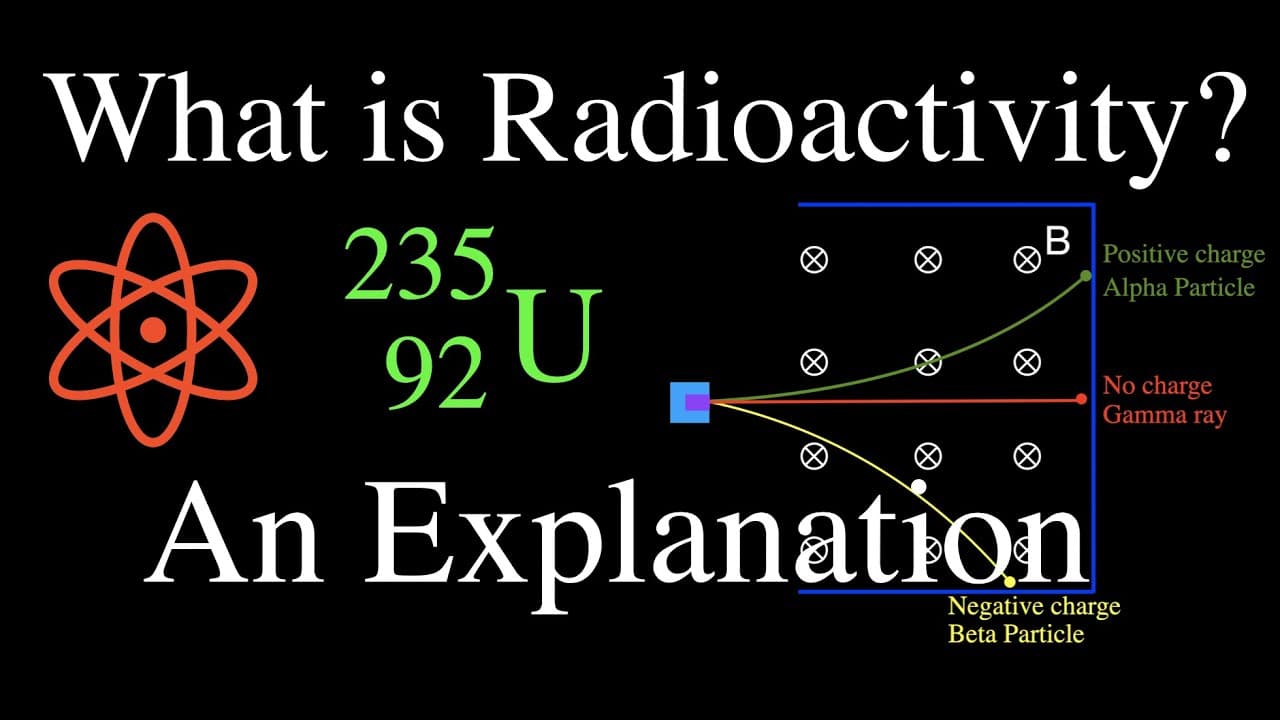
Radioactivity is the spontaneous emission of energy from unstable atomic nuclei through the emission of alpha, beta, and gamma particles, discovered in 1896 by Omri Becker.
Transcript
okay in today's video I am going to go over a brief explanation of rave activity also known as nuclear decay nuclear radiation radioactive decay radioactivity all those terms are kind of used interchangeably okay before we get started please don't forget I preached it very much bottom right hand corner there is that little red button there click su... Read More
Key Insights
- 🫀 Radioactivity involves the spontaneous emission of energy from unstable atomic nuclei.
- ☢️ Different types of particles, such as alpha, beta, and gamma, are emitted during radioactive decay.
- 👶 Marie and Pierre Curie made significant contributions to the study of radioactivity, discovering new radioactive elements.
- 😘 Alpha particles have the lowest penetrating power, while gamma rays have the highest.
- ⛓️ The decay chain for thorium demonstrates the process of radioactive decay through alpha and beta decay.
- ❓ Radioactivity was first discovered in 1896 by Omri Becker through experiments with phosphorescent materials.
- 🏑 Radioactive decay is an essential concept in physics and chemistry, influencing various fields of study.
Install to Summarize YouTube Videos and Get Transcripts
Explore YouTube Video Summarizer or Get YouTube Transcript Extractor
Questions & Answers
Q: Who discovered radioactivity, and when?
Radioactivity was discovered in 1896 by Omri Becker, a French scientist.
Q: What are the different types of particles emitted in radioactive decay?
The types of particles emitted in radioactive decay include alpha particles, beta particles, gamma rays, neutrinos, and energy positrons.
Q: How did Omri Becker discover radioactivity?
Omri Becker discovered radioactivity by studying phosphorescent materials, like uranium, which emitted energy without external excitation.
Q: What contributions did Marie and Pierre Curie make to the study of radioactivity?
Marie and Pierre Curie discovered polonium and radium, two additional radioactive elements, and won the Nobel Prize in Physics in 1903 for their work.
Summary & Key Takeaways
-
Radioactivity is the spontaneous emission of energy from unstable nuclei through the emission of radiation.
-
Discovered in 1896 by Omri Becker, radioactivity involves the emission of alpha particles, beta particles, gamma rays, neutrinos, and positrons.
-
Marie and Pierre Curie also made significant contributions to the study of radioactivity, discovering polonium and radium.
Read in Other Languages (beta)
Share This Summary 📚
Summarize YouTube Videos and Get Video Transcripts with 1-Click
Try YouTube Summary with ChatGPT & Claude or YouTube Transcript Generator
Explore More Summaries from Step by Step Science 📚

Summarize YouTube Videos and Get Video Transcripts with 1-Click
Try YouTube Summary with ChatGPT & Claude or YouTube Transcript Generator