What Are Electrons and Ions in Atoms?
TL;DR
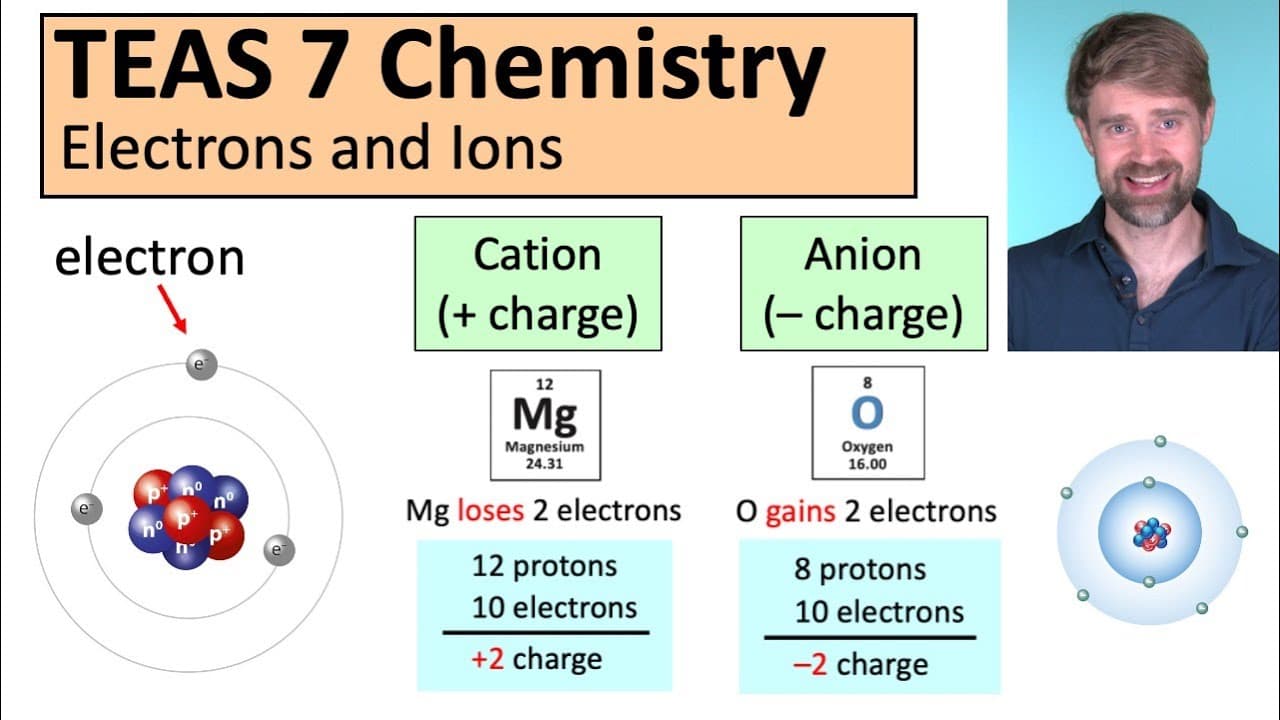
Electrons are negatively charged particles, while protons are positively charged, and they balance each other in neutral atoms, resulting in a net charge of zero. Atoms gain or lose electrons to form ions when there's an imbalance; losing electrons creates positive ions (cations) and gaining them creates negative ions (anions). Understanding this charge balance is essential for chemistry, especially in exams like the TEAS.
Transcript
in this video we're going to talk about electrons ions and how atoms get charges like plus two or minus two this video is especially for people who are preparing to take the teas exam and it's part of my short course on the chemistry section of the te's you can find a link to the full course in the description below the video so let's get started b... Read More
Key Insights
- 🫀 Electrons and protons in an atom carry opposite charges that cancel each other out, resulting in an electrically neutral atom.
- #️⃣ The atomic number of an element determines the number of protons in its nucleus.
- 💁 Ions are formed when atoms gain or lose electrons, leading to an imbalance in the charges of protons and electrons.
- 💁 A positive ion, or cat ion, is formed when an atom loses electrons, while a negative ion, or anion, is formed when an atom gains electrons.
- ➗ The charge of an ion is represented by a superscript in its symbol, with a plus sign for positive ions and a minus sign for negative ions.
- 🈂️ It is crucial to carefully count protons and electrons while accounting for charges when determining the net charge and charge state of an atom or ion.
- 😂 The TEAS exam may test knowledge on the charges of protons and electrons and their balancing in neutral atoms and ions.
Install to Summarize YouTube Videos and Get Transcripts
Explore YouTube Video Summarizer or Get YouTube Transcript Extractor
Questions & Answers
Q: How do protons and electrons balance each other out in an atom?
Protons, which carry a positive charge, and electrons, which carry a negative charge, cancel each other out due to their opposite charges. This balancing of charges results in a net charge of zero for an electrically neutral atom.
Q: What is the significance of the atomic number in determining the number of protons in an atom?
The atomic number of an element indicates the number of protons in the nucleus of its atoms. The number of protons remains constant for an element, regardless of its charge state.
Q: What happens when an atom gains or loses electrons?
When an atom gains electrons, the balance between protons and electrons is disrupted, leading to a net negative charge. Conversely, when an atom loses electrons, the net charge becomes positive. These charged atoms are called ions.
Q: How is the charge of an ion represented in its symbol?
The charge of an ion can be represented by a superscript either with a plus sign (+) for a positive ion (cat ion) or a minus sign (-) for a negative ion (anion). The magnitude of the charge is indicated by the number.
Summary & Key Takeaways
-
Electrons and protons are part of the basic atomic structure, with protons carrying a positive charge and electrons carrying a negative charge.
-
The charges of protons and electrons balance each other out, resulting in a net charge of zero and an electrically neutral atom.
-
Atoms can gain or lose electrons, which leads to an imbalance between the charges of protons and electrons, resulting in a net charge and the formation of ions.
Read in Other Languages (beta)
Share This Summary 📚
Summarize YouTube Videos and Get Video Transcripts with 1-Click
Try YouTube Summary with ChatGPT & Claude or YouTube Transcript Generator
Explore More Summaries from Tyler DeWitt 📚
Summarize YouTube Videos and Get Video Transcripts with 1-Click
Try YouTube Summary with ChatGPT & Claude or YouTube Transcript Generator