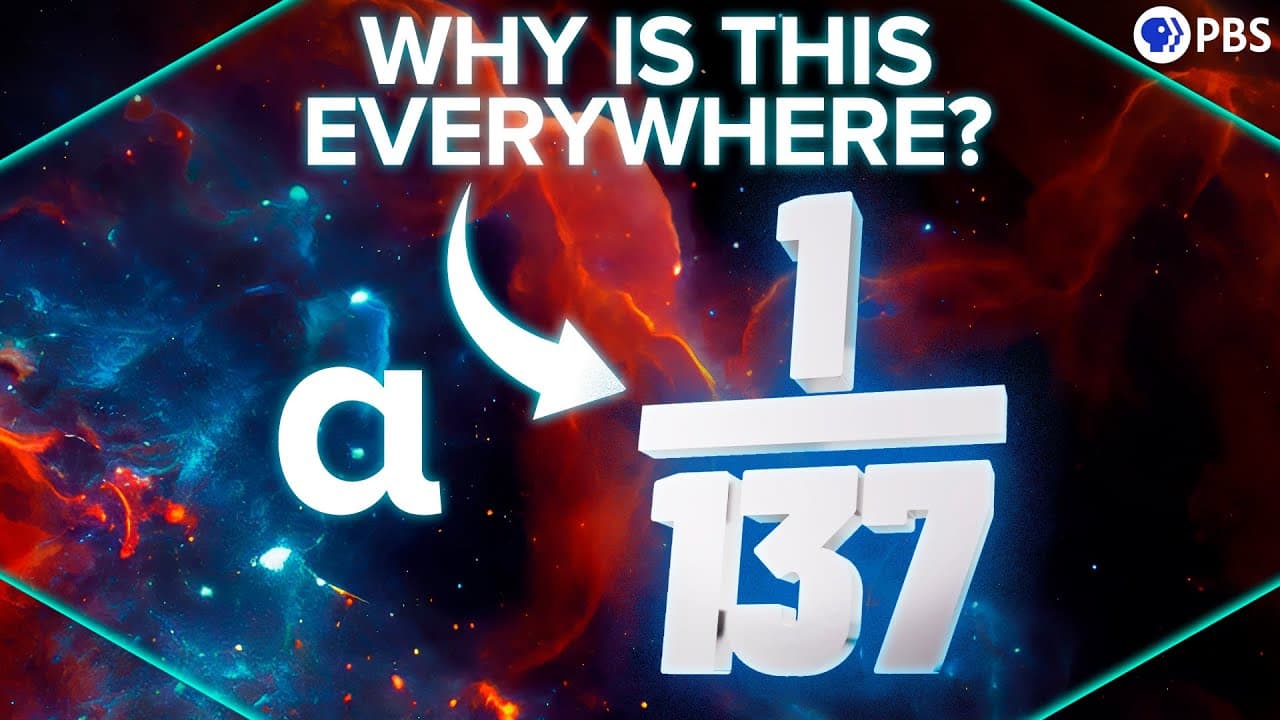
Why Is 1/137 One of the Greatest Unsolved Problems In Physics?
TL;DR
The fine structure constant, 1/137, baffles physicists due to its ubiquitous nature.
Transcript
Thank you to Squarespace for Supporting PBS. It’s the job of physicists to worry about numbers, but there’s one number that physicists have stressed about more than any other. That number is 0.00729735256 - approximately 1/137. This is the fine structure constant, and it appears everywhere in our equations of quantum physics, and we’re still trying... Read More
Key Insights
- The fine structure constant, approximately 1/137, is a dimensionless number that appears in various equations of quantum physics, yet its significance remains a mystery.
- Physicists like Paul Dirac, Wolfgang Pauli, and Richard Feynman have pondered the fine structure constant's meaning, highlighting its fundamental importance in physics.
- The constant emerged from observations of spectral lines in quantum mechanics, where it explained discrepancies in energy levels when considering relativity and electron spin.
- The fine structure constant is unitless, making it unique among constants and suggesting its potential universality across the cosmos.
- In quantum mechanics, the constant is the coupling strength of the electromagnetic force, influencing how particles like electrons interact with photons.
- The constant's value affects atomic structures and chemical bonds, suggesting that even slight variations could prevent the formation of life-sustaining elements like carbon.
- Some theories propose the constant might result from random values set at the universe's inception, or it could indicate a deeper relationship between fundamental constants.
- The fine structure constant’s specialness may hint at underlying universal principles or a mathematical constant yet to be fully understood.
Install to Summarize YouTube Videos and Get Transcripts
Explore YouTube Video Summarizer or Get YouTube Transcript Extractor
Questions & Answers
Q: Why is the fine structure constant significant in physics?
The fine structure constant is significant because it appears ubiquitously in quantum physics equations and influences electromagnetic interactions. Its dimensionless nature means it is a pure number, suggesting a universal property. This constant affects atomic structures and chemical bonds, indicating its role in the fundamental workings of the universe, yet its precise significance remains unknown.
Q: How was the fine structure constant discovered?
The fine structure constant was discovered during the study of spectral lines emitted by electrons transitioning between energy levels in atoms. Physicists observed discrepancies in the energy levels predicted by early quantum models, which were later explained by considering relativity and electron spin. The constant emerged as a key factor in these calculations, revealing its importance in quantum mechanics.
Q: What role does the fine structure constant play in atomic structures?
The fine structure constant influences atomic structures by determining the strength of the electromagnetic force, which affects how electrons orbit nuclei. Its value impacts the size of atoms and the stability of chemical bonds. If the constant were different, electrons might be too tightly or loosely bound, preventing the formation of stable atoms and molecules necessary for life.
Q: Why is the fine structure constant considered dimensionless?
The fine structure constant is considered dimensionless because it is a pure number without any associated units, resulting from the cancellation of units in its defining equation. This characteristic makes it unique among physical constants, as it does not depend on any specific system of measurement, suggesting a universal property that holds true across the cosmos.
Q: How does the fine structure constant relate to electromagnetic interactions?
The fine structure constant represents the coupling strength of the electromagnetic force, determining the likelihood of interactions between charged particles, like electrons, and photons. It serves as a base probability in calculations involving electromagnetic interactions, influencing how particles emit or absorb photons and interact with each other, as visualized in Feynman diagrams.
Q: What are some theories about the origin of the fine structure constant?
Some theories propose that the fine structure constant's value was set randomly at the universe's inception, possibly as part of a multiverse where different constants exist. Others suggest it reflects a deeper relationship between fundamental constants or elementary particle properties. Alternatively, it might be a mathematical constant akin to pi, yet to be fully understood.
Q: What implications does the fine structure constant have for life in the universe?
The fine structure constant's value has significant implications for life, as it influences atomic size and chemical bond stability. If the constant were slightly different, essential elements like carbon might not form, preventing the development of life-sustaining molecules. Its precise value suggests a delicate balance in the universe's physical laws, crucial for life's existence.
Q: Why do some physicists consider the fine structure constant a mystery?
Physicists consider the fine structure constant a mystery due to its unexplained ubiquity and profound influence in quantum physics. Despite its critical role in electromagnetic interactions, the reason for its specific value and its dimensionless nature remain elusive. This mystery suggests it might hold key insights into the universe's fundamental principles or relationships between constants.
Summary & Key Takeaways
-
The fine structure constant, approximately 1/137, is a dimensionless number that appears universally in quantum physics equations, yet its significance remains one of the greatest unsolved problems in physics.
-
Physicists have long been fascinated by the fine structure constant due to its unexpected appearances in various physical phenomena and its role as the coupling strength of the electromagnetic force.
-
The constant's unique, unitless nature and its potential impact on atomic and chemical structures suggest it may hold vital clues to understanding universal principles or relationships between fundamental constants.
Read in Other Languages (beta)
Share This Summary 📚
Summarize YouTube Videos and Get Video Transcripts with 1-Click
Try YouTube Summary with ChatGPT & Claude or YouTube Transcript Generator
Explore More Summaries from PBS Space Time 📚




Summarize YouTube Videos and Get Video Transcripts with 1-Click
Try YouTube Summary with ChatGPT & Claude or YouTube Transcript Generator