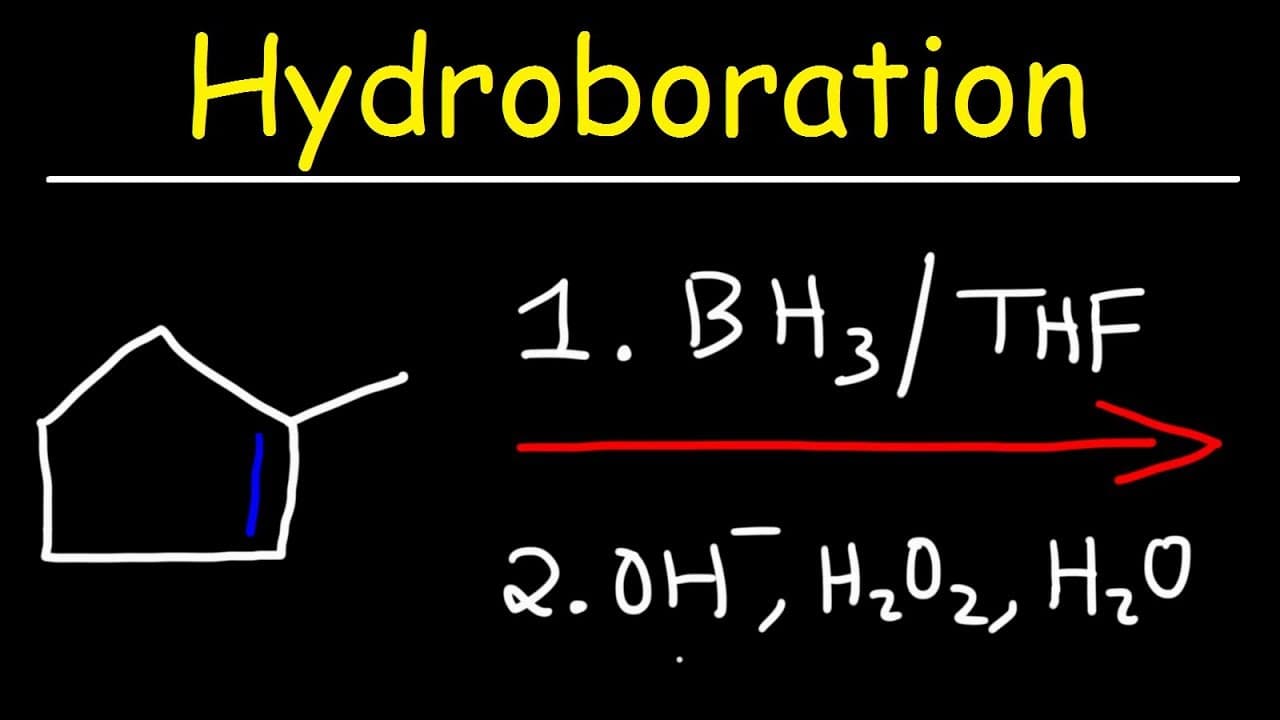
Hydroboration - Oxidation Reaction Mechanism
TL;DR
The hydroboration oxidation reaction involves the addition of an OH group to the less substituted carbon atom of an alkene, resulting in the formation of an alcohol.
Transcript
in this lesson we're going to go over the hydroboration oxidation reaction so let's start with one butane what is the major product of this reaction and the first step we're going to have bh3 with thf bh3 is boring thf is tetrahydrofuran and tetrahydrofuran looks like this that's thf in step two we're going to have hydroxide hydrogen peroxide and w... Read More
Key Insights
- 🇦🇬 The hydroboration oxidation reaction proceeds with anti-Markovnikov regiochemistry.
- 🫀 The OH group is added to the less substituted carbon atom of the alkene.
- 👊 The reaction mechanism involves a concerted process of alkene attack on boron, followed by hydride and hydroxide ion attacks.
- ❓ The reaction does not involve rearrangements or carbocation intermediates.
- 💁 Hydroboration oxidation is a reversible reaction, and the final product can be formed through the reverse reaction as well.
- 😑 Hydroxide and peroxide ions play crucial roles in the second step of the reaction.
- 😒 The use of deuterated boron reagents can lead to the formation of deuterium-labeled products.
Install to Summarize YouTube Videos and Get Transcripts
Explore YouTube Video Summarizer or Get YouTube Transcript Extractor
Questions & Answers
Q: What is the major product of the hydroboration oxidation reaction?
The major product is one butanol, where the OH group is added to the less substituted carbon atom of the alkene through anti-Markovnikov regiochemistry.
Q: Does the hydroboration oxidation reaction involve any rearrangements?
No, this reaction does not proceed with any rearrangements. There are no carbocations formed during the reaction that could lead to rearrangements.
Q: How does the mechanism of the hydroboration oxidation reaction compare to the reaction of an alkene with HBr?
The hydroboration oxidation reaction and the reaction of an alkene with HBr have similarities in terms of the attack of a nucleophilic double bond on an electrophilic center (boron for hydroboration oxidation and hydrogen for HBr). However, the regiochemistry and products formed are different.
Q: What are the key steps in the hydroboration oxidation reaction mechanism?
The key steps in the mechanism include the attack of the alkene on a boron atom, followed by the attack of a hydride ion on a carbon atom. This process repeats until the boron atom is no longer able to add to an alkene. In the second step, hydroxide and peroxide ions react with the boron species, leading to the formation of the final product, one butanol.
Summary & Key Takeaways
-
The major product of the hydroboration oxidation reaction is one butanol, where the OH group is added to the less substituted carbon atom of the double bond.
-
The reaction follows anti-Markovnikov regiochemistry, meaning the OH group goes to the primary carbon of the alkene.
-
The reaction proceeds through a concerted mechanism involving the attack of the double bond on a boron atom and subsequent attacks by hydride and hydroxide ions.
Read in Other Languages (beta)
Share This Summary 📚
Summarize YouTube Videos and Get Video Transcripts with 1-Click
Try YouTube Summary with ChatGPT & Claude or YouTube Transcript Generator
Explore More Summaries from The Organic Chemistry Tutor 📚



Summarize YouTube Videos and Get Video Transcripts with 1-Click
Try YouTube Summary with ChatGPT & Claude or YouTube Transcript Generator