Lecture 11.1 - Machine Learning on Sequences
TL;DR
Explores sequence learning challenges and introduces Markov processes.
Transcript
graph neural networks extract information from data encoded on graphs they are able to exploit underlying regularities in the data structure to create architectures that are stable scalable and invariant to permutations several applications speech recognition and epidemic modeling being two examples exhibit a time dependency in addition to the spat... Read More
Key Insights
- Graph neural networks can effectively extract information from data structured as graphs, which are scalable and invariant to permutations, useful in applications like speech recognition and epidemic modeling.
- Time dependency and variable data sequence lengths necessitate specialized architectures for processing sequential data, highlighting the complexity in predicting sequence outcomes.
- Predicting a moving particle's trajectory involves understanding its past movements, not just its current position, to determine potential entry into a forbidden area.
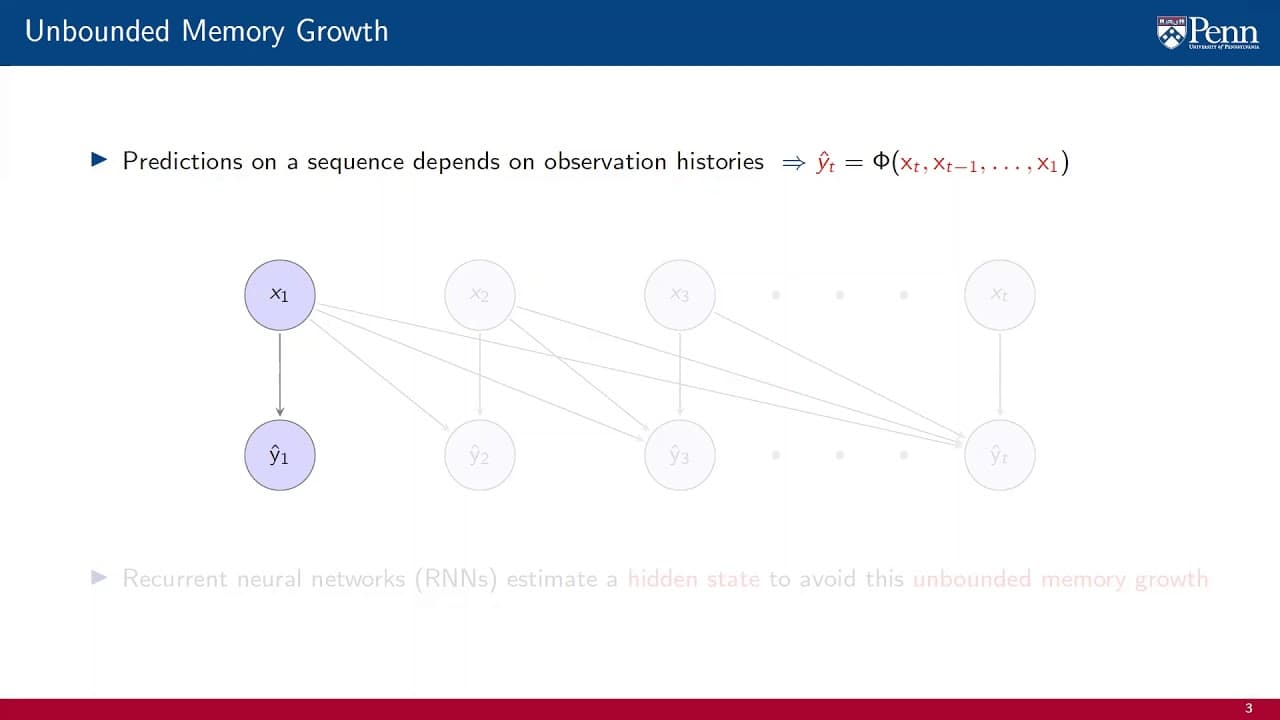
- Memory growth challenges arise in sequence predictions as the number of observations increases, leading to exponential growth in learning task complexity.
- Recurrent neural networks (RNNs) address unbounded memory growth by estimating hidden states, facilitating efficient sequence prediction without retaining entire history.
- Markov processes offer a simplified learning framework by assuming future states depend only on the current state, making past data irrelevant for prediction.
- In non-Markovian processes, the history of the sequence is crucial for accurate predictions, necessitating architectures like RNNs that consider past information.
- Understanding memory and stochastic processes is key to developing architectures that handle time-dependent sequence predictions effectively.
Install to Summarize YouTube Videos and Get Transcripts
Explore YouTube Video Summarizer or Get YouTube Transcript Extractor
Questions & Answers
Q: What are graph neural networks used for?
Graph neural networks are used to extract information from data encoded in graph structures. They are particularly effective in applications such as speech recognition and epidemic modeling, where they exploit the regularities in data structure to create stable, scalable architectures that are invariant to permutations.
Q: Why is time dependency important in sequence learning?
Time dependency is crucial in sequence learning because the evolution of a process often relies on its past values. This dependency means that predictions cannot be made based solely on current observations; instead, the entire history of the sequence must be considered, complicating the learning process.
Q: What challenge does memory growth pose in sequence predictions?
Memory growth poses a significant challenge in sequence predictions because as the number of observations increases, the complexity of the learning task grows exponentially. This unbounded growth in memory requirements makes it difficult to efficiently predict sequence outcomes without specialized architectures like recurrent neural networks.
Q: How do recurrent neural networks address memory growth issues?
Recurrent neural networks (RNNs) address memory growth issues by estimating hidden states, allowing them to make predictions based on relevant historical data without storing the entire sequence history. This approach helps manage the exponential growth in complexity and memory requirements associated with sequence predictions.
Q: What is a Markov process in the context of sequence learning?
In sequence learning, a Markov process is a stochastic process where the future state depends only on the current state, making past data irrelevant for predictions. This memoryless property simplifies learning by reducing it to a sequence of independent learning tasks, focusing only on current observations.
Q: Why is the Markov property significant in learning sequences?
The Markov property is significant in learning sequences because it simplifies the learning process. By assuming that future states depend only on the current state, it eliminates the need to consider past data, reducing the complexity of learning tasks and making predictions more manageable.
Q: What happens when a process is not Markovian?
When a process is not Markovian, the history of the sequence becomes crucial for making accurate predictions. In such cases, architectures like recurrent neural networks are needed to account for past information, as predictions cannot rely solely on the current state, unlike in Markov processes.
Q: How do stochastic processes relate to sequence learning?
Stochastic processes are fundamental to sequence learning as they model the probabilistic nature of sequence evolution over time. Understanding these processes, particularly memoryless ones like Markov processes, helps in designing architectures that efficiently handle time-dependent data by focusing on current states while managing historical information.
Summary & Key Takeaways
-
This lecture discusses challenges in learning sequences, focusing on the need for specialized architectures to handle time-dependent data without excessive memory growth. It introduces graph neural networks, RNNs, and Markov processes as potential solutions.
-
The complexity of predicting sequence outcomes grows exponentially with data observations, necessitating efficient architectures like RNNs to manage memory and learning tasks. Markov processes simplify prediction by focusing only on current states.
-
Non-Markovian processes require consideration of past data for accurate predictions, unlike Markov processes where past information is irrelevant. The lecture sets the stage for introducing RNNs as a solution for handling sequence prediction challenges.
Read in Other Languages (beta)
Share This Summary 📚
Summarize YouTube Videos and Get Video Transcripts with 1-Click
Try YouTube Summary with ChatGPT & Claude or YouTube Transcript Generator
Explore More Summaries from Alelab Alelab 📚
Summarize YouTube Videos and Get Video Transcripts with 1-Click
Try YouTube Summary with ChatGPT & Claude or YouTube Transcript Generator