What Is the Rabot Method for Sequence Transformation?
TL;DR
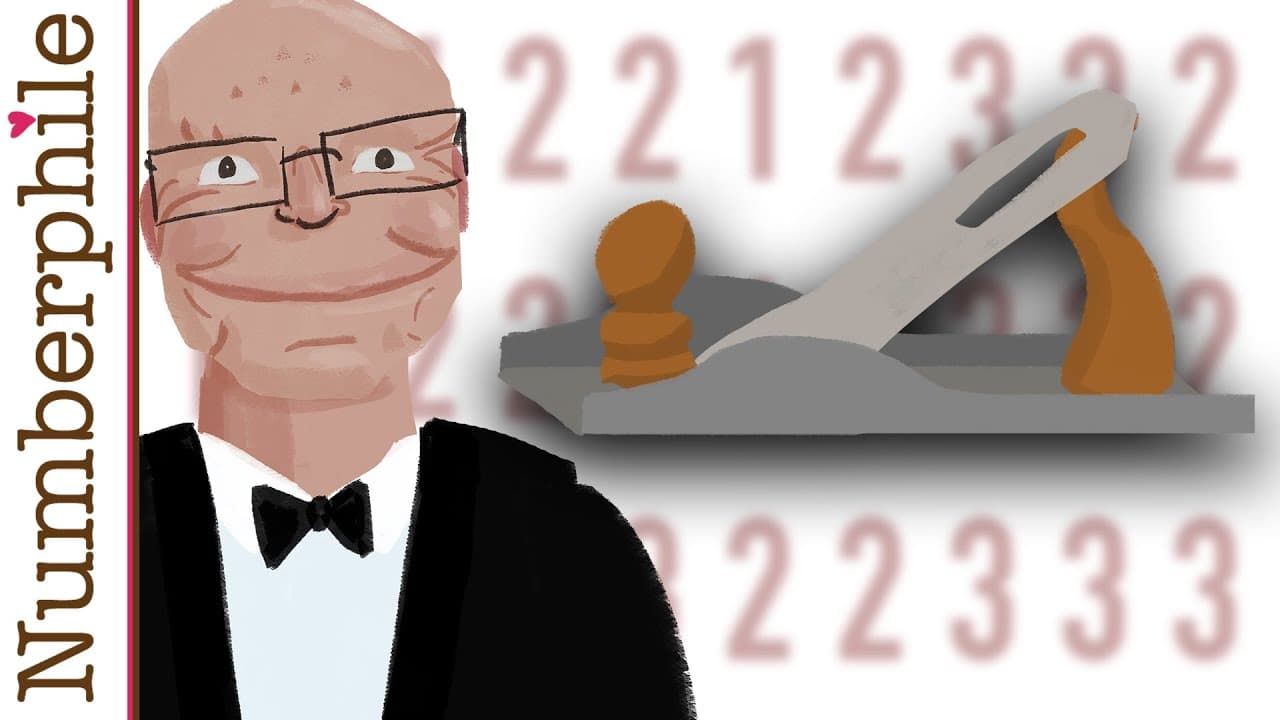
The Rabot method transforms sequences by shortening the runs of identical elements, effectively 'planing' them down. This method can be applied to unique sequences such as Golomb's sequence, which self-generates its run lengths, revealing interesting patterns. The average value after applying the Rabot transformation to k-bit binary numbers follows a specific formula, illustrating deeper mathematical relationships.
Transcript
So I want to tell you about a letter I got a little while ago that I only just got around to reading. Actually it was in 2003 that it arrived but I only just found it on the floor; my study is very messy. So the author is a contributor to the OEIS, a former contributor, I have- think I have to say, called Claude Lenormand. He suggested two transfor... Read More
Key Insights
- 🏃 The Rabot method shortens runs in sequences, altering their structure.
- 🤳 Golomb's sequence self-generates its run lengths, reflecting a unique pattern.
- #️⃣ Applying the Rabot method to binary numbers reveals distinct transformation patterns.
- ❓ The average value after Rabot transformation follows a specific mathematical formula.
- #️⃣ Sequence transformations offer interesting insights into number patterns and mathematical relationships.
- 😫 The Mandelbrot set provides a complex framework for exploring mathematical concepts.
- 🙈 Mathematical sequences can exhibit self-generating properties, as seen in Golomb's sequence.
Install to Summarize YouTube Videos and Get Transcripts
Explore YouTube Video Summarizer or Get YouTube Transcript Extractor
Questions & Answers
Q: What is the Rabot method for sequence transformation?
The Rabot method, introduced by Claude Lenormand, involves shortening runs in a sequence, creating a new transformed sequence with altered run lengths.
Q: How does Golomb's non-decreasing sequence work?
Golomb's sequence generates a non-decreasing sequence based on run lengths, where each term represents the length of the consecutive identical terms.
Q: How is the Rabot method applied to binary numbers?
When applying the Rabot method to binary numbers, runs of length 1 are removed, resulting in a new sequence with truncated runs and transformed values.
Q: What is the average value after applying the Rabot method to a binary number?
The average value after Rabot transformation of a k-bit binary number is approximately three halves to the power k minus 1 minus a half.
Summary & Key Takeaways
-
Claude Lenormand proposed the Rabot method for transforming sequences by shortening runs.
-
Sol Golomb's non-decreasing sequence self-generates its own run lengths.
-
Applying the Rabot method to sequences and binary numbers reveals interesting patterns and sequences.
Read in Other Languages (beta)
Share This Summary 📚
Summarize YouTube Videos and Get Video Transcripts with 1-Click
Try YouTube Summary with ChatGPT & Claude or YouTube Transcript Generator
Explore More Summaries from Numberphile 📚


Summarize YouTube Videos and Get Video Transcripts with 1-Click
Try YouTube Summary with ChatGPT & Claude or YouTube Transcript Generator