Monitor Using Semaphore
TL;DR
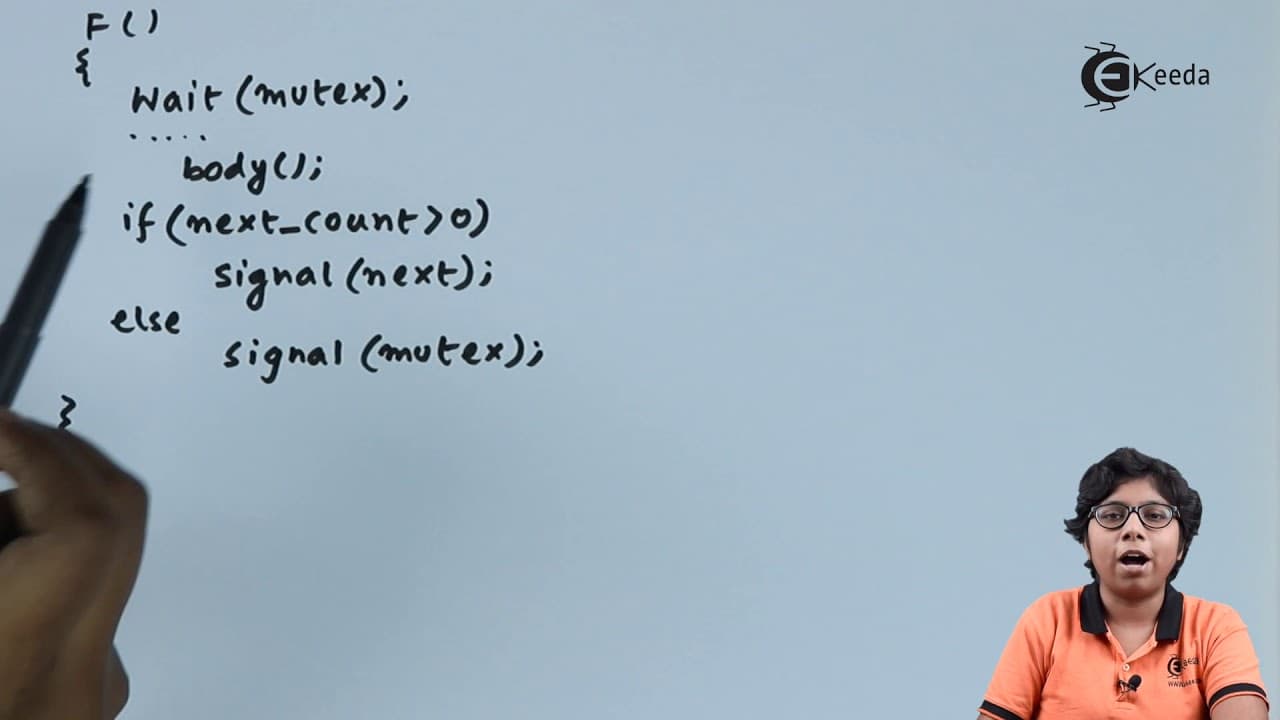
This video explains how a monitor can be implemented using a semaphore, replacing the waiting signal function with a mutex and condition variable.
Transcript
click the Bell icon to get latest videos from Ikeda hello friends today we will discuss about how a monitor can be implemented using a sim ofor how the waiting signal function replaced by the mutex and next semaphore and how the condition variable is applied to that particular mutex semaphore monitor illustration can be exemplified with the help of... Read More
Key Insights
- 🚦 Monitors can be implemented using semaphores, mutex, and condition variables.
- 📡 The wait and signal functions in a monitor are replaced to achieve synchronization.
- 👣 The implementation involves using semaphores and variables to track the status of suspended processes.
- ❓ While this method is widely used, there are possibilities for improvement and alternative implementations.
- ♿ Proper synchronization using monitors ensures mutual exclusion and prevents conflicts in accessing shared resources.
- 👻 Semaphores play a crucial role in coordinating processes and allowing them to wait or signal each other.
- 🆘 Condition variables help attach specific conditions to monitors, enabling processes to wait until those conditions are met.
Install to Summarize YouTube Videos and Get Transcripts
Explore YouTube Video Summarizer or Get YouTube Transcript Extractor
Questions & Answers
Q: What is the purpose of implementing a monitor using a semaphore?
Implementing a monitor using a semaphore allows for proper synchronization and mutual exclusion between multiple processes accessing a shared resource. It ensures that only one process can access the resource at a time, preventing conflicts and inconsistencies.
Q: How is the wait operation implemented in the monitor?
The wait operation in the monitor is implemented by invoking the wait mutex operation, which causes the process to suspend itself if another process is already inside the monitor. It waits until the semaphore next becomes non-zero, indicating that it can proceed.
Q: What is the role of condition variables in monitor implementation?
Condition variables are used to attach specific conditions to a monitor. They allow processes to wait for a certain condition to be satisfied before proceeding. The implementation involves using semaphores and a variable to track the number of suspended processes.
Q: Are there any limitations or criticisms of this monitor implementation?
Yes, some systems may not accept this generalized implementation, and researchers suggest improvements. While effective, there may be more efficient ways to implement monitors using other synchronization techniques.
Summary & Key Takeaways
-
The video discusses the implementation of a monitor using a semaphore, mutex, and condition variable.
-
It explains how the wait and signal functions are replaced to achieve synchronization.
-
The video also mentions that while this implementation is widely used, there is room for improvement.
Read in Other Languages (beta)
Share This Summary 📚
Summarize YouTube Videos and Get Video Transcripts with 1-Click
Try YouTube Summary with ChatGPT & Claude or YouTube Transcript Generator
Explore More Summaries from Ekeeda 📚





Summarize YouTube Videos and Get Video Transcripts with 1-Click
Try YouTube Summary with ChatGPT & Claude or YouTube Transcript Generator