Change of basis explained simply | Linear algebra makes sense
TL;DR
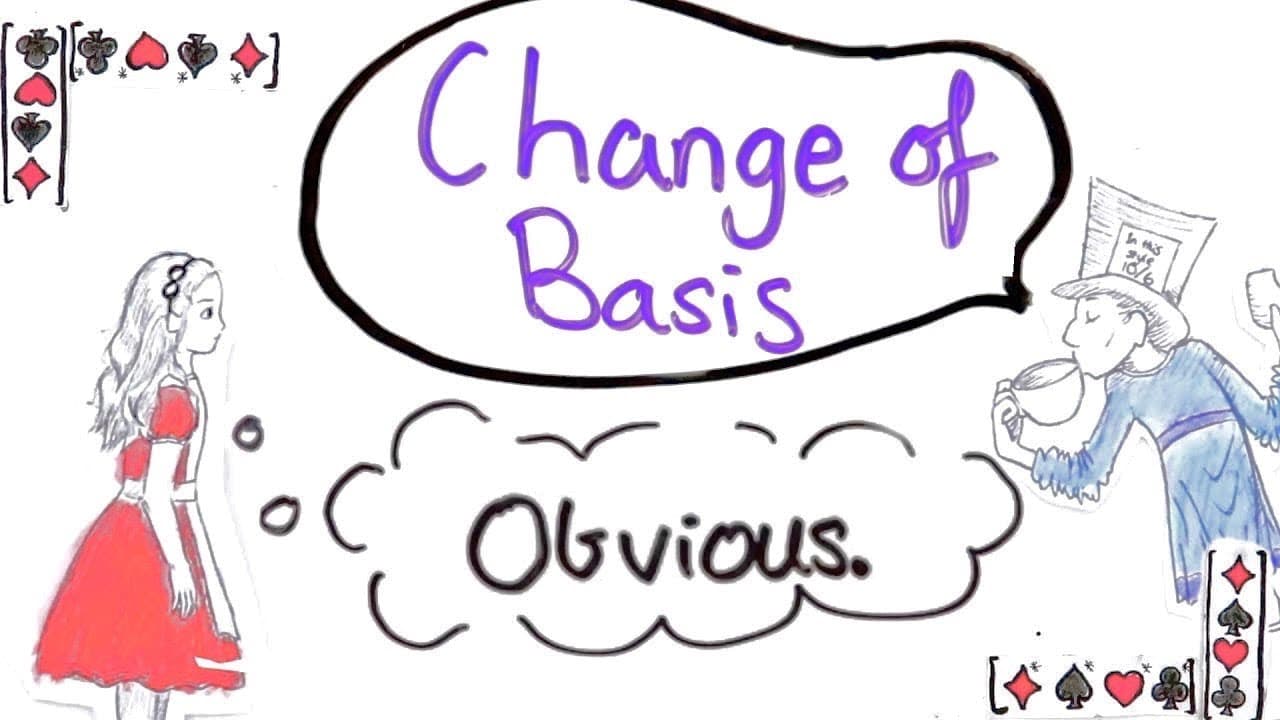
Learn how to change the basis of a vector or matrix by understanding the concept, without relying on the change of basis formula.
Transcript
Linear Algebra courses often include a part about changing the basis of a vector or a matrix, and in my experience, this part of the course can be a bit confusing- especially this mysterious change of basis formula they give you. What you’ll see in this video is, if you really understand what changing a basis actually is, how to do it will become o... Read More
Key Insights
- 👻 Changing the basis in linear algebra involves translating a vector from one basis to another, allowing communication between different bases.
- 💱 Understanding how to write each basis vector in another basis is crucial to changing the basis without relying on complex calculations.
- 💱 The change of basis can be represented by a matrix, known as the change of basis matrix, which simplifies the process and enables translation between different bases.
- 💻 The change of basis matrix has useful properties, such as computing its inverse to translate vectors back to the original basis.
Install to Summarize YouTube Videos and Get Transcripts
Explore YouTube Video Summarizer or Get YouTube Transcript Extractor
Questions & Answers
Q: What is the basic concept of changing the basis in linear algebra?
Changing the basis involves writing a vector in another basis to enable communication between different bases. It allows vectors to be translated from one basis to another.
Q: How can Alice write her basis vectors in Bob's basis without doing any calculations?
By carefully observing the minus signs in the options, Alice can deduce that her second basis vector in Bob's basis is represented as b1 - b2 divided by square root 2.
Q: What is the purpose of the change of basis matrix?
The change of basis matrix, represented as Q, allows a vector written in one basis to be translated to another basis. It simplifies the process of changing the basis and can also be used to compute its inverse.
Q: How can Alice describe a linear transformation to Bob using the change of basis matrix?
By applying both the change of basis matrix, Q, and its inverse, Q inverse, Alice can translate Bob's vectors to her basis, perform the linear transformation, and then translate the result back to Bob's basis.
Summary & Key Takeaways
-
Changing the basis of a vector involves writing the vector in another basis, allowing communication between different bases.
-
The change of basis can be illustrated using a simple example, where Alice wants to communicate her basis vector to Bob, who uses a different basis.
-
By understanding how to write each of her basis vectors in Bob's basis, Alice can translate any vector to his basis without calculation.
-
The change of basis can be represented by a matrix, known as the change of basis matrix, which allows for translation between different bases.
Read in Other Languages (beta)
Share This Summary 📚
Summarize YouTube Videos and Get Video Transcripts with 1-Click
Try YouTube Summary with ChatGPT & Claude or YouTube Transcript Generator
Explore More Summaries from Looking Glass Universe 📚





Summarize YouTube Videos and Get Video Transcripts with 1-Click
Try YouTube Summary with ChatGPT & Claude or YouTube Transcript Generator