Boiling Point of Organic Compounds
TL;DR
The boiling points of organic compounds are influenced by factors such as molecular weight, polarity, branching, and hydrogen bonding.
Transcript
in this lesson we're going to talk about the boiling point of organic compounds so which molecule has a higher boiling point is it butane or hexane what would you say the answer is going to be hexane hexane has a boiling point of about 69 degrees celsius and for butane it's negative 0.5 degrees celsius so by the difference well hexane has a higher ... Read More
Key Insights
- 😥 Boiling points of organic compounds increase with molecular weight due to increased London dispersion forces.
- 😥 The polarity of functional groups, such as aldehydes and alcohols, can significantly affect boiling points.
- 😥 Branching in organic compounds decreases boiling points due to reduced contact area.
- 😥 The size of halogen atoms in alkyl halides influences their boiling points.
- 😥 Hydrogen bonding between molecules contributes to higher boiling points in certain compounds.
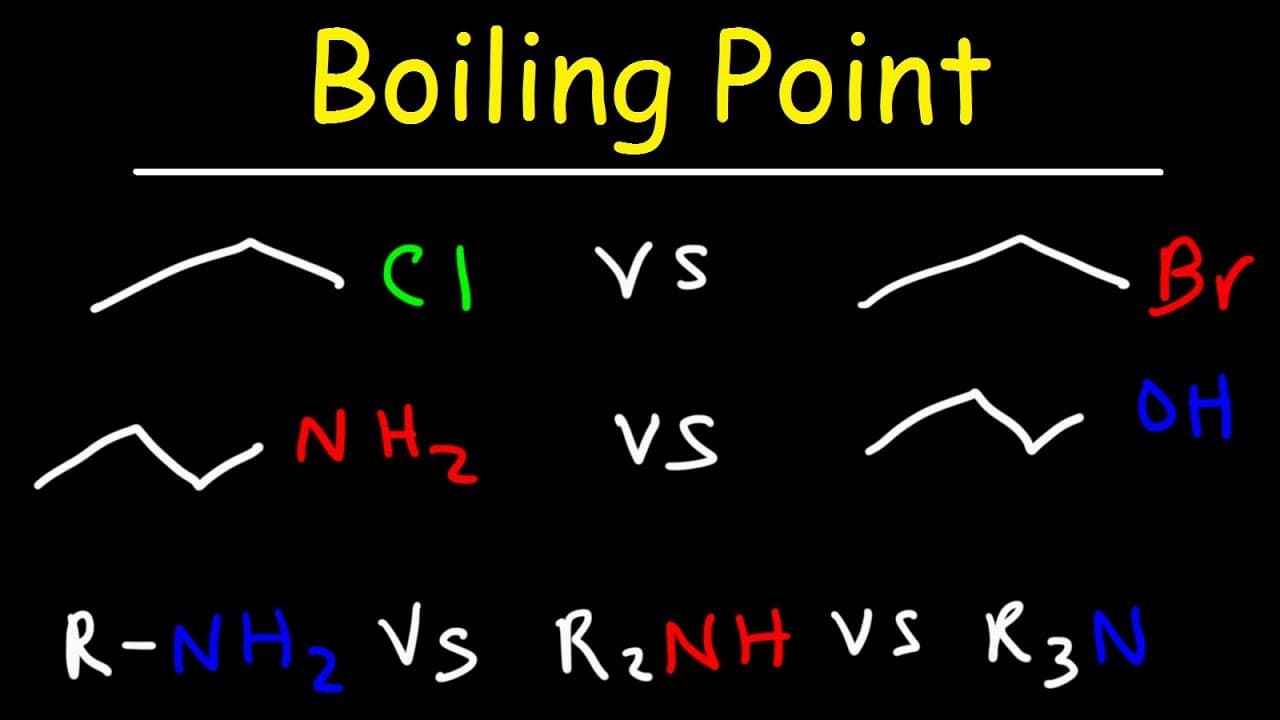
- 😥 Primary alcohols have higher boiling points than primary amines due to the greater polarity of the OH bond.
- 😥 Primary amines generally have higher boiling points than secondary amines, and tertiary amines have the lowest boiling points.
Install to Summarize YouTube Videos and Get Transcripts
Explore YouTube Video Summarizer or Get YouTube Transcript Extractor
Questions & Answers
Q: Why does hexane have a higher boiling point than butane?
Hexane has a higher boiling point than butane because it has a higher molecular weight, leading to increased London dispersion forces.
Q: Why does acetaldehyde have a higher boiling point than ethane?
Acetaldehyde has a higher boiling point than ethane because the aldehyde functional group makes it a polar molecule, with dipole-dipole interactions in addition to dispersion forces.
Q: Why does ethanol have a higher boiling point than acetaldehyde?
Ethanol has a higher boiling point than acetaldehyde because it can form hydrogen bonds due to the direct attachment of hydrogen to oxygen.
Q: Why does pentane have a higher boiling point than neopentane?
Pentane has a higher boiling point than neopentane because the contact area between pentane molecules is greater, resulting in stronger London dispersion forces.
Q: Why does ethyl bromide have a higher boiling point than ethyl chloride?
Ethyl bromide has a higher boiling point than ethyl chloride because the bromine atom is larger and can form stronger London dispersion forces.
Summary & Key Takeaways
-
Boiling points of organic compounds increase with higher molecular weight due to increased London dispersion forces.
-
Polar molecules have higher boiling points compared to non-polar molecules of similar molecular weight, due to dipole-dipole interactions and hydrogen bonding.
-
Branching in organic compounds reduces contact area and decreases boiling points.
-
Alkyl halides with larger halogen atoms have higher boiling points compared to those with smaller halogen atoms.
-
Primary alcohols have higher boiling points than primary amines due to the greater polarity of the OH bond compared to the NH bond.
Read in Other Languages (beta)
Share This Summary 📚
Summarize YouTube Videos and Get Video Transcripts with 1-Click
Try YouTube Summary with ChatGPT & Claude or YouTube Transcript Generator
Explore More Summaries from The Organic Chemistry Tutor 📚





Summarize YouTube Videos and Get Video Transcripts with 1-Click
Try YouTube Summary with ChatGPT & Claude or YouTube Transcript Generator