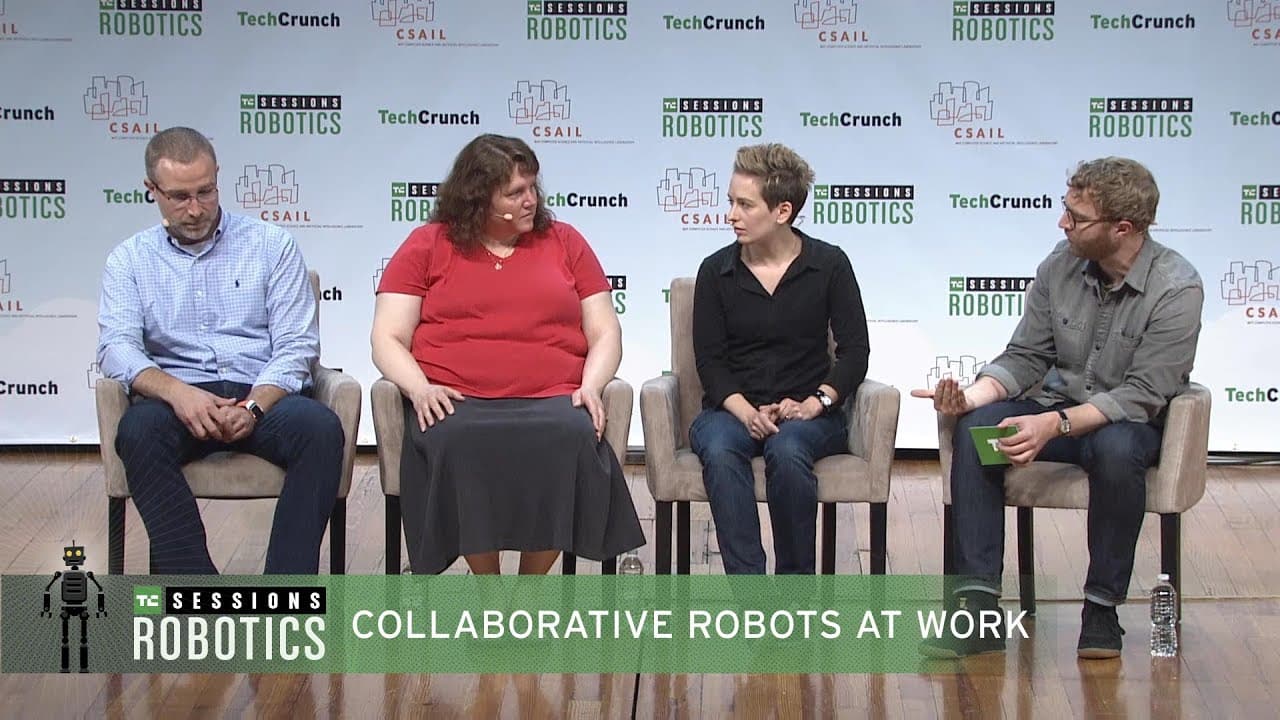
Collaborative Robots At Work
TL;DR
Robots and humans have complementary strengths, and collaborative robotics can enhance productivity, safety, and job satisfaction in the workplace.
Transcript
thank you all very much for coming out I just want to start out with perhaps a common misconception although perhaps less so with this crowd that robots in the workplace have to be as you put it earlier androids that were directly replacing a worker that's like well we're going to replace the guy doing this with a robot that's doing this but obviou... Read More
Key Insights
- 🤖 Collaborative robotics focuses on enhancing human work rather than replacing humans with robots, leveraging their complementary strengths.
- 🦺 Exoskeletons can improve worker safety and productivity by reducing fatigue and enabling safer movements, especially in hazardous environments.
- 😒 Standards and regulations are being developed to ensure the safe and effective use of collaborative robotics in industries.
- 📭 Open source technologies, miniaturization of sensors, and advancements in computing power have lowered the entry barrier for automation in various industries.
- 🥺 Flexibility and agility in manufacturing are becoming crucial, leading to increased interest in collaborative robotics.
- 👨💼 Collaboration between large manufacturers and small artisan businesses can benefit from the automation and flexibility offered by collaborative robotics.
- 😌 The responsibility of society and companies lies in retraining and preparing the workforce for major changes caused by automation, ensuring a smooth transition and support for affected individuals.
Install to Summarize YouTube Videos and Get Transcripts
Explore YouTube Video Summarizer or Get YouTube Transcript Extractor
Questions & Answers
Q: How does collaborative robotics differ from replacing humans with robots in the workplace?
Collaborative robotics aims to assist humans in their work by simplifying tasks and enhancing productivity, while still allowing humans to utilize their flexibility, dexterity, and judgement, which robots currently lack.
Q: What are some advancements in enhancing worker safety using collaborative robotics?
Exoskeletons are being developed to help workers in hazardous environments by reducing fatigue, providing ergonomic support, and improving movement, allowing them to work longer and more safely.
Q: How are standards and regulations being developed to ensure the safe use of collaborative robotics?
International safety standards organizations are modifying existing standards to accommodate collaborative robotics. Compliance with these standards ensures that the systems deployed in workplaces do not harm workers and create a roadmap for safe implementation.
Q: How can communication gap between humans and robots be bridged in the workplace?
Companies are focusing on intuitive communication methods, such as using a mobile robot to lead operators and provide instructions through familiar concepts like GPS navigation. Visual communication and icons are also being explored to quickly convey important information to workers.
Summary & Key Takeaways
-
Collaborative robotics focuses on simplifying work for humans and enhancing their productivity, rather than replacing them with robots.
-
Exoskeletons can help humans in their work by providing safety, reducing fatigue, and improving movement, especially in hazardous environments.
-
Standards and regulations are being developed to ensure the safe and effective use of collaborative robotics in industries.
Read in Other Languages (beta)
Share This Summary 📚
Summarize YouTube Videos and Get Video Transcripts with 1-Click
Try YouTube Summary with ChatGPT & Claude or YouTube Transcript Generator
Explore More Summaries from TechCrunch 📚






Summarize YouTube Videos and Get Video Transcripts with 1-Click
Try YouTube Summary with ChatGPT & Claude or YouTube Transcript Generator