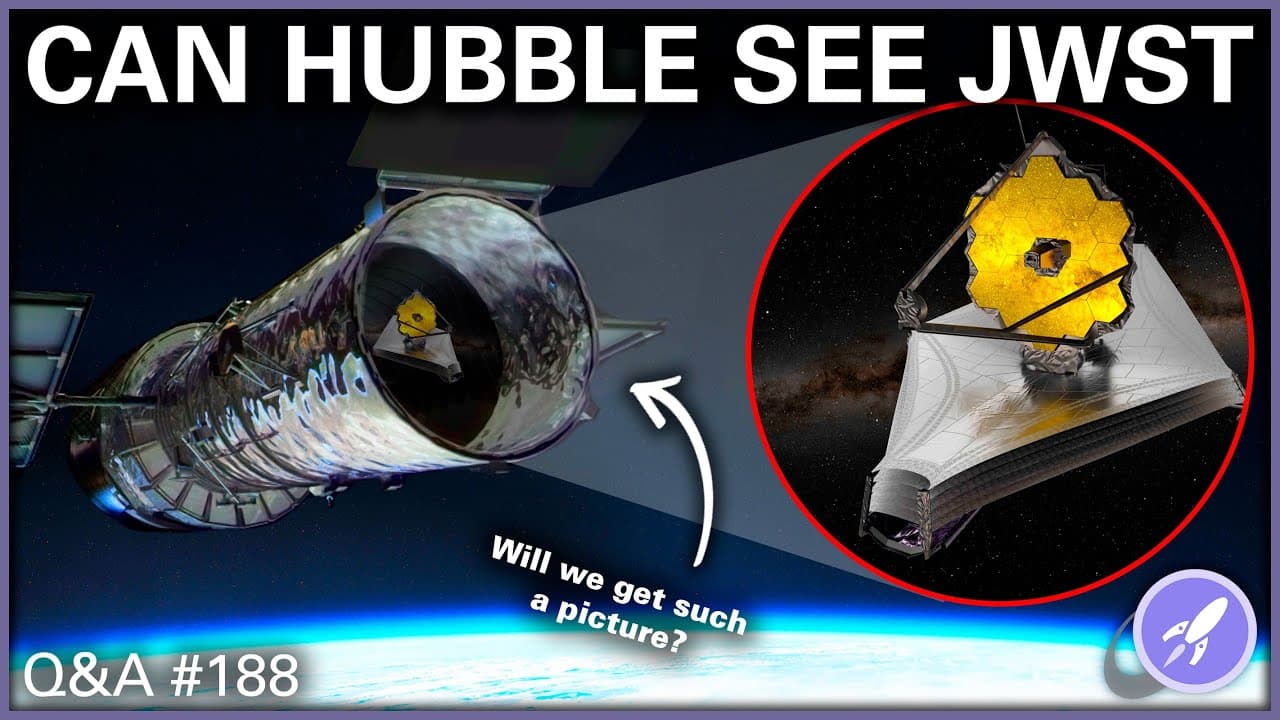
Recycling the ISS, Artificial Meteor Storms, Can Hubble See JWST | Q&A 188
TL;DR
Fraser Cain answers space and astronomy questions with insights on quasars, planetary construction, and alien life possibilities.
Transcript
Unknown: Hi, everyone. I'm Fraser Cain. I'm the publisher of Universe Today. I've been a space and astronomy news journalist for over 20 years. This is the question Show Your questions, my answers. Now, as always, wherever you are across my channel, if a question pops in your brain, just write it down. I will gather them up, and I will answer them ... Read More
Key Insights
- 🖤 Quasars are bright sources of radiation powered by actively feeding supermassive black holes in distant galaxies.
- 🚴 Pluto's relocation near the Sun could result in a comet-like transformation due to its icy composition.
- 😘 Deorbiting the ISS instead of creating an orbital junkyard is driven by cost constraints and technical challenges of repurposing space structures.
- 💦 Understanding the implications of comet sample returns can provide insights into the origin of water on Earth.
Install to Summarize YouTube Videos and Get Transcripts
Explore YouTube Video Summarizer or Get YouTube Transcript Extractor
Questions & Answers
Q: Can quasars appear anywhere in the Universe?
Quasars are formed by supermassive black holes actively feeding and emitting bright radiation, usually seen in distant galaxies. Understanding quasars has evolved over time, shedding light on the Universe's history.
Q: What would happen if Pluto was moved closer to the Sun?
Moving Pluto between Earth and Mars could initiate a comet-like transformation due to its icy composition. Factors like the frost line determine such phenomena in our Solar System.
Q: Why deorbit the ISS instead of creating an orbital junkyard?
Deorbiting the ISS is influenced by the challenges of maintaining an aged structure in space and the unfeasibility of repurposing it for spare parts due to high costs and technical complexities.
Q: Could asteroids deflect Earth closer to the Sun during an impact?
The mechanics of orbital dynamics dictate that Earth's trajectory wouldn't significantly change even from a near-Earth asteroid impact, as orbital paths are stable unless continuously influenced by external forces.
Summary & Key Takeaways
-
Fraser Cain answers diverse space-related questions, discussing quasars as active black holes, the potential effects of moving Pluto, the challenges of the ISS deorbiting, and the nature of the Universe.
-
He explains the science behind potential asteroid strikes, the habitability of moons in the Sun's habitable zone, and the likelihood of alien bases on the Moon.
-
The Q&A also covers the feasibility of construction equipment for the Moon, the possibility of a comet sample return mission, and the insights gained from studying water in comets.
Read in Other Languages (beta)
Share This Summary 📚
Summarize YouTube Videos and Get Video Transcripts with 1-Click
Try YouTube Summary with ChatGPT & Claude or YouTube Transcript Generator
Explore More Summaries from Fraser Cain 📚
Summarize YouTube Videos and Get Video Transcripts with 1-Click
Try YouTube Summary with ChatGPT & Claude or YouTube Transcript Generator