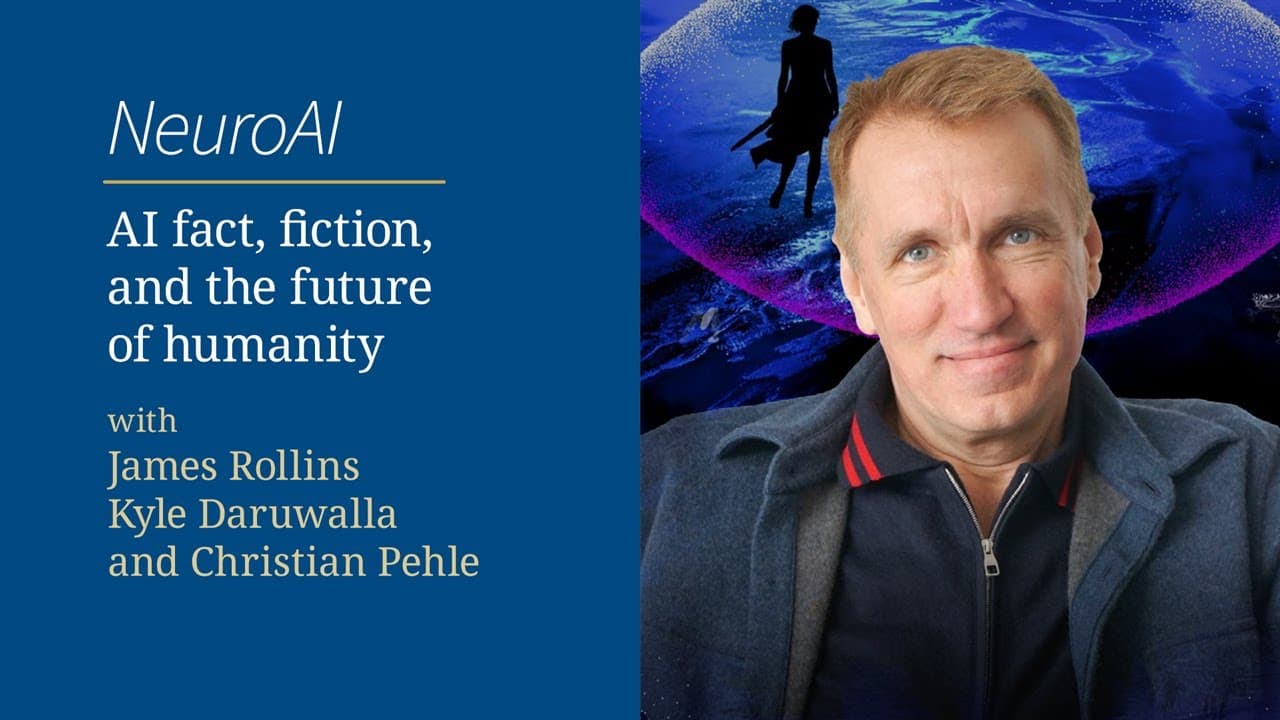
AI fact, fiction, and the future of humanity
TL;DR
Panel discusses AI, its implications, and intersections with literature.
Transcript
Welcome, everyone, to this virtual panel discussion between techno-thriller and sci-fi author James Rollins and Cold Spring Harbor Laboratory’s NeuroAI Scholars Christian Pehle and Kyle Daruwalla. My name is Hrishikesh Deshpande, and I'll be co-moderating this discussion with Caroline Cosgrove. Cold Spring Harbor Laboratory, which was founded in 18... Read More
Key Insights
- Cold Spring Harbor Laboratory hosts community events to engage with the public on scientific research and advancements.
- James Rollins, a techno-thriller author, explores AI in his novels, focusing on empathy and consciousness in artificial systems.
- The rapid progress in AI, especially in language models, has surprised many researchers, shifting focus from computer vision.
- AI's current limitations include understanding physical world interactions and energy efficiency compared to biological systems.
- The potential of AI to enhance human capabilities, particularly in medical applications, is promising but requires careful consideration.
- AI is increasingly intersecting with creative fields, aiding artists and writers in generating new ideas and content.
- The concept of AI reaching singularity raises questions about resource constraints and societal impacts.
- The future of AI may lie in democratizing access to technology and making it more energy-efficient for broader scientific breakthroughs.
Install to Summarize YouTube Videos and Get Transcripts
Explore YouTube Video Summarizer or Get YouTube Transcript Extractor
Questions & Answers
Q: What are the main topics discussed in the panel?
The panel covers a range of topics related to AI, including its rapid advancements, intersections with literature, potential applications in enhancing human capabilities, and the ethical considerations of AI development. The discussion also highlights the importance of democratizing AI technology and improving its energy efficiency.
Q: How does James Rollins incorporate AI into his novels?
James Rollins incorporates AI into his novels by exploring themes of empathy and consciousness in artificial systems. He draws inspiration from current scientific research and aims to educate and excite readers about scientific advancements through engaging storytelling. Rollins often blends historical mysteries with futuristic technology in his works.
Q: What are the current limitations of AI according to the panelists?
The panelists highlight several limitations of current AI systems, including their inability to understand and interact with the physical world, limited energy efficiency compared to biological systems, and challenges in mimicking human consciousness. They emphasize the need for further research to overcome these hurdles and advance AI technology.
Q: How is AI intersecting with creative fields?
AI is increasingly being used in creative fields such as art and literature. It assists artists and writers by generating new ideas and content, offering unique perspectives and possibilities. While AI can serve as a valuable tool, there is an ongoing discussion about its impact on traditional creative roles and the importance of maintaining human input in the creative process.
Q: What are the potential benefits of AI in medical applications?
AI holds significant potential in medical applications, particularly in assisting with degenerative disorders and enhancing human capabilities. For example, AI can be used to develop personalized treatment plans, assist in brain stimulation for conditions like Parkinson's, and improve diagnostic accuracy. The panelists emphasize the importance of using AI responsibly in healthcare to maximize its benefits.
Q: What is the panel's view on the AI singularity?
The panelists express skepticism about the likelihood of AI reaching singularity, citing resource constraints and the need for public policy to address potential risks. They believe that while AI will continue to advance, the idea of a runaway superintelligence is unlikely due to physical and resource limitations. Instead, they focus on current AI challenges and opportunities.
Q: How can AI be democratized and made more energy-efficient?
The panelists advocate for democratizing AI by making it more accessible and reducing its energy consumption. This involves developing energy-efficient AI models and technologies that can be widely used by researchers and the public. By doing so, AI can become a tool for scientific discovery and innovation, benefiting a broader range of users and applications.
Q: What role does AI play in scientific discovery?
AI plays a crucial role in scientific discovery by analyzing large datasets, identifying patterns, and generating insights that might not be immediately apparent to human researchers. It can accelerate research in fields such as genomics, neuroscience, and drug discovery, providing valuable tools for scientists to push the boundaries of knowledge and innovation.
Summary & Key Takeaways
-
The panel discussion explores the intersection of AI and literature, with a focus on the rapid advancements in AI technology and its implications for society. James Rollins shares insights from his novels, which often incorporate cutting-edge scientific research.
-
Researchers from Cold Spring Harbor Laboratory discuss the challenges and opportunities presented by AI, particularly in understanding human language and energy efficiency. The conversation touches on the potential of AI to enhance human capabilities and the importance of democratizing access to AI technology.
-
The discussion also delves into the creative applications of AI, its role in scientific discovery, and the ethical considerations of AI development. The panelists emphasize the need for public policy and open dialogue to navigate the future of AI responsibly.
Read in Other Languages (beta)
Share This Summary 📚
Summarize YouTube Videos and Get Video Transcripts with 1-Click
Try YouTube Summary with ChatGPT & Claude or YouTube Transcript Generator
Explore More Summaries from Cold Spring Harbor Laboratory 📚


Summarize YouTube Videos and Get Video Transcripts with 1-Click
Try YouTube Summary with ChatGPT & Claude or YouTube Transcript Generator