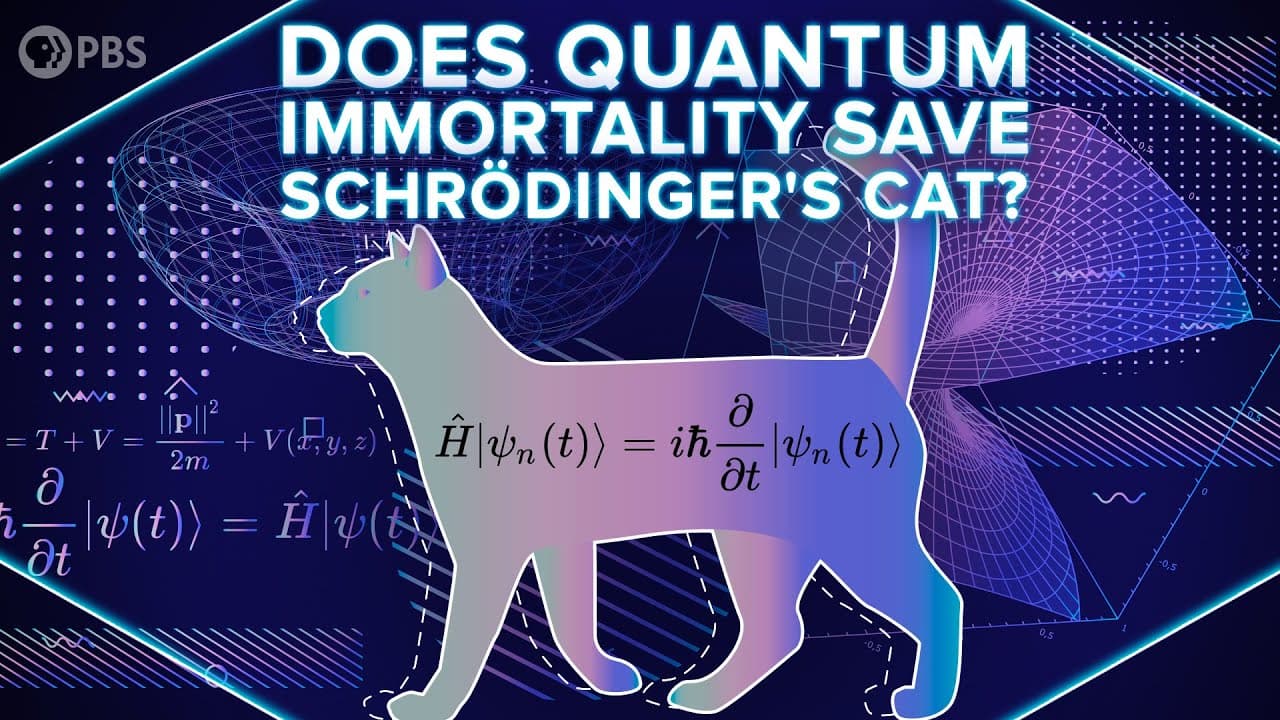
Does Quantum Immortality Save Schrödinger's Cat?
TL;DR
Exploring quantum immortality through Schrödinger's cat thought experiment.
Transcript
To quote eminent scientist Tyler Durden: "On a long enough timeline, the survival rate for everyone drops to zero." Actually… not necessarily. If the quantum multiverse is real there may be a version of you that lives forever. In the last couple of episodes we’ve been delving into a key mystery of quantum mechanics - why don’t we have quantum magic... Read More
Key Insights
- Quantum immortality is a thought experiment inspired by Schrödinger's cat, suggesting that in the multiverse, a version of you may survive indefinitely.
- Decoherence explains why we don't observe quantum superpositions in our macroscopic world, but it doesn't solve the measurement problem.
- The Many Worlds interpretation posits that all possible outcomes of quantum events exist in separate branches of reality.
- Quantum immortality proposes that a physicist could survive a deadly experiment in at least one branch of reality, providing evidence for the Many Worlds interpretation.
- The Copenhagen interpretation suggests that unobserved wavefunction branches vanish upon measurement, contrasting with the Many Worlds view.
- Quantum immortality raises ethical issues as it implies countless physicists would die in other timelines for one to survive.
- Max Tegmark argues that death is an incremental process, reducing the likelihood of survival in Many Worlds timelines.
- The Doomsday Argument uses probabilistic reasoning to estimate humanity's survival, suggesting a low chance of reaching the year 3000.
Install to Summarize YouTube Videos and Get Transcripts
Explore YouTube Video Summarizer or Get YouTube Transcript Extractor
Questions & Answers
Q: What is quantum immortality?
Quantum immortality is a thought experiment based on the Many Worlds interpretation of quantum mechanics. It suggests that in a multiverse, there could be branches where an individual survives indefinitely, even in situations with a high probability of death, as all possible outcomes of quantum events exist in separate realities.
Q: How does decoherence relate to the measurement problem?
Decoherence is a process that explains the transition from quantum superpositions to classical outcomes by preventing interaction between different wavefunction branches. However, it doesn't solve the measurement problem, which questions why we observe a single, definite outcome rather than multiple possibilities inherent in quantum systems.
Q: What is the Many Worlds interpretation?
The Many Worlds interpretation of quantum mechanics posits that all possible outcomes of quantum events occur in separate, non-communicating branches of reality. Each branch represents a different version of the universe, where different outcomes are realized, providing a framework for understanding quantum phenomena without collapsing wavefunctions.
Q: How does the Copenhagen interpretation differ from Many Worlds?
The Copenhagen interpretation suggests that unobserved branches of a wavefunction vanish upon measurement, leaving only the observed outcome as real. In contrast, the Many Worlds interpretation claims that all branches are equally real and continue to exist, each representing a different outcome of a quantum event in separate realities.
Q: What is the Doomsday Argument?
The Doomsday Argument is a probabilistic reasoning approach that estimates the likelihood of humanity's survival based on the assumption that we are typical members of the human race. It suggests that we are likely near the midpoint of human existence, implying a low probability of humanity surviving much longer, particularly to the year 3000.
Q: What are the ethical implications of quantum immortality?
Quantum immortality raises significant ethical concerns, as it implies that countless individuals would die in other branches of reality for one to survive. This thought experiment challenges our understanding of life and death, highlighting the potential consequences of interpreting quantum mechanics through the lens of Many Worlds.
Q: How does Max Tegmark view quantum immortality?
Max Tegmark argues that death is an incremental process involving many quantum events, reducing the likelihood of survival in Many Worlds timelines. He suggests that even if some branches allow for survival beyond typical lifespans, it's prudent to live as though we have only one timeline, emphasizing healthy lifestyle choices.
Q: How does the Doomsday Argument estimate humanity's survival chances?
The Doomsday Argument estimates humanity's survival chances by assuming exponential population growth and calculating the probability of being born at a typical point in human history. It suggests a low probability of humanity reaching future milestones, like the year 3000, based on statistical reasoning, though it remains a debated and controversial theory.
Summary & Key Takeaways
-
Quantum immortality is a concept derived from the Many Worlds interpretation, suggesting that in some branches of reality, individuals may survive indefinitely. This idea is explored through a thought experiment involving a physicist replacing Schrödinger's cat in a deadly setup, providing evidence for the Many Worlds theory.
-
The episode discusses decoherence and its role in the quantum-classical transition, explaining why we don't observe quantum superpositions in everyday life. While decoherence prevents interaction between wavefunction branches, it doesn't solve the measurement problem or explain why we observe one outcome.
-
The Doomsday Argument is revisited, using statistical reasoning to predict humanity's survival chances. Assuming exponential population growth, the argument suggests a low probability of human existence extending to the year 3000, though it remains a controversial and debated topic.
Read in Other Languages (beta)
Share This Summary 📚
Summarize YouTube Videos and Get Video Transcripts with 1-Click
Try YouTube Summary with ChatGPT & Claude or YouTube Transcript Generator
Explore More Summaries from PBS Space Time 📚
Summarize YouTube Videos and Get Video Transcripts with 1-Click
Try YouTube Summary with ChatGPT & Claude or YouTube Transcript Generator