How to Solve Probability Density Functions Step-by-Step
TL;DR
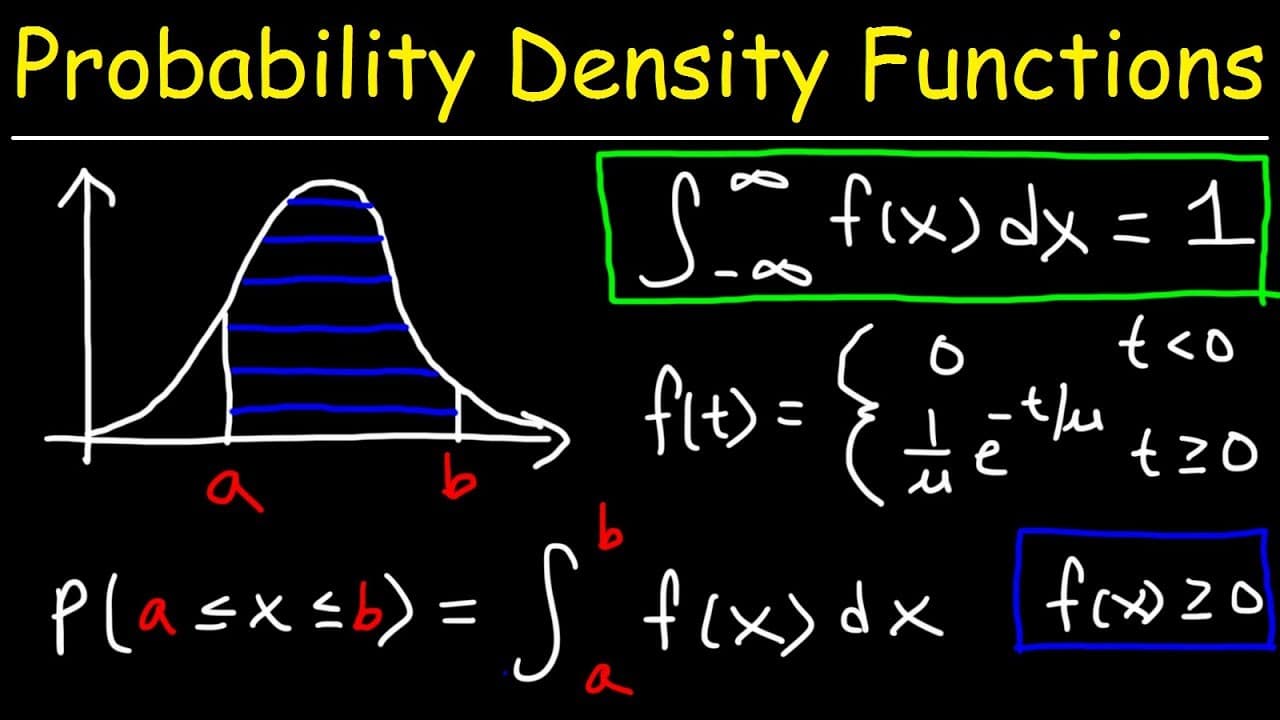
To solve probability density functions (PDFs), first verify that the function is non-negative and integrate it over its domain to ensure it sums to 1. For specific probability calculations, evaluate the definite integral of the PDF over the desired range. Exponential density functions can model waiting times, with probabilities calculated similarly.
Transcript
in this video we're going to talk about how to solve probability density functions so we're given f of X which is 0.04 X times 5 minus X now if f is a probability density function it has to be equal to or less than zero so it can't be negative so notice that when X is zero the function will be equal to zero and also in X is five so X has to be betw... Read More
Key Insights
- 🚱 The function in a probability density function must be non-negative and the integral of the function over its entire domain must be equal to 1.
- 🧡 The probability that a random variable falls within a specific range can be calculated by evaluating the definite integral of the density function over that range.
- ⌛ Exponential density functions can be used to model waiting times, and the probability that a customer has to wait more than a certain amount of time can be calculated by evaluating the definite integral of the exponential function over the appropriate range.
Install to Summarize YouTube Videos and Get Transcripts
Explore YouTube Video Summarizer or Get YouTube Transcript Extractor
Questions & Answers
Q: How can we verify if a function is a probability density function?
To verify if a function is a probability density function, we need to check if it is non-negative and if the integral of the function over its entire domain is equal to 1.
Q: How do we calculate the probability that a random variable falls within a specific range?
To calculate the probability that a random variable falls within a specific range, we need to evaluate the definite integral of the density function over that range.
Q: How do we calculate the probability that a customer has to wait more than a certain amount of time at a restaurant?
We can use an exponential density function to calculate the probability that a customer has to wait more than a certain amount of time. We need to evaluate the definite integral of the exponential function over the range of waiting times.
Q: How do we calculate the probability that a customer will be served within a specific time frame?
We can calculate the probability that a customer will be served within a specific time frame by evaluating the definite integral of the exponential function over that range of time.
Summary & Key Takeaways
-
The video begins by discussing how to verify if a given function is a probability density function by checking if it meets certain conditions.
-
It then demonstrates how to calculate the probability that a random variable falls within a specific range by evaluating the definite integral of the density function over that range.
-
The video also covers how to calculate the probability that a customer has to wait more than a certain amount of time at a restaurant using an exponential density function.
-
Finally, it shows how to calculate the probability that a customer will be served within a specific time frame using an exponential density function.
Read in Other Languages (beta)
Share This Summary 📚
Summarize YouTube Videos and Get Video Transcripts with 1-Click
Try YouTube Summary with ChatGPT & Claude or YouTube Transcript Generator
Explore More Summaries from The Organic Chemistry Tutor 📚
Summarize YouTube Videos and Get Video Transcripts with 1-Click
Try YouTube Summary with ChatGPT & Claude or YouTube Transcript Generator