Kirchhoff's Current Law, Junction Rule, KCl Circuits - Physics Problems
TL;DR
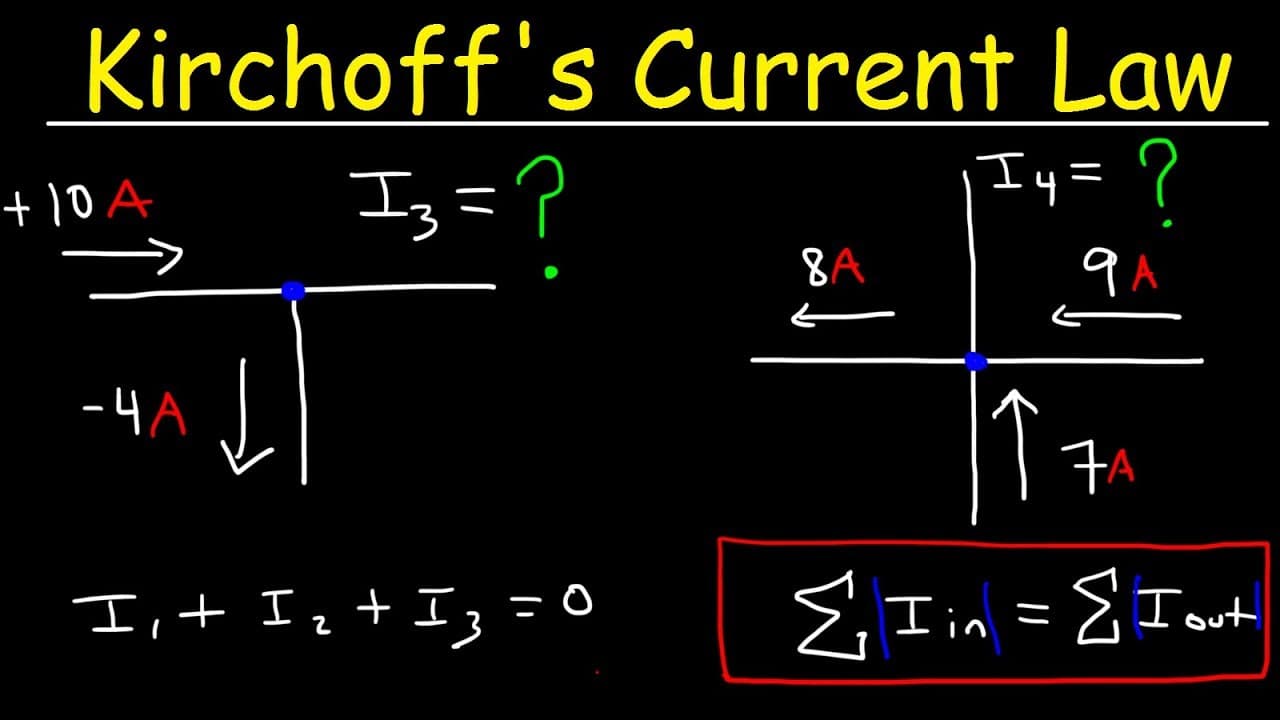
Kirchhoff's Current Law states that the total current flowing into a junction must equal the total current flowing out, resulting in a net current of zero.
Transcript
in this video we're going to talk about kirchhoff's current law abbreviated kcl so the basic idea behind kirchhoff's current law is that the total current that flows into a junction must equal the total current that flows out of the junction so if we assign the current values that flow into a junction let's say if we make it positive and the curren... Read More
Key Insights
- ⚾ Kirchhoff's Current Law is based on the principle of conservation of charge, where the total current entering a junction equals the total current leaving.
- 👻 By assigning positive and negative values to currents, KCL allows us to determine the direction in which the current is flowing.
- 🆘 KCL is a fundamental concept in circuit analysis, helping to solve for unknown currents and analyze circuit behavior.
- ❓ KCL can be applied to complex circuits with multiple interconnected junctions.
- 💐 The sum of currents flowing into a circuit junction must always be equal to the sum of currents flowing out, ensuring conservation of charge.
- 😫 KCL enables the calculation of unknown currents in a circuit by setting up an equation with balanced currents.
- 💐 The net current flowing in a circuit junction is always zero, as per Kirchhoff's Current Law.
Install to Summarize YouTube Videos and Get Transcripts
Explore YouTube Video Summarizer or Get YouTube Transcript Extractor
Questions & Answers
Q: What is the basic principle behind Kirchhoff's Current Law?
Kirchhoff's Current Law states that the total current flowing into a junction must be equal to the total current flowing out, resulting in a net current of zero.
Q: How can we assign positive or negative values to the currents?
If a current is entering a junction, it is assigned a positive value. If it is leaving the junction, it is assigned a negative value.
Q: What is the significance of calculating unknown currents using KCL?
KCL allows us to set up an equation where the sum of all currents is equal to zero, enabling us to solve for unknown currents in a circuit.
Q: How can KCL be used in practice to analyze circuits?
By applying KCL at different junctions in a circuit, we can determine the current relationships between branches and analyze circuit behavior.
Summary & Key Takeaways
-
Kirchhoff's Current Law (KCL) states that the sum of all currents flowing into a junction equals the sum of all currents flowing out.
-
By assigning positive and negative values to the currents, we can determine the direction in which the current is flowing.
-
KCL helps in calculating unknown currents by setting up an equation where the sum of all currents is equal to zero.
Read in Other Languages (beta)
Share This Summary 📚
Summarize YouTube Videos and Get Video Transcripts with 1-Click
Try YouTube Summary with ChatGPT & Claude or YouTube Transcript Generator
Explore More Summaries from The Organic Chemistry Tutor 📚


Summarize YouTube Videos and Get Video Transcripts with 1-Click
Try YouTube Summary with ChatGPT & Claude or YouTube Transcript Generator