Coding of space and time in cortical structures
TL;DR
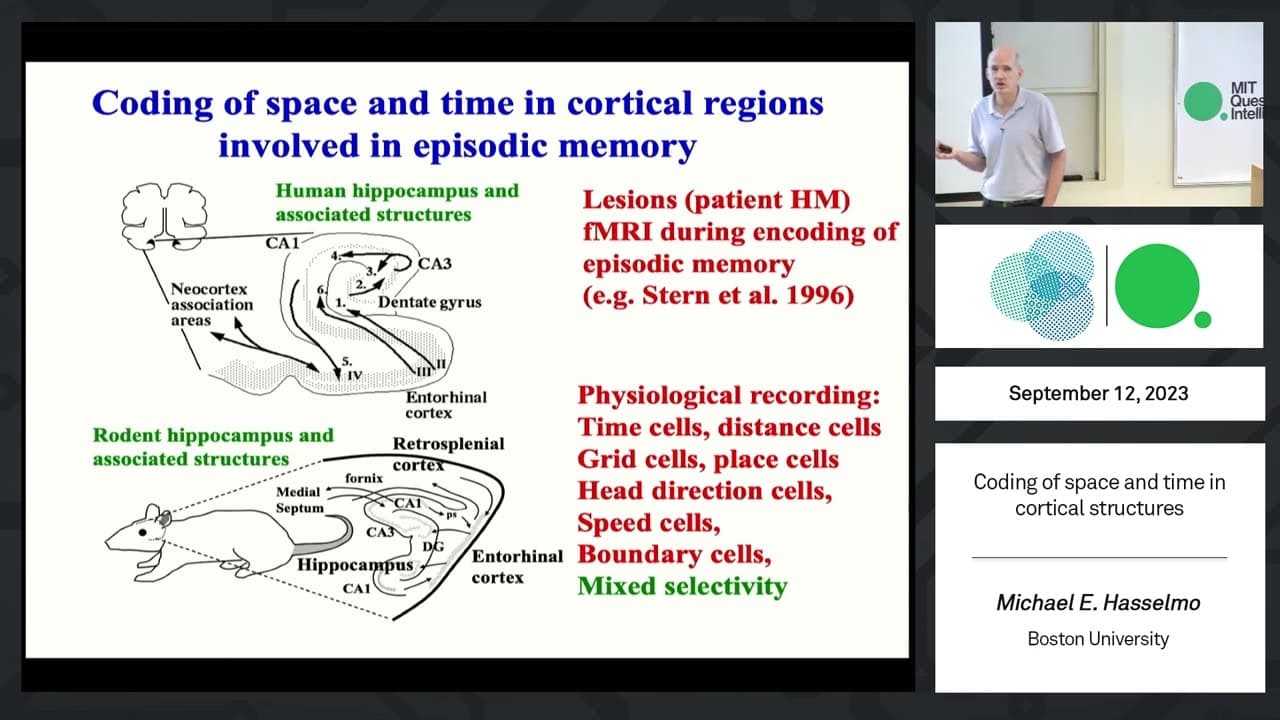
The brain has specialized cells that help encode information about space and time, such as grid cells that code for location and time cells that code for the passage of time.
Transcript
MATT WILSON: So it's a real pleasure to be able to welcome and introduce a great colleague and friend of mine, Mike Hasselmo. So Mike didn't want me to go too long. We have a long history together. We actually were-- we started our careers at Caltech together. I was a graduate student. Mike was a postdoc in the lab of Jim Bauer. Mike started off do... Read More
Key Insights
- 💁 Cells in the hippocampus and entorhinal cortex encode information about space and time, including time cells that fire at specific intervals and grid cells that form a spatial grid.
- 👾 The medial septum plays a crucial role in regulating the theta rhythm, which is important for coding time and space.
- 👻 The coding of boundaries in egocentric coordinates allows for the generation of allocentric representations of space in the grid cell system.
- ❓ The dynamics of encoding and retrieval are regulated by the theta rhythm, with different phases corresponding to different processes.
Install to Summarize YouTube Videos and Get Transcripts
Explore YouTube Video Summarizer or Get YouTube Transcript Extractor
Questions & Answers
Q: How do time cells in the brain help encode the passage of time?
Time cells in the hippocampus and entorhinal cortex fire at specific intervals, providing a temporal representation of events. This allows the brain to differentiate events that occur at different times.
Q: How do grid cells code for an animal's location in space?
Grid cells fire in a hexagonal pattern and their firing fields form a grid-like representation of space. Each cell within the grid fires at a specific combination of locations, providing the brain with a spatial map.
Q: Can you explain the role of the medial septum in the coding of space and time?
The medial septum provides rhythmic input to the hippocampus and entorhinal cortex, regulating the theta rhythm. This rhythm is important for generating time and grid cell responses, and may be involved in the dynamic encoding and retrieval of information.
Q: What is the relationship between egocentric and allocentric representations of space?
Egocentric representations of space are based on an animal's viewpoint, while allocentric representations are based on the location of objects and boundaries relative to the animal. The brain transforms the egocentric view into an allocentric representation, which is essential for spatial navigation and memory.
Key Insights:
- Cells in the hippocampus and entorhinal cortex encode information about space and time, including time cells that fire at specific intervals and grid cells that form a spatial grid.
- The medial septum plays a crucial role in regulating the theta rhythm, which is important for coding time and space.
- The coding of boundaries in egocentric coordinates allows for the generation of allocentric representations of space in the grid cell system.
- The dynamics of encoding and retrieval are regulated by the theta rhythm, with different phases corresponding to different processes.
- The brain uses a combination of egocentric and allocentric representations to navigate and store memories of the environment.
Summary & Key Takeaways
-
Memory and spatial navigation rely on the coding of space and time in the brain.
-
Time cells in the hippocampus and entorhinal cortex fire at specific intervals, helping to encode the timing of events.
-
Grid cells in the entorhinal cortex have firing fields that form a hexagonal grid pattern, coding for an animal's location in space.
Read in Other Languages (beta)
Share This Summary 📚
Summarize YouTube Videos and Get Video Transcripts with 1-Click
Try YouTube Summary with ChatGPT & Claude or YouTube Transcript Generator
Explore More Summaries from MITCBMM 📚
Summarize YouTube Videos and Get Video Transcripts with 1-Click
Try YouTube Summary with ChatGPT & Claude or YouTube Transcript Generator