CBMM10 Panel: Neuroscience to AI and back again

TL;DR
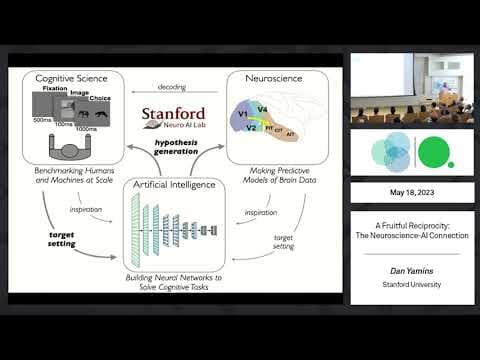
Some deep artificial neural networks (ANNs) are considered the current best models of the mechanisms by which primates process sensory input.
Transcript
TOMASO POGGIO: If you look at evolution, evolution went from probably very simple associative reflexes to language, to logic, eventually to large language models. And in a sense, these are back to association, so from programming to learning and associating things, so I guess neuroscience to AI and back again. That's it. Jim? JAMES DICARLO: OK. All... Read More
Key Insights
- 😠 Deep ANNs have been successful models in sensory processing and computer vision.
- 😠 There are limitations to deep ANNs, including their fragility, limited generalization, and lack of alignment with neural and behavioral data.
- 😠 Deep ANNs serve as models for cognitive science but fall short of providing detailed insights into neural circuits and processes.
Install to Summarize YouTube Videos and Get Transcripts
Explore YouTube Video Summarizer or Get YouTube Transcript Extractor
Questions & Answers
Q: Are deep ANNs the best models of how primates process sensory input?
While deep ANNs have informed and inspired the development of AI technologies, they do not fully capture all aspects of neural processing and mechanisms in the brain.
Q: Can models like deep ANNs understand the principles of brain function?
Deep ANNs provide a computable model for visual processing but lack the level of understanding and abstraction needed to fully explain brain function.
Q: Can deep ANNs be used to study cell types and connectomes in neural circuits?
Deep ANNs can inform initial hypotheses about cell types and connectivity, but they do not capture the complexity and specificity of real biological networks.
Q: Can deep ANNs be generalized to other domains of intelligence, beyond sensory systems?
Deep ANNs are limited in their ability to capture higher-level cognitive processes and do not provide a complete understanding of intelligence beyond sensory processing.
Key Insights:
- Deep ANNs have been successful models in sensory processing and computer vision.
- There are limitations to deep ANNs, including their fragility, limited generalization, and lack of alignment with neural and behavioral data.
- Deep ANNs serve as models for cognitive science but fall short of providing detailed insights into neural circuits and processes.
- Deep ANNs can inform initial hypotheses about mechanisms in biological systems but do not fully capture the complexity of real neural networks.
Summary & Key Takeaways
-
Evolution went from simple reflexes to language and logic, and then back to association and learning through AI.
-
Deep architectures, especially convolutional networks, have been successful models in sensory processing and computer vision.
-
These models have informed and inspired the development of AI technologies and have had an impact on visual processing and other cognitive functions.
Read in Other Languages (beta)
Share This Summary 📚
Summarize YouTube Videos and Get Video Transcripts with 1-Click
Try YouTube Summary with ChatGPT & Claude or YouTube Transcript Generator
Explore More Summaries from MITCBMM 📚



Summarize YouTube Videos and Get Video Transcripts with 1-Click
Try YouTube Summary with ChatGPT & Claude or YouTube Transcript Generator