CBMM10 Panel: Research on Intelligence in the Age of AI

TL;DR
Panel discusses AI's impact on neuroscience and future of intelligence research.
Transcript
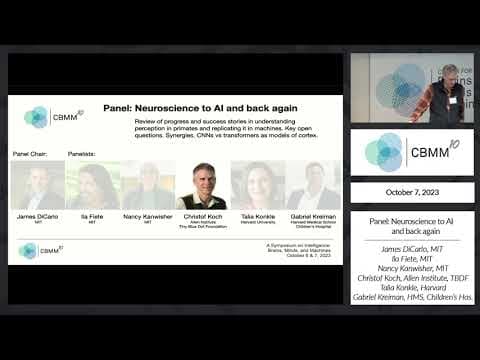
TOMASO POGGIO: I'm Tomaso Poggio. Of course, did not change. What we had to change, unfortunately, for the sad events happening in Israel right now is that Amnon Shashua was in the panel, cannot attend because they are in a state of war right there. And Pietro Perona has been so gracious to accept to jump in at the last moment, so he will replace A... Read More
Key Insights
- The panel emphasized the importance of understanding intelligence to comprehend human existence, highlighting AI's potential to aid this understanding.
- There was consensus on the need for benchmarking AI capabilities, but challenges remain in defining meaningful benchmarks.
- Neuroscience has significantly influenced AI, but the relationship is evolving as AI systems diverge from biological models.
- The panelists discussed the potential for AI to revolutionize scientific research, particularly in fields like biology and chemistry.
- The role of theory in AI development was debated, with some panelists advocating for its importance in understanding AI systems.
- The potential for AI to assist in neuroscience was highlighted, particularly in decoding brain states and understanding brain function.
- There was a discussion on the limitations and capabilities of current AI models, particularly in terms of creativity and problem-solving.
- The panelists explored the possibility of AI systems developing new theories or conjectures, with some optimism for future advancements.
Install to Summarize YouTube Videos and Get Transcripts
Explore YouTube Video Summarizer or Get YouTube Transcript Extractor
Questions & Answers
Q: What is the role of theory in AI development?
The role of theory in AI development is debated among the panelists. Some argue that theory is crucial for understanding AI systems, akin to the role of theory in physics. However, others believe that while precise theory may be elusive due to the complexity of neural networks, theory can still guide AI development by providing insights into scaling, optimization, and other key areas.
Q: How has neuroscience influenced AI?
Neuroscience has significantly influenced AI by inspiring key concepts such as neural networks and distributed representations. Ideas from neuroscience have shaped the development of AI models, particularly in areas like deep learning and reinforcement learning. However, as AI systems evolve, the direct influence of neuroscience may diminish, although neuroscience can still offer valuable insights into the functioning of AI systems.
Q: What potential does AI have to revolutionize scientific research?
AI has the potential to revolutionize scientific research by addressing complex, combinatorial problems in fields like biology and chemistry. AI systems can model and search large solution spaces, enabling breakthroughs such as protein folding predictions with AlphaFold. As AI continues to advance, it could assist in generating new hypotheses and exploring scientific questions that were previously intractable.
Q: What are the challenges in benchmarking AI capabilities?
Benchmarking AI capabilities is challenging due to the difficulty in defining meaningful benchmarks. Many problems lack clear, objective answers, and AI systems can exhibit both impressive capabilities and unexpected failures. Effective benchmarks should capture the nuances of AI performance and guide the development of AI systems, but achieving this requires careful consideration and collaboration across disciplines.
Q: Can current AI models exhibit creativity?
Current AI models can exhibit a form of creativity, particularly in generating new content such as poetry, music, and art. They can also make novel moves in games, as demonstrated by AlphaGo. However, their creativity is often limited to extrapolating from existing data rather than inventing entirely new concepts or theories. True out-of-the-box creativity, like inventing a new game, remains a challenge for AI.
Q: What breakthroughs in neuroscience could impact AI?
Understanding how the brain learns, particularly if it uses mechanisms other than backpropagation, could significantly impact AI. Insights into the brain's learning processes might inspire new learning algorithms for AI. Additionally, understanding the diversity of neuron types and their roles could inform the development of more efficient and powerful AI models.
Q: Is there potential for AI to assist in neuroscience?
AI has significant potential to assist in neuroscience by providing tools for analyzing and decoding brain states. AI techniques can help interpret complex neural data and identify patterns that are difficult for humans to discern. This collaboration could lead to new insights into brain function and advance our understanding of cognition and intelligence.
Q: What is the future of AI and neuroscience collaboration?
The future of AI and neuroscience collaboration involves leveraging AI to analyze neural data and develop new theories of brain function. Neuroscience can continue to inspire AI development by providing insights into cognitive processes. As AI systems become more advanced, they may offer new tools and methods for exploring the brain, potentially leading to breakthroughs in understanding human intelligence.
Summary & Key Takeaways
-
The panel explored the intersection of AI and neuroscience, discussing how AI can aid our understanding of human intelligence. They emphasized the importance of benchmarking AI capabilities and the challenges in defining meaningful benchmarks. Neuroscience has influenced AI development, but the relationship is changing as AI systems evolve.
-
AI's potential to revolutionize scientific research was a key topic, with applications in biology and chemistry highlighted. The role of theory in AI development was debated, with some panelists stressing its importance for understanding AI systems. The potential for AI to assist in neuroscience was also discussed.
-
The panelists examined the limitations and capabilities of current AI models, particularly in terms of creativity and problem-solving. They explored the possibility of AI systems developing new theories or conjectures, expressing optimism for future advancements in AI capabilities and understanding.
Read in Other Languages (beta)
Share This Summary 📚
Summarize YouTube Videos and Get Video Transcripts with 1-Click
Try YouTube Summary with ChatGPT & Claude or YouTube Transcript Generator
Explore More Summaries from MITCBMM 📚



Summarize YouTube Videos and Get Video Transcripts with 1-Click
Try YouTube Summary with ChatGPT & Claude or YouTube Transcript Generator