Can Liability Laws Govern AI Development Risks?
TL;DR
Liability law could be key in managing AI risks by holding developers accountable for potential harms. This approach naturally scales with the risks AI systems pose, encouraging developers to consider third-party impacts. Using centuries-old legal frameworks could adapt to new tech without new legislation, offering a viable way to govern AI responsibly.
Transcript
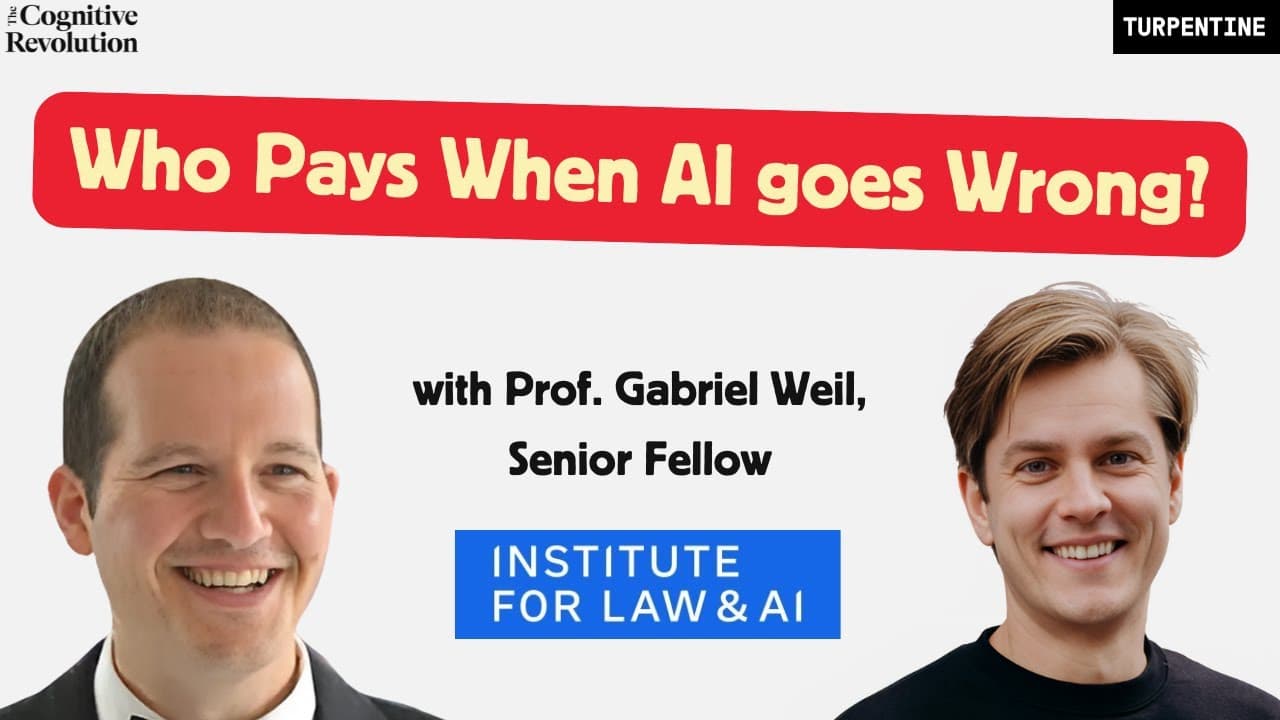
Hello and welcome back to the cognitive revolution. Today we're continuing our short series on creative AI governance proposals with Gabriel While, assistant professor of law at Turo University and senior fellow at the Institute for Law and AI, who argues that liability law may be our best tool for shaping the decisions that AI developers make. As ... Read More
Key Insights
- Liability law is potentially the best tool for shaping decisions made by AI developers.
- Negligence, products liability, and 'abnormally dangerous activities' doctrines could apply to AI.
- Liability risk scales with the risks companies take, incentivizing safer AI development.
- Unlike new legislation, liability law is well-established and adaptable to new technologies.
- Punitive damages could hold companies accountable for risks they create, not just actual harm.
- Concrete scenarios like voice cloning and coding agents highlight the complexities of AI liability.
- Responsibility should be shared among model developers, application developers, and end users.
- The approach aims to balance AI's societal benefits with the need to mitigate potential harms.
Install to Summarize YouTube Videos and Get Transcripts
Explore YouTube Video Summarizer or Get YouTube Transcript Extractor
Questions & Answers
Q: How can liability law help govern AI development?
Liability law can help govern AI development by holding developers accountable for the risks their systems pose. By applying doctrines like negligence and products liability, liability law naturally scales with the dangers AI systems create, incentivizing developers to consider third-party impacts. This approach can adapt to new technologies without requiring new legislation, offering a viable framework for responsible AI governance.
Q: What are the key legal frameworks discussed for AI liability?
The key legal frameworks discussed for AI liability include negligence, products liability, and the doctrine of abnormally dangerous activities. Negligence involves proving a breach of duty that causes harm, while products liability focuses on defects in products. The abnormally dangerous activities doctrine holds entities accountable for inherently risky activities, regardless of care exercised. These frameworks could apply to AI to manage development risks.
Q: How does liability risk scale with AI development risks?
Liability risk scales with AI development risks by aligning the potential legal consequences with the magnitude of the risks AI systems pose. If an AI system is deemed safe, liability risks are minimal. However, as the risks increase, so do the potential legal repercussions, encouraging developers to take greater precautions. This scaling effect incentivizes AI companies to thoroughly assess and mitigate risks associated with their technologies.
Q: What role do punitive damages play in AI liability?
Punitive damages play a role in AI liability by holding companies accountable not only for actual harms but also for the potential risks they irresponsibly create. By imposing financial penalties for near-miss incidents that could have been catastrophic, punitive damages incentivize companies to internalize the risks they take. This mechanism aims to deter reckless behavior and promote safer AI development practices.
Q: How can responsibility for AI harms be shared among stakeholders?
Responsibility for AI harms can be shared among stakeholders by considering the roles of model developers, application developers, and end users. Liability frameworks can allocate accountability based on each party's contribution to the risk. For instance, if a model's design flaw leads to harm, the developer may be liable. Similarly, application developers and end users might share responsibility if their actions contribute to misuse or harm.
Q: What are some concrete scenarios illustrating AI liability complexities?
Concrete scenarios illustrating AI liability complexities include the Character AI case, where an AI's interaction contributed to a user's harm, and voice cloning risks, where AI-generated voices could be misused for fraud. Another example involves coding agents that might overwhelm systems or hack critical infrastructure. These scenarios highlight the need for clear liability frameworks to determine responsibility and incentivize safer AI practices.
Q: Why might liability law be preferable to new AI-specific legislation?
Liability law might be preferable to new AI-specific legislation because it leverages established legal principles that can adapt to new technologies. Unlike new legislation, which can be slow and contentious to implement, liability law offers a flexible framework that naturally scales with the risks AI systems pose. This approach allows for timely governance while balancing the need to realize AI's societal benefits with mitigating potential harms.
Q: What challenges exist in applying liability law to AI development?
Challenges in applying liability law to AI development include determining foreseeability of harms, attributing responsibility among multiple stakeholders, and assessing punitive damages for near-miss incidents. Additionally, the rapid pace of AI advancements and the complexity of AI systems can complicate the application of traditional legal frameworks, requiring careful consideration to ensure liability laws effectively incentivize safer AI practices without stifling innovation.
Summary & Key Takeaways
-
Liability law could govern AI development by adapting existing legal frameworks like negligence and products liability to new technologies. This approach naturally scales with the risks AI systems pose, encouraging developers to consider third-party impacts. Using centuries-old principles might offer a viable way to ensure responsible AI governance without new legislation.
-
Professor Gabriel Weil suggests using punitive damages to hold AI companies accountable not only for actual harms but also for the potential risks they irresponsibly create. The conversation explores various scenarios, such as the Character AI case and voice cloning, to illustrate how liability could incentivize safer AI practices.
-
The episode discusses how responsibility for AI harms should be shared among model developers, application developers, and end users. By leveraging liability law, the approach seeks to balance the societal benefits of AI with the need to mitigate significant risks, offering a promising alternative to traditional regulatory measures.
Read in Other Languages (beta)
Share This Summary 📚
Summarize YouTube Videos and Get Video Transcripts with 1-Click
Try YouTube Summary with ChatGPT & Claude or YouTube Transcript Generator
Explore More Summaries from Cognitive Revolution "How AI Changes Everything" 📚


Summarize YouTube Videos and Get Video Transcripts with 1-Click
Try YouTube Summary with ChatGPT & Claude or YouTube Transcript Generator