Standard Deviation and Coefficient of Variation
TL;DR
Coefficient of Variation (CV) is a unitless measure that compares the standard deviation to the mean of a data set, commonly used to compare different data sets.
Transcript
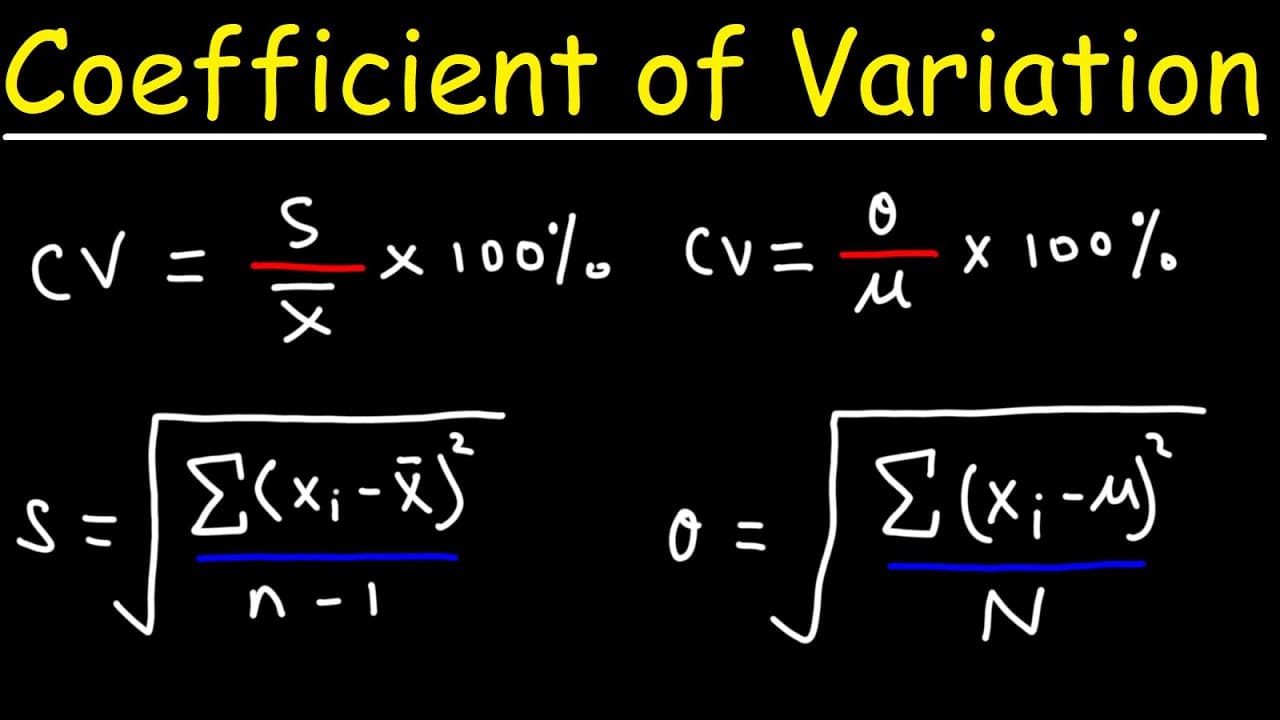
let's talk about the coefficient of variation in order to calculate it for a sample the coefficient of variation is going to equal the sample standard deviation divided by the sample mean times 100% for a population the coefficient of variation is going to equal the population standard deviation / the population mean time 100% if you want to expres... Read More
Key Insights
- 🥳 The coefficient of variation compares the dispersion of data sets by considering the ratio of the standard deviation to the mean.
- 😫 It is commonly used when comparing data sets with different units since it is a unitless measure.
- 😥 The formula for calculating the sample and population standard deviation is similar, involving squared differences between data points and the mean.
- 😘 Coefficient of variation can help identify data sets with higher or lower variability.
- 📪 A lower coefficient of variation indicates that the data points are closer to the mean, while a higher coefficient of variation suggests greater dispersion.
- 🏑 Coefficient of variation is particularly useful in fields like finance, biology, and economics when comparing data from different sources or categories.
- ❓ It provides insights into the consistency and variability of data.
Install to Summarize YouTube Videos and Get Transcripts
Explore YouTube Video Summarizer or Get YouTube Transcript Extractor
Questions & Answers
Q: What is the coefficient of variation and why is it useful?
The coefficient of variation (CV) is a ratio between the standard deviation and the mean, indicating the dispersion of data. It is useful because it allows comparing different data sets by canceling out units, providing a unitless measure.
Q: How do you calculate the coefficient of variation for a sample?
To calculate the coefficient of variation for a sample, divide the sample standard deviation by the sample mean. Then multiply the result by 100% to express it as a percentage.
Q: Can you calculate the coefficient of variation for a population?
Yes, the population coefficient of variation is calculated by dividing the population standard deviation by the population mean. Again, multiply by 100% if you want to express it as a percentage.
Q: What does a coefficient of variation of 20% mean?
A coefficient of variation of 20% means that the standard deviation is 20% of the mean. It indicates a relatively high dispersion or variability in the data.
Summary & Key Takeaways
-
The coefficient of variation is the ratio of the standard deviation to the mean, used to measure the dispersion of data and compare different data sets.
-
CV is calculated as the sample standard deviation divided by the sample mean, or the population standard deviation divided by the population mean, multiplied by 100%.
-
It is a unitless measure, making it useful for comparing data sets, and can be expressed as a percentage.
Read in Other Languages (beta)
Share This Summary 📚
Summarize YouTube Videos and Get Video Transcripts with 1-Click
Try YouTube Summary with ChatGPT & Claude or YouTube Transcript Generator
Explore More Summaries from The Organic Chemistry Tutor 📚



Summarize YouTube Videos and Get Video Transcripts with 1-Click
Try YouTube Summary with ChatGPT & Claude or YouTube Transcript Generator