Optics: Real and Apparent Depth
TL;DR
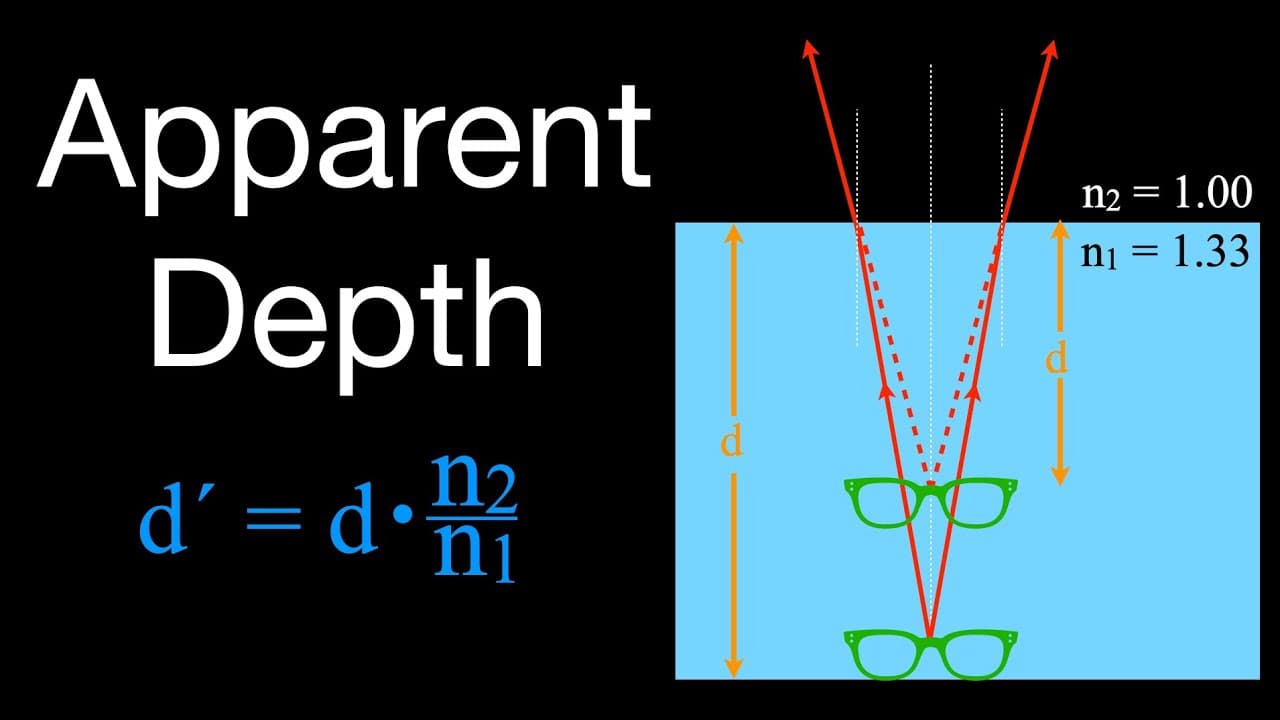
Light refraction creates an apparent depth, affecting how objects appear underwater.
Transcript
in today's video we're going to be going over a parent and actual depth now before you start please don't forget to subscribe to our Channel step by step science please support our Channel Please Subscribe click the notifications Bell leave us nice possible comment give us a thumbs up and don't forget to share this video and in addition to that we ... Read More
Key Insights
- 🙂 Light refraction creates an apparent depth that differs from the actual depth of objects underwater.
- 🫰 Snell's Law can be used to calculate the apparent depth based on the indices of refraction of the materials.
- 💁 Virtual images formed due to apparent depth can affect how objects are perceived underwater.
- 🖐️ Angles of incidence and refraction play a crucial role in determining the apparent depth of objects.
- 🏹 Practical applications, like fishing with a bow and arrow, demonstrate the importance of understanding apparent depth.
- 🙂 Understanding apparent depth enhances our knowledge of how light behaves at material boundaries.
- 🫰 The perceived depth of objects underwater can be influenced by the indices of refraction of the surrounding materials.
Install to Summarize YouTube Videos and Get Transcripts
Explore YouTube Video Summarizer or Get YouTube Transcript Extractor
Questions & Answers
Q: How does light refraction at the air-water boundary create apparent depth?
Light rays bend at the boundary due to differing indices of refraction, creating a virtual image that appears shallower than the actual depth.
Q: How is Snell's Law used to calculate apparent depth?
Snell's Law relates the indices of refraction to the angles of incidence and refraction, allowing the calculation of the apparent depth relative to the actual depth.
Q: Why does the virtual image of an object underwater appear closer to the surface?
Our eyes perceive the light rays as continuing in straight lines, leading us to see the virtual image closer to the surface than the actual object's depth.
Q: How does understanding apparent depth help in practical situations like catfishing with a bow and arrow?
Knowing the difference between apparent and actual depth helps anglers aim accurately below the virtual image to catch fish submerged deeper in the water.
Summary & Key Takeaways
-
Light rays refract at the air-water boundary, creating an apparent depth that differs from the actual depth.
-
Snell's Law is used to calculate the apparent depth based on the indices of refraction of air and water.
-
Examples illustrate how apparent depth affects the perception of objects underwater.
Read in Other Languages (beta)
Share This Summary 📚
Summarize YouTube Videos and Get Video Transcripts with 1-Click
Try YouTube Summary with ChatGPT & Claude or YouTube Transcript Generator
Explore More Summaries from Step by Step Science 📚
Summarize YouTube Videos and Get Video Transcripts with 1-Click
Try YouTube Summary with ChatGPT & Claude or YouTube Transcript Generator