Attention for Neural Networks, Clearly Explained!!!
TL;DR
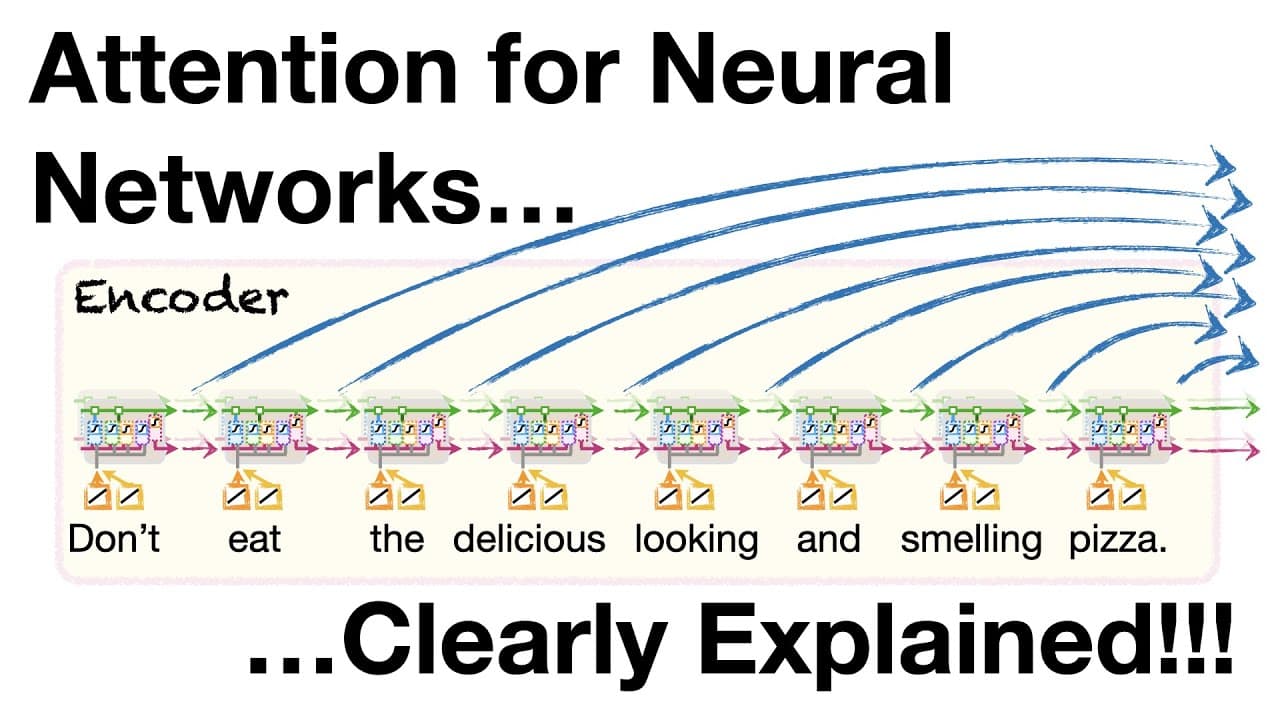
Attention in encoder-decoder models allows each step of the decoder to directly access input values, improving the translation of longer and more complicated sentences.
Transcript
it'll help if you pay attention when we add it to an encoded decoder model hooray stat Quest hello I'm Josh starmer and welcome to statquest today we're going to talk about attention and it's going to be clearly explained light down it makes it easy to start with nothing and then scale it up in the cloud this stat Quest is also brought to you by th... Read More
Key Insights
- 👻 Attention improves the translation of longer and more complicated sentences by allowing each step of the decoder to access individual encodings for each input word.
- 🔑 Similarity scores and the softmax function are used to determine the influence of each input word on the prediction of the next output word.
- 💁 Attention in encoder-decoder models is a stepping stone towards understanding Transformers, which form the basis of large language models like GPT.
- 🫥 The cosine similarity and dot product are two common methods for calculating similarity scores in attention mechanisms.
- 🪜 The addition of attention adds complexity to encoder-decoder models, but it greatly enhances their translation capabilities.
- 💁 The addition of attention provides separate paths for long and short-term memories, improving the model's ability to retain important information.
- ❓ Attention is important for understanding the foundations of Transformers, which are widely used in natural language processing tasks.
Install to Summarize YouTube Videos and Get Transcripts
Explore YouTube Video Summarizer or Get YouTube Transcript Extractor
Questions & Answers
Q: Why does the basic encoder-decoder model struggle with translating longer phrases?
The basic model compresses the entire input sentence into a single context vector, leading to the forgetting of important words. This causes the translation to lose its intended meaning.
Q: How does attention help improve translation in encoder-decoder models?
Attention adds additional paths from the encoder to the decoder, allowing each step of the decoder to directly access input values. This ensures that important words are remembered and considered during translation.
Q: What is the role of similarity scores in attention?
Similarity scores determine how similar the outputs from the encoder and decoder lstms are at each step. These scores help determine the influence of each input word on the decoder's output.
Q: Do we still need lstms once attention is added?
No, lstms are not necessary once attention is implemented. Attention allows for direct access to input values, making lstms redundant in this context.
Key Insights:
- Attention improves the translation of longer and more complicated sentences by allowing each step of the decoder to access individual encodings for each input word.
- Similarity scores and the softmax function are used to determine the influence of each input word on the prediction of the next output word.
- Attention in encoder-decoder models is a stepping stone towards understanding Transformers, which form the basis of large language models like GPT.
- The cosine similarity and dot product are two common methods for calculating similarity scores in attention mechanisms.
- The addition of attention adds complexity to encoder-decoder models, but it greatly enhances their translation capabilities.
- The addition of attention provides separate paths for long and short-term memories, improving the model's ability to retain important information.
- Attention is important for understanding the foundations of Transformers, which are widely used in natural language processing tasks.
- The incorporation of attention in encoder-decoder models is just one approach, and different manuscripts may have slightly different methods for implementing attention.
Summary & Key Takeaways
-
In a basic encoder-decoder model, longer phrases can be problematic as the model compresses the entire input sentence into a single context vector, leading to the forgetting of important words.
-
Attention solves this issue by adding additional paths from the encoder to the decoder, allowing each step of the decoder to access input values directly.
-
The addition of attention improves the translation of longer phrases and sets the foundation for understanding Transformers.
Read in Other Languages (beta)
Share This Summary 📚
Summarize YouTube Videos and Get Video Transcripts with 1-Click
Try YouTube Summary with ChatGPT & Claude or YouTube Transcript Generator
Explore More Summaries from StatQuest with Josh Starmer 📚

Summarize YouTube Videos and Get Video Transcripts with 1-Click
Try YouTube Summary with ChatGPT & Claude or YouTube Transcript Generator