How To Find The Domain of a Composite Function | Precalculus
TL;DR
Learn how to determine the domain of a composite function by analyzing the individual functions and their restrictions.
Transcript
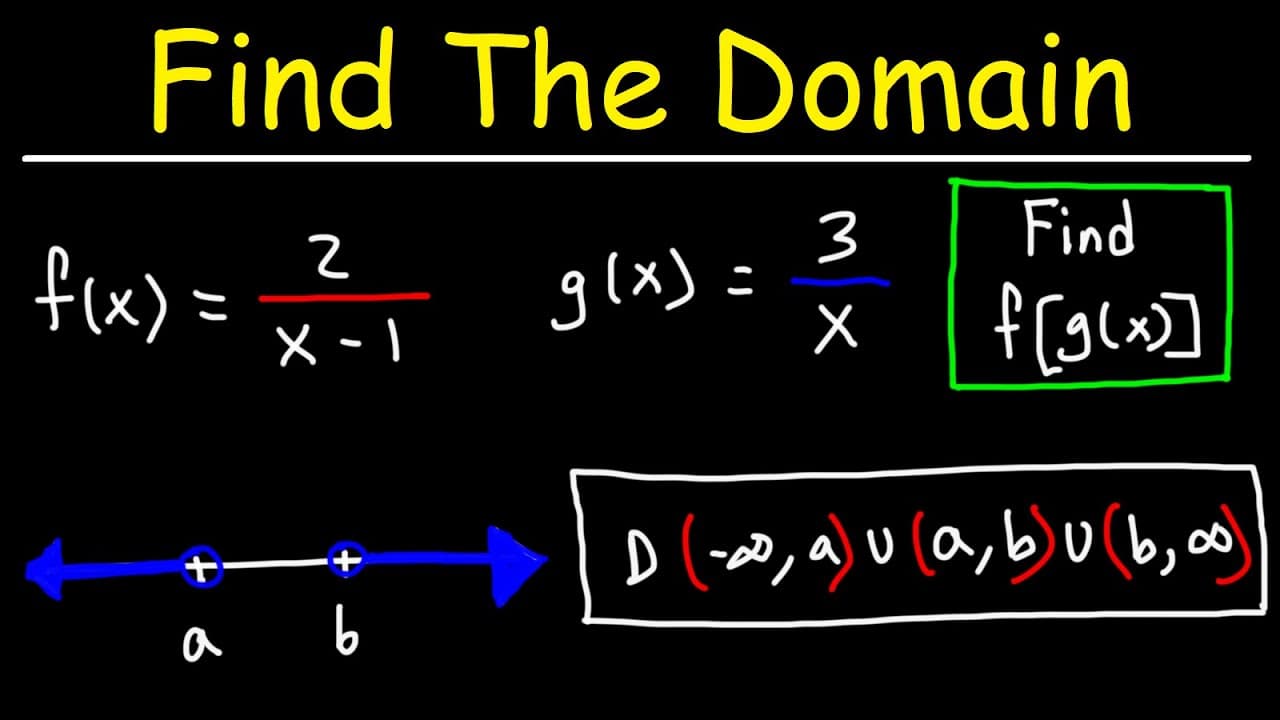
in this video we're going to talk about how to find the domain of a composite function so let's say that f of x is 4 divided by X Plus 2. and we're going to say G of X this is also going to be a rational function let's say G of X is 1 over X so with this information go ahead and find the composite function f of G of x and determine the domain right... Read More
Key Insights
- 💠 The domain of a composite function depends on the restrictions of the inside function.
- ❓ A composite function can have different domain restrictions compared to the individual functions.
- 🫚 When dealing with square roots, the value inside the square root must be greater than or equal to zero.
- ➗ Multiplying or dividing the inequality by a negative number requires reversing the inequality sign.
- 😑 The domain of a composite function is expressed by combining the restrictions from all involved functions.
Install to Summarize YouTube Videos and Get Transcripts
Explore YouTube Video Summarizer or Get YouTube Transcript Extractor
Questions & Answers
Q: How do you find the domain of a composite function?
To find the domain of a composite function, analyze the restrictions of the individual functions involved, and determine which values of x are not allowed. These restrictions carry over to the composite function.
Q: Can the domain of a composite function be different from the individual functions?
Yes, the domain of a composite function can differ from the individual functions. Certain x values might be restricted in one function but allowed in the composite function if they produce valid outputs based on the composition.
Q: What happens if a value is not in the domain of the inside function in a composite function?
If a value is not in the domain of the inside function, it cannot be in the domain of the composite function. The restriction carries over, and that particular value of x will not produce a valid output for the composite function.
Q: How is the domain of a composite function expressed in interval notation?
The domain is expressed in interval notation by listing the intervals or ranges of x values that are allowed. The notation uses parentheses for excluding limit points and brackets for including them.
Summary & Key Takeaways
-
Two rational functions, f(x) and g(x), are given, and the domain of each function is analyzed separately.
-
The composite function, f(g(x)), is formed by substituting g(x) into f(x), and its domain is determined based on the restrictions of g(x).
-
The process of finding the domain of a composite function is demonstrated through examples.
-
The domain is expressed in interval notation, showing the possible values for x.
Read in Other Languages (beta)
Share This Summary 📚
Summarize YouTube Videos and Get Video Transcripts with 1-Click
Try YouTube Summary with ChatGPT & Claude or YouTube Transcript Generator
Explore More Summaries from The Organic Chemistry Tutor 📚


Summarize YouTube Videos and Get Video Transcripts with 1-Click
Try YouTube Summary with ChatGPT & Claude or YouTube Transcript Generator