How Do RC Circuits Charge and Discharge Capacitors?
TL;DR
In RC circuits, capacitors charge by allowing current to flow from the battery through a resistor, reaching a steady voltage after several time constants. They can discharge by gradually losing voltage back to zero once the circuit is closed. Typically, about five time constants are needed for complete charging or discharging.
Transcript
in this video we're going to talk about capacitors particularly when they're charging and discharging so let's say if we have an rc circuit that is a circuit containing a capacitor with a resistor and we're going to have an open switch initially let's say that the voltage of the battery is 12 volts this is the resistor r and here we have the capaci... Read More
Key Insights
- 🔋 Capacitors in an RC circuit can be charged and discharged by connecting them to a battery through a resistor.
- ⚡ The voltage of a capacitor gradually increases during the charging process, reaching the battery voltage when fully charged.
- 🐎 The time constant, calculated as the product of resistance and capacitance, determines the speed of charging or discharging.
- ⚡ The voltage across the resistor is zero when the capacitor is fully charged and increases to the battery voltage when discharging.
- ⌛ The voltage of a capacitor can be calculated at any time during charging or discharging using appropriate equations.
- 🥡 It takes about 5 time constants for a capacitor to be fully charged or discharged.
- 🈂️ The percentage of charge remaining in a capacitor can be calculated using the exponential decay equation.
Install to Summarize YouTube Videos and Get Transcripts
Explore YouTube Video Summarizer or Get YouTube Transcript Extractor
Questions & Answers
Q: What happens when a capacitor is fully charged?
When a capacitor is fully charged, no current flows through it, and the voltage across the resistor becomes zero.
Q: How does the time constant affect capacitor charging?
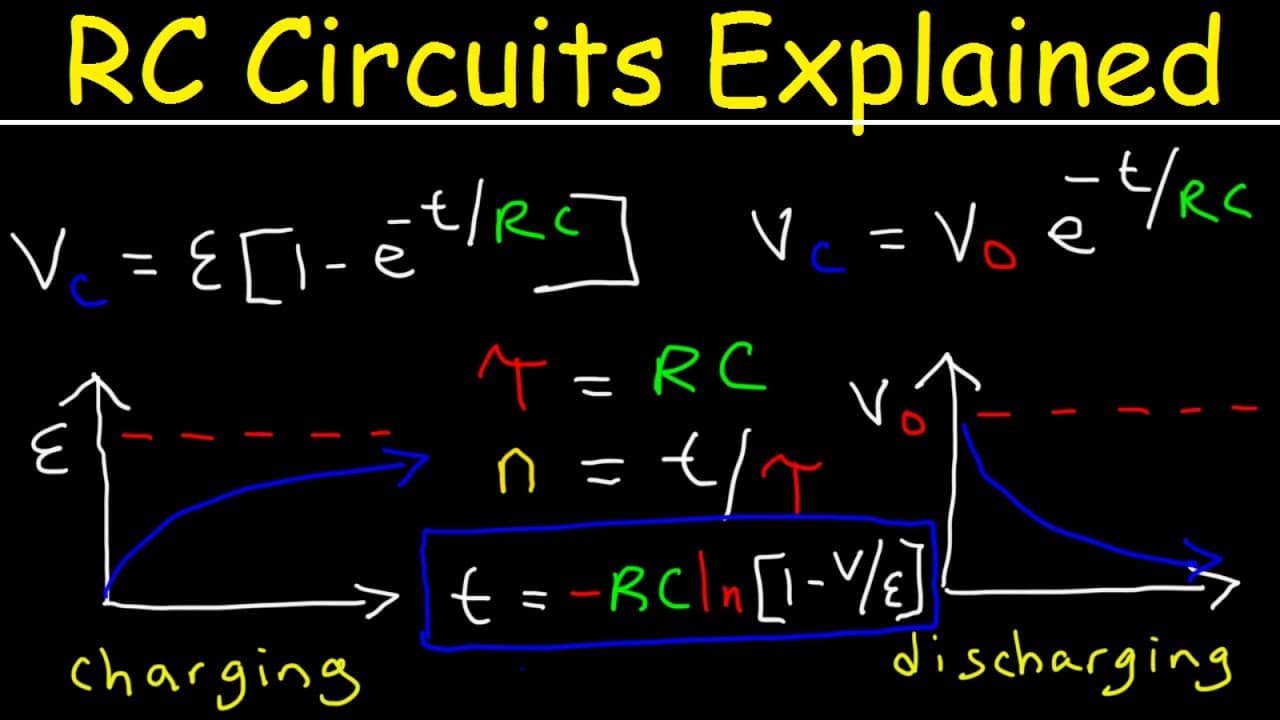
The time constant, determined by the product of resistance and capacitance, affects the speed at which the capacitor charges. A larger time constant leads to slower charging.
Q: How can we calculate the voltage of a capacitor at a specific time during charging?
The equation V = EMF × (1 - e^(-t/RC)) can be used, where V is the voltage of the capacitor, EMF is the battery voltage, t is time, R is resistance, and C is capacitance.
Q: How long does it take for a capacitor to reach 90% of its maximum charge?
The time it takes for a capacitor to reach 90% of its maximum charge can be calculated using the equation t = -RC × ln(1 - V/EMF).
Summary & Key Takeaways
-
Capacitors in an RC circuit can be charged and discharged by connecting them to a battery through a resistor.
-
When a capacitor is charging, current flows from the positive terminal of the battery to the capacitor, gradually increasing its voltage.
-
Once the capacitor is fully charged, no current flows, and the voltage across the resistor becomes zero.
-
When discharging, the capacitor gradually loses voltage until it reaches zero, following an exponential decay curve.
Read in Other Languages (beta)
Share This Summary 📚
Summarize YouTube Videos and Get Video Transcripts with 1-Click
Try YouTube Summary with ChatGPT & Claude or YouTube Transcript Generator
Explore More Summaries from The Organic Chemistry Tutor 📚




Summarize YouTube Videos and Get Video Transcripts with 1-Click
Try YouTube Summary with ChatGPT & Claude or YouTube Transcript Generator