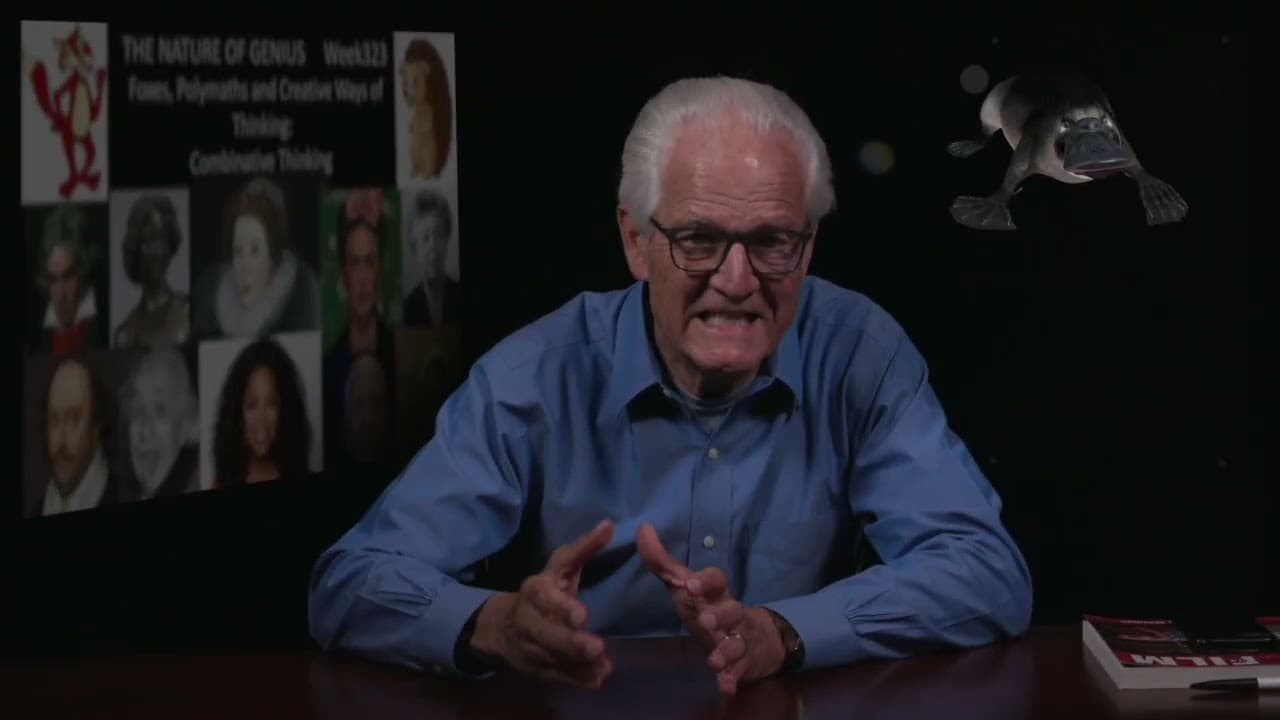
Nature of Genius 323 Combinative Thinking
TL;DR
Combinative thinking, the ability to connect and combine seemingly unrelated ideas, is a key component of creativity and genius.
Transcript
often when I'm out riding in a car or walking with my wife Sherry we'll be talking and she'll say oh what made you think of that well I have to stop and think about that for a moment I have to rewind the sequence of my thoughts back whence they came well I was thinking about this which caused me to think about that which I associated with that and ... Read More
Key Insights
- 🤔 Associative thinking, also known as divergent thinking, is essential for creative and innovative ideas to emerge.
- 🤔 Combinative thinking allows for the connection and combination of seemingly unrelated ideas, leading to new and unique solutions.
- 🤔 Genius individuals like Mozart, Van Gogh, Picasso, and Steve Jobs demonstrate the power of combinative thinking in their respective fields.
- 🥰 Combinative thinking can be observed in various disciplines, including music, art, technology, and science.
- 🤔 The ability to make metaphors and think analogously is a uniquely human capacity that is closely related to combinative thinking.
- 🤔 Everyday examples of combinative thinking include the inventions of Velcro, Post-it notes, and the Super Soaker.
- 🤔 Combinative thinking has led to significant advancements and innovations throughout history, such as Darwinian evolution, the printing press, and the World Wide Web.
Install to Summarize YouTube Videos and Get Transcripts
Explore YouTube Video Summarizer or Get YouTube Transcript Extractor
Questions & Answers
Q: What is associative thinking and how does it contribute to creativity?
Associative thinking, also known as divergent thinking, is the ability to connect and associate unrelated ideas. It allows for creative leaps and associations to be made, leading to increased creativity and innovative ideas. This type of thinking allows for the exploration of different possibilities and connections, leading to new and unique solutions.
Q: How did Mozart demonstrate combinative thinking in his compositions?
Mozart's ability to freely associate sounds and combine musical ideas demonstrated his mastery of combinative thinking. He would riff on sounds or musical ideas, creating variations that were related but slightly different from the original theme. This allowed him to create complex and intricate compositions that showcased his genius.
Q: How did Van Gogh and Picasso use combinative thinking in their artistic styles?
Van Gogh combined the traditions of Western art with the imagery of wool and textile manufacturing, which he was exposed to growing up in Holland. This combination led to his unique and innovative style of art, as seen in his iconic painting, "Starry Night." Picasso combined the flat, geometric shapes of Cezanne's paintings with the African masks he saw at the ethnography museum, creating the first completely Cubist painting, "Les Demoiselles d'Avignon."
Q: How did Steve Jobs view combinative thinking in relation to creativity?
Steve Jobs believed that creativity was simply the act of connecting things. He emphasized the importance of being able to connect experiences and synthesize new ideas, which is a key component of combinative thinking. Jobs used this approach in the development of the iPhone, combining various functionalities and features to create a revolutionary device.
Summary & Key Takeaways
-
Associative thinking, also known as divergent thinking, allows for creative connections and associations to be made, leading to increased creativity.
-
Mozart's ability to freely associate sounds and combine musical ideas showcases the power of combinative thinking in music.
-
Combinative genius can be observed in the works of artists like Van Gogh and Picasso, who combined different elements and artistic styles to create innovative and groundbreaking art.
Read in Other Languages (beta)
Share This Summary 📚
Summarize YouTube Videos and Get Video Transcripts with 1-Click
Try YouTube Summary with ChatGPT & Claude or YouTube Transcript Generator
Explore More Summaries from YaleCourses 📚

Summarize YouTube Videos and Get Video Transcripts with 1-Click
Try YouTube Summary with ChatGPT & Claude or YouTube Transcript Generator