How to Solve Nonhomogeneous Second Order Differential Equations
TL;DR
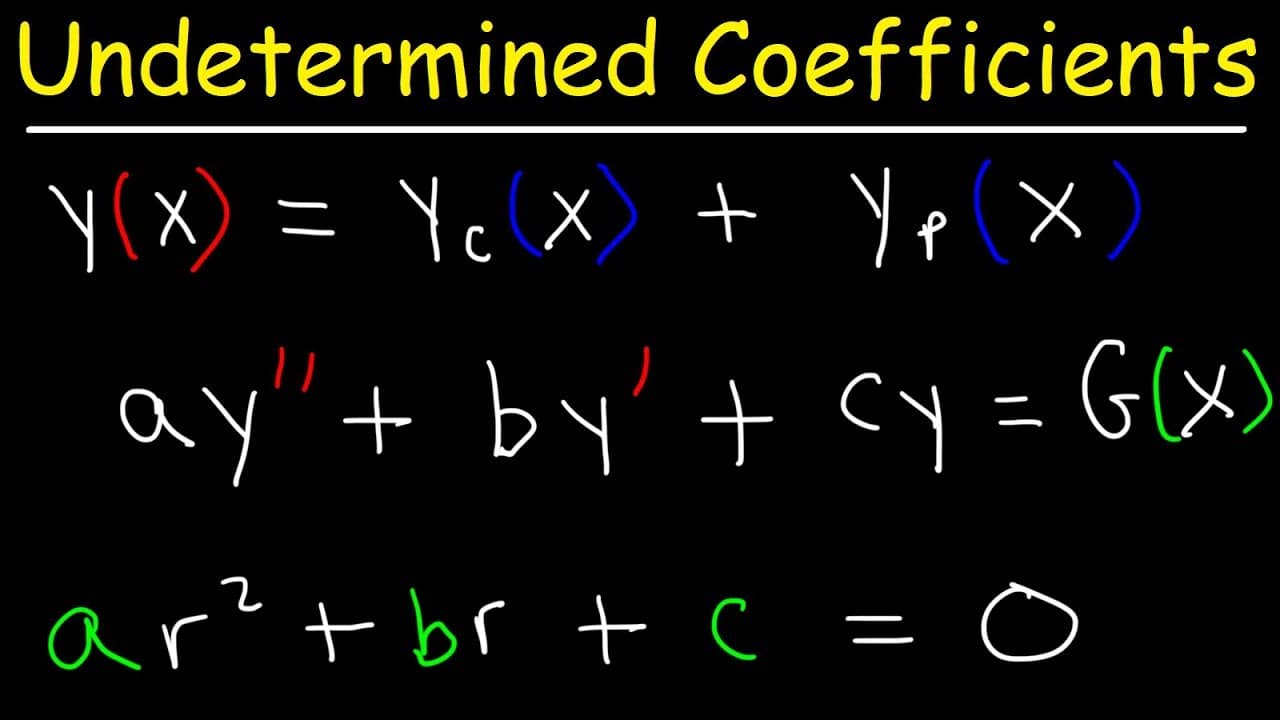
To solve a nonhomogeneous second order differential equation, use the formula y(x) = yp(x) + yc(x), where yp is the particular solution and yc is the general solution of the corresponding homogeneous equation. The homogeneous part is solved using the auxiliary equation, while the particular solution can often be found by guessing a form based on the nonhomogeneous term.
Transcript
in this video we're going to talk about how to solve second order homogeneous differential equations using the method of undetermined coefficients so the example problem that we're going to work on is this one y double prime plus five y prime plus six y is equal let's fix that y is equal to x squared now this particular equation is a homogeneous di... Read More
Key Insights
- 🚱 The general solution to a non-homogeneous linear differential equation consists of the particular solution and the general solution of the homogeneous differential equation.
- 🚱 The undetermined coefficients method is used to find the particular solution of the non-homogeneous part.
- 🫚 The auxiliary equation is solved to find the roots, which determine the general solution of the homogeneous differential equation.
- 🪈 The general solution to a non-homogeneous second order linear differential equation is given by y(x) = yp(x) + yc(x), where yp(x) is the particular solution and yc(x) is the general solution of the homogeneous part.
Install to Summarize YouTube Videos and Get Transcripts
Explore YouTube Video Summarizer or Get YouTube Transcript Extractor
Questions & Answers
Q: What is the general solution to a non-homogeneous second order linear differential equation?
The general solution to a non-homogeneous second order linear differential equation is given by y(x) = yp(x) + yc(x), where yp(x) is the particular solution of the non-homogeneous part and yc(x) is the general solution of the homogeneous part.
Q: How do you find the particular solution of a non-homogeneous differential equation?
The particular solution of a non-homogeneous differential equation can be found by guessing a solution of the form of the forcing function. For example, if g(x) = x^2, a possible particular solution is yp(x) = ax^2 + bx + c.
Q: What is the homogeneous differential equation?
The homogeneous differential equation is in the form ay'' + by' + cy = 0, where a, b, and c are constants. It represents the differential equation without the non-homogeneous part.
Q: How do you solve the homogeneous differential equation?
To solve the homogeneous differential equation, you need to find the roots of the auxiliary equation, which is obtained by substituting y(x) = e^(r*x) into the homogeneous equation. The roots of the auxiliary equation will determine the general solution.
Summary & Key Takeaways
-
To find the general solution to a non-homogeneous differential equation, we need to use the formula y(x) = yp(x) + yc(x), where yp(x) represents the particular solution of the non-homogeneous part and yc(x) represents the general solution of the homogeneous differential equation.
-
The homogeneous differential equation is in the form ay'' + by' + cy = 0, where a, b, and c are constants.
-
The particular solution of the non-homogeneous differential equation can be found by guessing a solution of the form of the forcing function, i.e., yp(x) = ax^2 + bx + c for g(x) = x^2.
Read in Other Languages (beta)
Share This Summary 📚
Summarize YouTube Videos and Get Video Transcripts with 1-Click
Try YouTube Summary with ChatGPT & Claude or YouTube Transcript Generator
Explore More Summaries from The Organic Chemistry Tutor 📚

Summarize YouTube Videos and Get Video Transcripts with 1-Click
Try YouTube Summary with ChatGPT & Claude or YouTube Transcript Generator