The Map of Chemistry
TL;DR
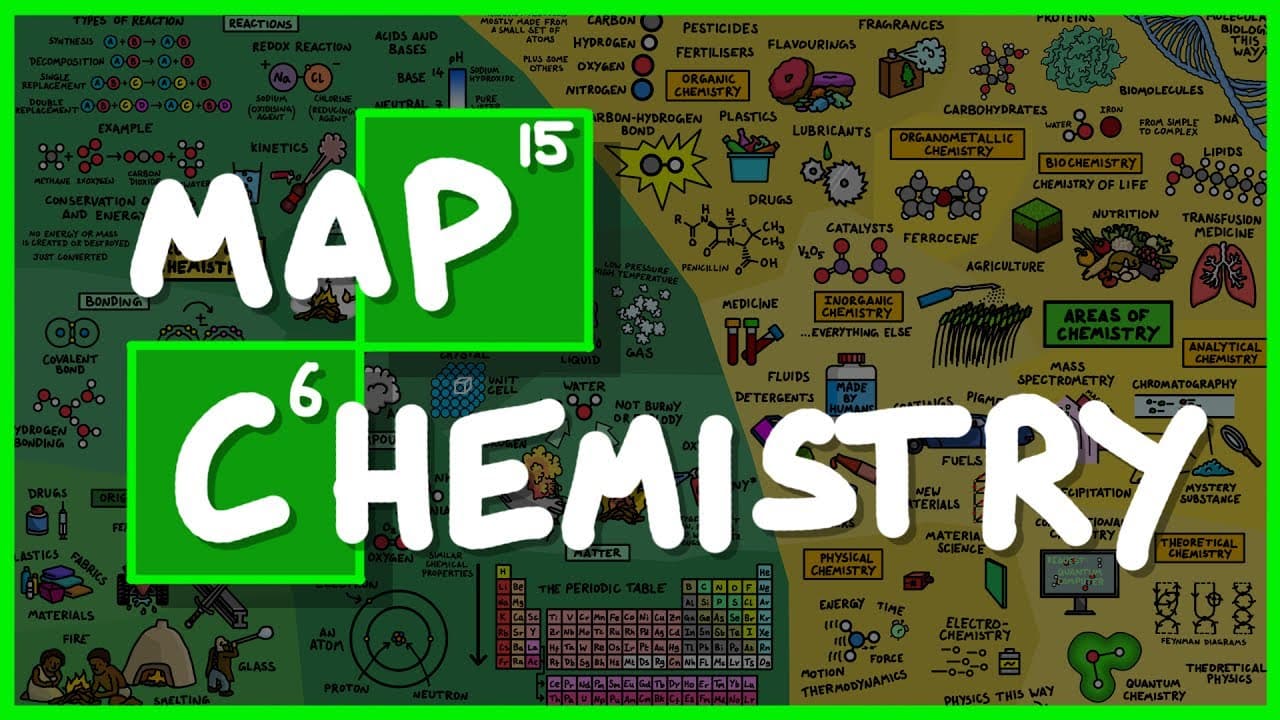
Chemistry is a complex subject that studies matter, from atoms to molecules, and explores how these substances interact. It encompasses various fields such as theoretical chemistry, physical chemistry, analytical chemistry, inorganic chemistry, organic chemistry, and biochemistry.
Transcript
The Universe is made of matter. 98% of this matter (ignoring the dark matter) is pure Hydrogen and Helium, but thankfully billions of years ago supergiant stars fused the hydrogen and helium into all the other elements and then exploded them all over the Universe and that’s where chemistry came from. These elements grouped together into a vast arra... Read More
Key Insights
- 🧡 Chemistry covers a broad range of topics, from the behavior of atoms to the study of complex biomolecules.
- ❓ Theoretical chemistry and quantum chemistry utilize mathematical methods and computational simulations to understand chemical systems.
- ❓ Physical chemistry focuses on the physics of chemical systems, including energy, motion, and quantum properties.
- ❓ Analytical chemistry employs various techniques to identify and measure the composition of substances.
- 👶 Inorganic chemistry explores non-living substances, contributing to fields like materials science and the development of new chemicals.
- ⚾ Organic chemistry investigates the structure and properties of carbon-based compounds, with applications in industry, consumer products, and pharmaceuticals.
- ❓ Biochemistry studies the chemistry of living organisms, including biomolecules like carbohydrates, lipids, proteins, and nucleic acids.
- 👨🔬 Research in biochemistry has had significant impacts on medicine, agriculture, and understanding the functions of vitamins and minerals in the body.
Install to Summarize YouTube Videos and Get Transcripts
Explore YouTube Video Summarizer or Get YouTube Transcript Extractor
Questions & Answers
Q: What is the relationship between atoms and molecules?
Atoms are the building blocks of matter, and when they combine, they form molecules. Molecules can have different properties than their individual atoms.
Q: How does energy influence chemical reactions?
Energy determines when reactions will occur and can be used to speed up or initiate reactions. It also influences the phase of matter (solid, liquid, or gas) that a substance exists in.
Q: What are the different types of chemical reactions?
Chemical reactions can be categorized into oxidation-reduction reactions (transfer of electrons), acid-base reactions (transfer of hydrogen ions), and equilibrium reactions (where the amounts of substances remain constant).
Q: How do analytical chemists determine the composition of a sample?
Analytical chemists use various techniques like spectroscopy and mass spectrometry to probe and measure different properties of materials, helping determine their composition and quantities.
Key Insights:
- Chemistry covers a broad range of topics, from the behavior of atoms to the study of complex biomolecules.
- Theoretical chemistry and quantum chemistry utilize mathematical methods and computational simulations to understand chemical systems.
- Physical chemistry focuses on the physics of chemical systems, including energy, motion, and quantum properties.
- Analytical chemistry employs various techniques to identify and measure the composition of substances.
- Inorganic chemistry explores non-living substances, contributing to fields like materials science and the development of new chemicals.
- Organic chemistry investigates the structure and properties of carbon-based compounds, with applications in industry, consumer products, and pharmaceuticals.
- Biochemistry studies the chemistry of living organisms, including biomolecules like carbohydrates, lipids, proteins, and nucleic acids.
- Research in biochemistry has had significant impacts on medicine, agriculture, and understanding the functions of vitamins and minerals in the body.
Overall, chemistry is a complex and fascinating subject that plays a fundamental role in understanding the physical world and advancing various scientific and technological fields.
Summary & Key Takeaways
-
The universe is composed of matter, with 98% being hydrogen and helium. Chemistry explores the various elements formed through the fusion of these gases.
-
Chemistry delves into the behavior of matter in its different forms, from simple atoms to complex biological molecules like proteins and DNA.
-
Chemistry plays a crucial role in human civilization, as advancements in the field have led to developments in metalworking, manufacturing, and the creation of new materials and drugs.
Read in Other Languages (beta)
Share This Summary 📚
Summarize YouTube Videos and Get Video Transcripts with 1-Click
Try YouTube Summary with ChatGPT & Claude or YouTube Transcript Generator
Explore More Summaries from Domain of Science 📚

Summarize YouTube Videos and Get Video Transcripts with 1-Click
Try YouTube Summary with ChatGPT & Claude or YouTube Transcript Generator