Cosmology Lecture 1
TL;DR
The cosmological principle holds that the universe is both isotropic (the same in every direction) and homogeneous (the same in every place). Isotropy around us implies homogeneity, because otherwise we would have to sit at a special center. On large enough scales, matter is uniformly distributed and gravity is the only force that matters.
Transcript
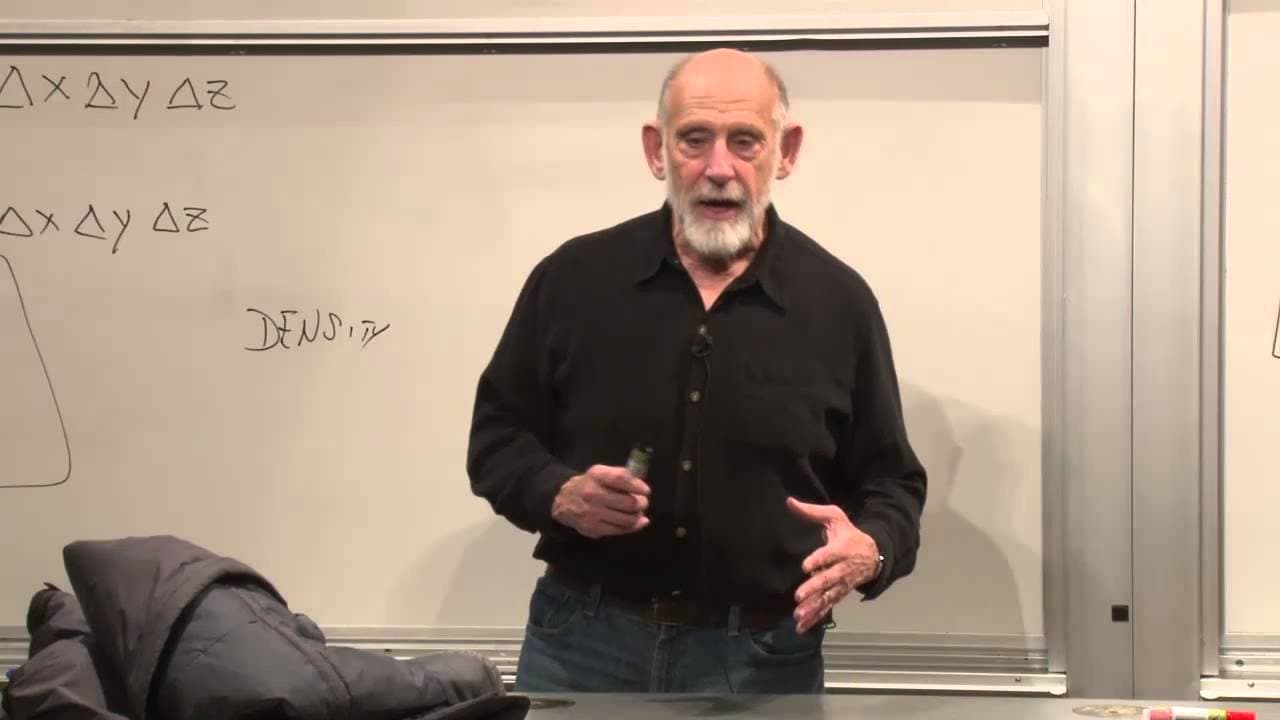
Stanford University okay let's uh let's start this uh this quarter's subject is cosmology cosmology is of course a very old subject uh it uh goes back thousands of years but I'm not going to tell you about thousands of years of cosmology but I say thousands of years I'm talking about the Greeks of course uh but we're not going to go here back thous... Read More
Key Insights
- Modern cosmology is a young science that became precise only after the discovery of the Big Bang and its microwave radiation remnant, roughly during the era when Susskind was a young student, replacing an older naturalist style of classifying strange stars and galaxies.
- The universe is treated as a physical system studied with equations rather than merely observed and catalogued, meaning cosmology now relies on physical principles and accurate mathematics that agree with observation.
- Isotropic means the universe looks the same in every direction once you average over patches of sky and look far enough to escape the foreground of our own galaxy, ignoring the immediate appearance of individual nearby stars.
- Homogeneous means the universe looks the same in every place, so an observer relocated to a very distant region would see essentially the same surroundings that we see from here.
- Isotropy implies homogeneity because the only way to be isotropic without being homogeneous is a shell-like or ringed structure centered on us, which would require us to occupy a special central position we have no reason to assume.
- The cosmological principle is the statement that space is, on average, uniformly filled with matter; it was originally asserted as a principle before observation strongly justified it, and later confirmed by astronomy and the cosmic microwave background.
- Galaxies are electrically neutral but not gravitationally neutral, so on large scales where matter is electrically neutral, Newtonian gravity is the only important force acting on the distribution of matter.
- A static universe seems natural because matter appears balanced on all sides of any point, but this guess is wrong; the expanding universe can be derived with Newtonian physics and did not logically require general relativity.
Install to Summarize YouTube Videos and Get Transcripts
Explore YouTube Video Summarizer or Get YouTube Transcript Extractor
Questions & Answers
Q: What is the cosmological principle?
The cosmological principle is the statement that the universe is homogeneous, meaning space is uniformly filled on average with matter so it looks the same in every place. It follows from the observation that the universe is isotropic, looking the same in every direction. It was first put forward as a principle before observation justified it, then supported by astronomy and confirmed by the cosmic microwave background, which showed the primordial matter distribution was extremely smooth.
Q: What is the difference between isotropic and homogeneous?
Isotropic means the universe looks the same in every direction you look, once you average over patches of sky and look far enough to get past the foreground of our own galaxy. Homogeneous means the universe looks the same in every place, so an observer in a very distant region would see roughly the same surroundings we see. Isotropy is about directions from one vantage point, while homogeneity is about moving to different locations.
Q: Why does isotropy imply the universe is homogeneous?
If the universe looks the same in every direction from where we stand, the only way it could still differ from place to place would be a shell-like or ringed structure centered on us. But if that were true, an observer who moved to a distant location would no longer see an isotropic sky. So unless we happen to sit at a special center of the universe, isotropy forces the distribution of matter to be the same everywhere, which is homogeneity.
Q: When did modern cosmology become a precise science?
Cosmology as a naturalist activity is ancient, going back to the Greeks, but the modern, precise science is new. It really dates to the discovery of the Big Bang, specifically the microwave radiation identified as the remnant of the Big Bang, which occurred during the era when Susskind was a young student. Before that, accuracy was so poor that being precise was extremely difficult, and cosmology resembled classifying and naming curiosities more than physics.
Q: What force governs the large-scale behavior of the universe?
Gravity is the only important force on large scales. Galaxies are electrically neutral, so electrical forces cancel out over big enough regions, but galaxies are not gravitationally neutral and interact through Newtonian gravity. Because matter tends to be electrically neutral at these scales, gravity alone determines whether the distribution of matter pulls together or does something else, which is why cosmological equations focus on gravitational interaction between mass points.
Q: Why is the guess that the universe is static wrong?
It seems natural to guess the universe is static because at any point there is as much matter pulling from one side as from the other, so no net force appears to act and everything should just stay in place. Susskind says this reasoning is wrong. The actual Newtonian equations of cosmology show the universe is not static, and the expanding universe emerges from this analysis rather than everything sitting still.
Q: Did understanding the expanding universe require general relativity?
No. Historically the expanding universe was not understood until after Einstein created the general theory of relativity, but that is only a fact about dates, not about logic. Susskind argues the expanding universe could have been derived with Newtonian physics, and that Newton himself could have done it if he had been a little smarter. The lecture sets out to derive the classical Newtonian equations of cosmology directly.
Q: How do you begin formulating the cosmology problem as physics?
You start with observations, such as the universe being isotropic and homogeneous. Then you follow the standard steps of a physics problem: know your variables and introduce a set of coordinates into the problem. Introducing coordinates means ruling space into a coordinate system across its dimensions. Galaxies can be treated effectively as mass points or particles distributed throughout space, letting you describe the universe as a system studied with equations.
Summary
This video discusses the subject of cosmology, focusing on the history and development of the field. The speaker explains that cosmology as a science is relatively new, and it wasn't until the discovery of the big bang and the cosmic microwave background that it became a more precise and mathematical discipline. The video also covers the concepts of isotropy and homogeneity in the universe, and how these ideas form the basis for understanding cosmological principles. The speaker then introduces the Hubble Constant and explains how it relates to the expansion of the universe. Finally, the video delves into Newtonian mechanics and the equation of motion for the scale factor of the universe.
Questions & Answers
Q: Why is cosmology considered a relatively new field?
Cosmology as a science is relatively new because it wasn't until the 20th century that significant discoveries were made, such as the big bang and the cosmic microwave background. These discoveries provided a more precise understanding of the universe and allowed cosmology to become a more mathematical and rigorous discipline.
Q: What is the significance of the big bang and the cosmic microwave background in cosmology?
The discovery of the big bang and the cosmic microwave background provided evidence for the birth and evolution of the universe. The cosmic microwave background is the remnant radiation from the big bang, and studying it has allowed scientists to better understand the early stages of the universe's development.
Q: How has the study of cosmology evolved over time?
In the past, cosmology was more akin to natural sciences, with astronomers observing and classifying various celestial objects. However, with advancements in technology and the development of more accurate equations, cosmology has become a more precise and mathematical science. Physicists and physical chemists have become more involved in understanding the universe as a physical system and studying it mathematically.
Q: What is the significance of isotropy and homogeneity in the universe?
Isotropy refers to the idea that the universe looks the same in every direction, while homogeneity means that it looks the same in every place. The presence of isotropy and homogeneity suggests that the universe is uniform and consistent on large scales. The cosmological principle, which is based on these concepts, allows for the study of the universe as a system using equations and physical principles.
Q: What is the Hubble Constant and why is it important?
The Hubble Constant is the ratio of the velocity of galaxies to their distance from us. It indicates how fast the universe is expanding. The constant is significant because it provides evidence for the expansion of the universe and helps determine its age. Additionally, it is a fundamental parameter in cosmological models and plays a role in understanding the dynamics of the universe.
Q: Can the Hubble Constant be constant or does it change over time?
The Hubble Constant can be time-dependent. It reflects the rate at which the universe is expanding, so if the expansion is accelerating or decelerating, then the Hubble Constant will change over time. In cosmological models, the Hubble Constant is typically a function of time.
Q: How does the density of mass in the universe relate to the scale factor?
The density of mass in the universe can be related to the scale factor by considering the mass per unit volume. If we assume that the density is constant, then the mass is related to the volume of a region. However, as the universe expands or contracts, the scale factor changes. This means that the density of mass also changes with time.
Q: What does the equation of motion for the scale factor tell us about the universe?
The equation of motion for the scale factor relates the acceleration of the scale factor to the density of mass in the universe. It indicates how the expansion or contraction of the universe is influenced by the distribution of mass. The equation shows that a static universe is only possible if it is empty, otherwise, the scale factor will change with time.
Q: Why is the universe not static according to the equation of motion for the scale factor?
The equation of motion for the scale factor shows that a static universe is only possible if there is no mass or density of mass present. If there is mass or density of mass in the universe, then the scale factor will change with time, indicating that the universe cannot be static.
Q: What does the equation of motion for the scale factor imply about the expansion or contraction of the universe?
The equation of motion for the scale factor indicates whether the universe is expanding or contracting by the sign of the second time derivative of the scale factor. If the acceleration is positive, it implies expansion, while if it is negative, it implies contraction. The equation helps describe the dynamics of the universe and how it evolves over time.
Takeaways
Cosmology is a relatively new field of study that has evolved over time thanks to the discovery of the big bang and the cosmic microwave background. The concepts of isotropy and homogeneity have allowed us to understand the universe as a system that can be studied using mathematical equations. The Hubble Constant plays a crucial role in determining the expansion rate of the universe. The equation of motion for the scale factor reveals that a static universe is only possible if it is empty. The discovery that the universe is expanding has profound implications for understanding the dynamics and evolution of the cosmos.
Summary & Key Takeaways
-
Cosmology is an ancient subject, but its modern scientific form is recent, dating to the discovery of the Big Bang and its microwave radiation. Earlier it resembled natural history, classifying odd stars and galaxies with poor accuracy rather than modeling the universe mathematically.
-
The starting observation is that the universe is isotropic, looking the same in every direction once you average over the sky and look beyond our own galaxy. From isotropy, unless we occupy a special center, it follows that the universe is also homogeneous, the same everywhere.
-
This uniform distribution of matter is the cosmological principle. Galaxies act like gravitating mass points interacting only through Newtonian gravity. Although matter appears balanced everywhere suggesting a static universe, this is false, and the expanding universe can be derived using Newtonian equations and coordinates.
Read in Other Languages (beta)
Share This Summary 📚
Summarize YouTube Videos and Get Video Transcripts with 1-Click
Try YouTube Summary with ChatGPT & Claude or YouTube Transcript Generator
Explore More Summaries from Stanford 📚



Summarize YouTube Videos and Get Video Transcripts with 1-Click
Try YouTube Summary with ChatGPT & Claude or YouTube Transcript Generator