What Is XGBoost Regression and How Does It Work?
TL;DR
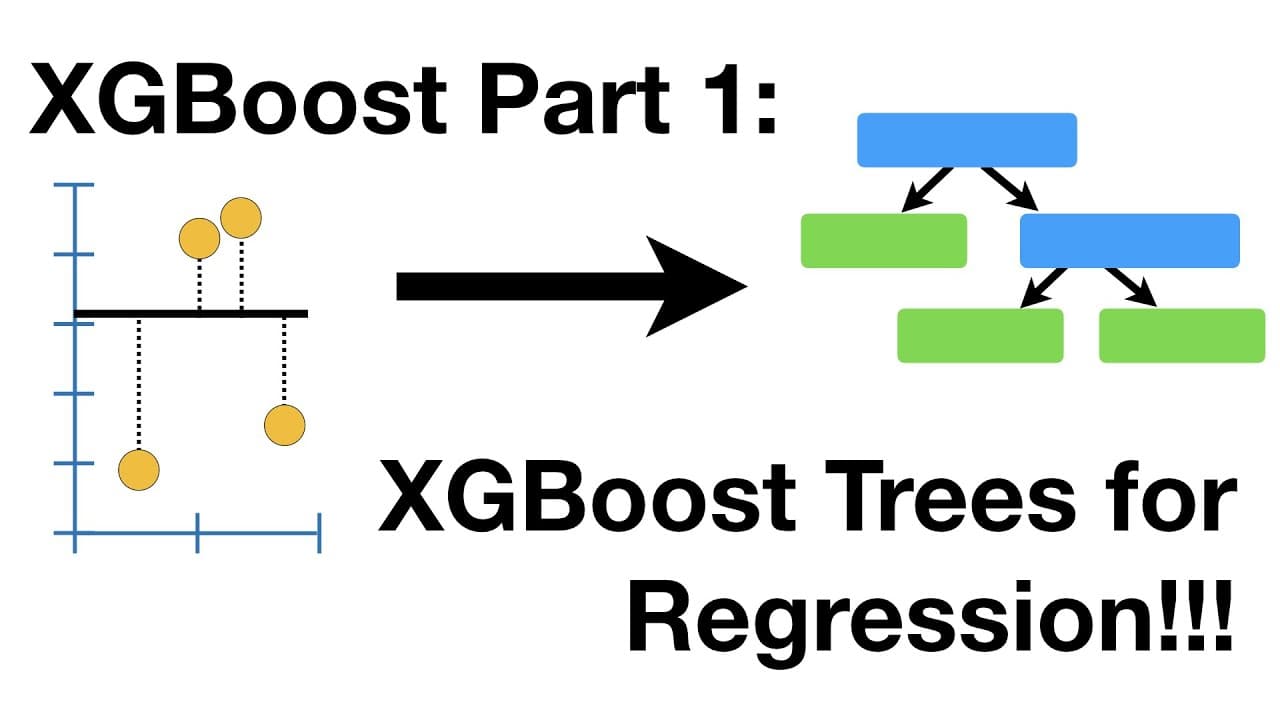
XGBoost regression uses unique trees to enhance predictive power by calculating similarity scores to determine optimal splits and employing pruning based on a user-defined complexity parameter, gamma. Additionally, a regularization parameter, lambda, helps reduce overfitting and influences output values, enabling more nuanced predictions.
Transcript
XG boost its extreme and its gradient boost stat quest hello I'm Josh stormer and welcome to stat quest today we're gonna talk about XG boost part 1 we're gonna talk about XG boost trees and how they're used for regression note this stat quest assumes that you are already familiar with at least the main ideas of how gradient boost does regression a... Read More
Key Insights
- ✊ XG Boost utilizes unique regression trees for enhanced predictive power.
- 💯 The process includes calculating similarity scores, gains, and pruning for optimal tree structure.
- ❓ Lambda as a regularization parameter contributes to balanced predictions and reduced overfitting.
- 🏛️ Building intuition about XG Boost regression is crucial for understanding its complexity.
- ☠️ Tree depth, learning rate, and pruning techniques play vital roles in XG Boost model refinement.
- ⚖️ Balancing complexity parameters like gamma and lambda is essential for accurate predictions.
- 💦 XG Boost's tree-building approach offers nuanced insights into how machine learning algorithms work.
Install to Summarize YouTube Videos and Get Transcripts
Explore YouTube Video Summarizer or Get YouTube Transcript Extractor
Questions & Answers
Q: What is XG Boost and why is it considered extreme in machine learning?
XG Boost is a machine learning algorithm known for its complexity and efficiency, often used with large datasets due to its strong predictive power and unique tree-building approach.
Q: How does XG Boost utilize regression trees and similarity scores for prediction?
XG Boost uses similarity scores to assess residuals, determining how well the data is clustered, leading to the decision to split nodes in the regression tree for better predictions.
Q: Can you explain the process of pruning XG Boost trees and the significance of the complexity parameter gamma?
Pruning XG Boost trees involves comparing gains with the complexity parameter gamma; if the gain surpasses gamma, the branch is retained, ensuring a balanced and accurate tree structure.
Q: How does the regularization parameter lambda impact XG Boost tree building?
Lambda in XG Boost acts as a regularization parameter, reducing overfitting by shrinking similarity scores and output values, leading to more controlled predictions and preventing extreme model fitting.
Summary & Key Takeaways
-
XG Boost is explained, focusing on regression trees for building predictions.
-
Discusses calculating similarity scores, gaining value to split data, and pruning trees based on user-defined complexity parameters.
-
Highlights how lambda as a regularization parameter affects pruning and output values, leading to more nuanced predictions.
Read in Other Languages (beta)
Share This Summary 📚
Summarize YouTube Videos and Get Video Transcripts with 1-Click
Try YouTube Summary with ChatGPT & Claude or YouTube Transcript Generator
Explore More Summaries from StatQuest with Josh Starmer 📚

Summarize YouTube Videos and Get Video Transcripts with 1-Click
Try YouTube Summary with ChatGPT & Claude or YouTube Transcript Generator