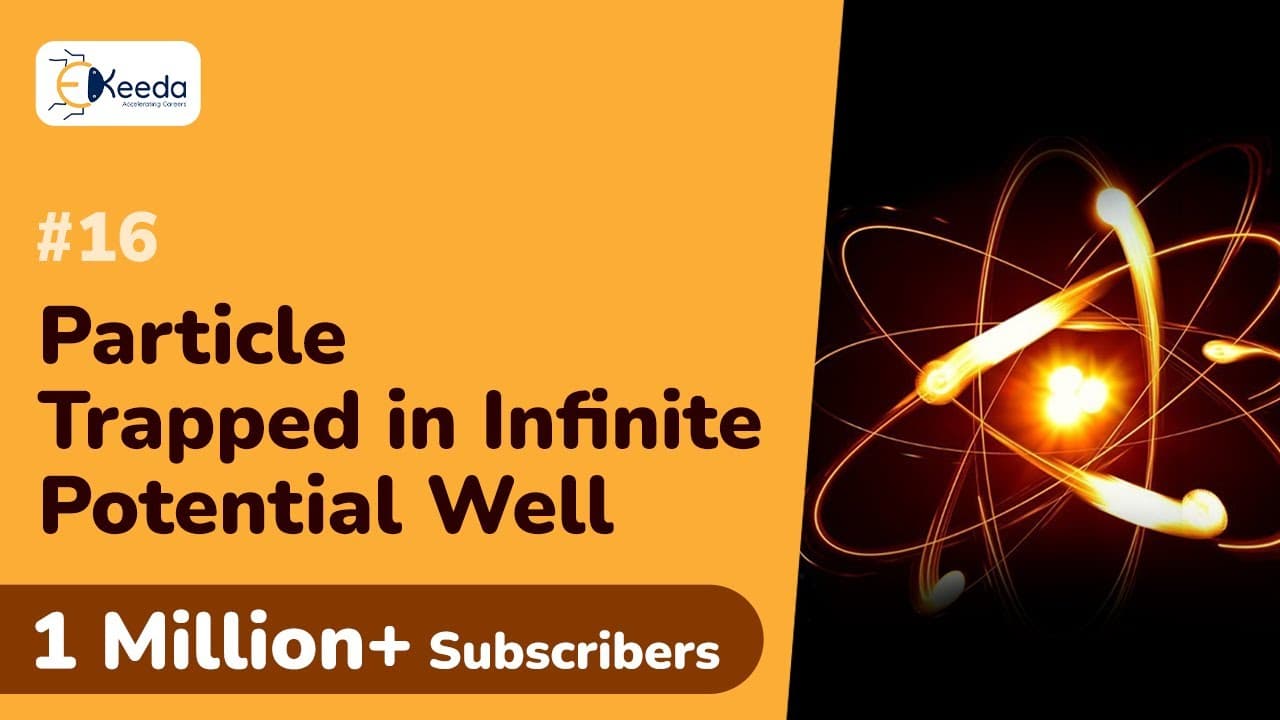
Particle Trapped in Infinite Potential Well - Quantum Physics - Engineering Physics 1
TL;DR
Derivation and application of Schrodinger's wave equation for a particle oscillating within a potential well.
Transcript
hello friends in previous classes we studied about schrodinger's wave equation both time dependent and of course time independent but they were just the mathematical illustrations and mathematical formulaes and now we'll be using those mathematical formulas to prove them in a given practical problem so let's begin well to begin first it is the most... Read More
Key Insights
- 👋 Schrodinger's wave equation is a fundamental equation in quantum mechanics that describes the wave-like behavior of particles.
- 👋 The potential well represents a region where the particle's energy is zero, and the wave function determines the probability of finding the particle within that region.
- 👋 The derivation of Schrodinger's wave equation for a particle in a potential well involves solving the time-independent wave equation and determining quantized energy levels.
- 🎚️ Energy levels are quantized, meaning they are restricted to specific values, demonstrating the discreteness of energy in quantum systems.
- 👋 The probability distribution function, obtained by integrating the squared wave function over a region, provides the likelihood of finding a particle within that region.
- 💥 The concept of perfectly elastic collisions helps explain the behavior of particles striking potential barriers within the potential well.
- 🎚️ Energy levels in the potential well follow a quantized pattern, where higher energy levels are multiples of the lowest energy level.
Install to Summarize YouTube Videos and Get Transcripts
Explore YouTube Video Summarizer or Get YouTube Transcript Extractor
Questions & Answers
Q: How is Schrodinger's wave equation practically applied in particle physics?
Schrodinger's wave equation is used to determine the probabilities of finding particles within specific regions, allowing physicists to study the behavior and interactions of particles in various systems. It provides a mathematical framework for understanding quantum phenomena.
Q: What is the significance of quantization in the energy levels of a particle?
The quantized energy levels imply that the energy of a particle in a potential well is restricted to specific values, represented by the square of integers. This demonstrates that energy is not continuous but rather comes in discrete packets or quanta.
Q: How does the probability distribution function represent the likelihood of finding a particle?
The probability distribution function, obtained by integrating the squared wave function over a given region, allows us to determine the probability of finding a particle within that region. An integral of 1 indicates a 100% chance of finding the particle in the specified region.
Q: Can you explain the concept of a perfectly elastic collision mentioned in the content?
In a perfectly elastic collision, there is no loss of kinetic energy. This means that a particle striking a potential barrier within the potential well will rebound with the same amount of energy it had before the collision, resulting in the particle oscillating within the well without losing energy or coming to rest.
Summary & Key Takeaways
-
The content explains the derivation and practical application of Schrodinger's wave equation in a particle oscillating within a potential well.
-
The potential well represents a region where the particle's energy is zero, and the wave function (psi) determines the probability of finding the particle within that region.
-
The derivation involves solving the time-independent wave equation and determining the quantized energy levels of the particle within the potential well.
-
The probability distribution function is derived by integrating the wave function squared over the region of interest, resulting in a value of 1.
Read in Other Languages (beta)
Share This Summary 📚
Summarize YouTube Videos and Get Video Transcripts with 1-Click
Try YouTube Summary with ChatGPT & Claude or YouTube Transcript Generator
Explore More Summaries from Ekeeda 📚


Summarize YouTube Videos and Get Video Transcripts with 1-Click
Try YouTube Summary with ChatGPT & Claude or YouTube Transcript Generator