Hooke's Law and Elastic Potential Energy
TL;DR
Hooke's Law states that the force required to stretch or compress a spring is directly proportional to the distance of displacement.
Transcript
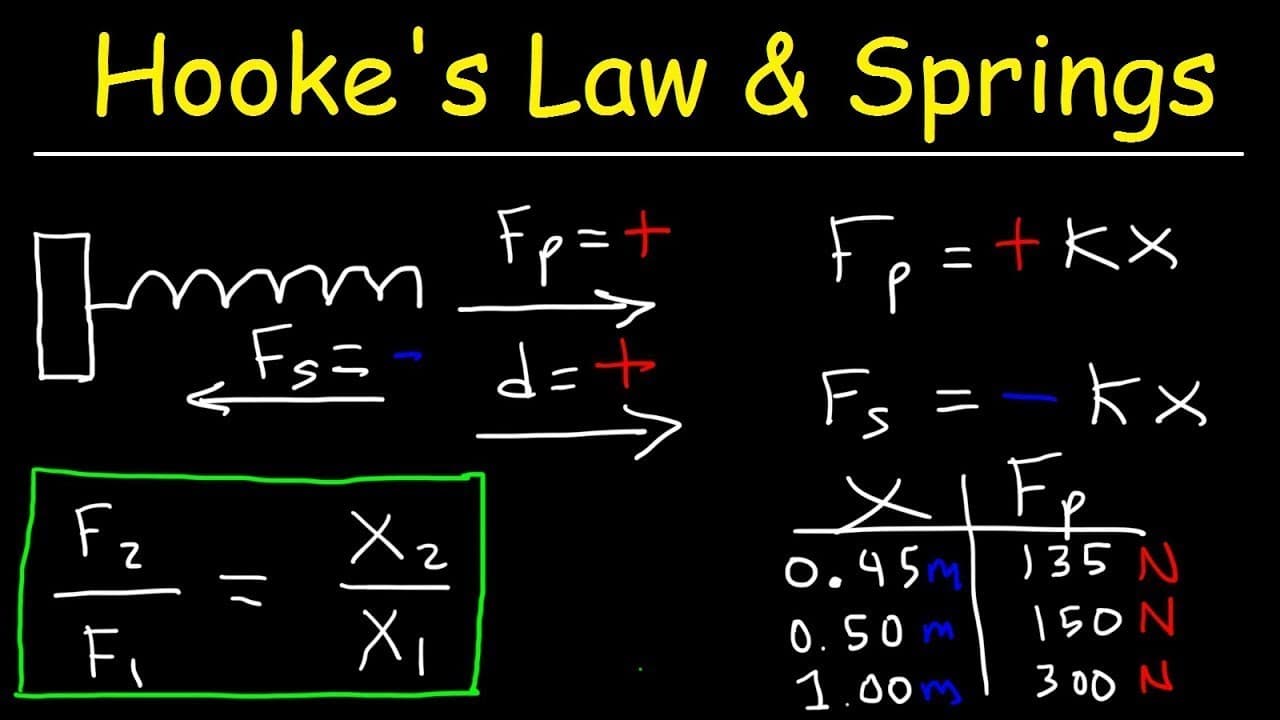
in this video we're going to talk about hooke's law and springs we're also going to go over some problems associated with it so what's the basic idea behind hooke's law so let's say if we have a horizontal spring and so that's the natural left of the horizontal spring now what we're going to do is we're going to apply a force to stretch the spring ... Read More
Key Insights
- 🌸 Hooke's Law states that the force required to stretch or compress a spring is directly proportional to the displacement of the spring.
- 🌸 The restoring force in Hooke's Law ensures that the spring returns to its original length after being stretched or compressed.
- 🌸 The spring constant, k, determines the stiffness of the spring, with a higher value indicating a stiffer spring.
- 🌸 Hooke's Law can be used to calculate the spring constant, as well as the force or displacement of a spring given the other variables.
- 🌸 The work required to stretch or compress a spring is determined by the change in potential energy, which is equal to one-half times the spring constant times the squared displacement.
- 💦 Work is positive when the force and displacement vectors are in the same direction, but negative when they are in opposite directions.
Install to Summarize YouTube Videos and Get Transcripts
Explore YouTube Video Summarizer or Get YouTube Transcript Extractor
Questions & Answers
Q: What is Hooke's Law?
Hooke's Law states that the force required to stretch or compress a spring is directly proportional to the distance of displacement. It can be represented by the equation F = kx, where F is the force applied, k is the spring constant, and x is the displacement.
Q: How is the spring constant related to the stiffness of a spring?
The spring constant, denoted as k, determines how stiff or loose the spring is. A higher spring constant indicates a stiffer spring that requires more force to stretch or compress, while a lower spring constant indicates a looser spring that is easier to manipulate.
Q: What is the significance of the restoring force in Hooke's Law?
The restoring force, denoted as Fs or Fr, is the force that brings the spring back to its original length after it has been stretched or compressed. It is equal in magnitude but opposite in direction to the applied force, ensuring that the spring returns to equilibrium.
Q: How can the spring constant be calculated?
The spring constant, k, can be calculated by dividing the applied force, Fp, by the displacement, x. For example, if a force of 200 newtons stretches the spring by 4 meters, the spring constant would be 50 newtons per meter (k = 200 N / 4 m).
Summary & Key Takeaways
-
Hooke's Law states that the force needed to stretch or compress a spring is proportional to the distance of displacement.
-
The force required to stretch a spring is positive, while the restoring force that brings it back to equilibrium is negative.
-
The spring constant, denoted as k, determines how stiff or loose the spring is.
Read in Other Languages (beta)
Share This Summary 📚
Summarize YouTube Videos and Get Video Transcripts with 1-Click
Try YouTube Summary with ChatGPT & Claude or YouTube Transcript Generator
Explore More Summaries from The Organic Chemistry Tutor 📚


Summarize YouTube Videos and Get Video Transcripts with 1-Click
Try YouTube Summary with ChatGPT & Claude or YouTube Transcript Generator