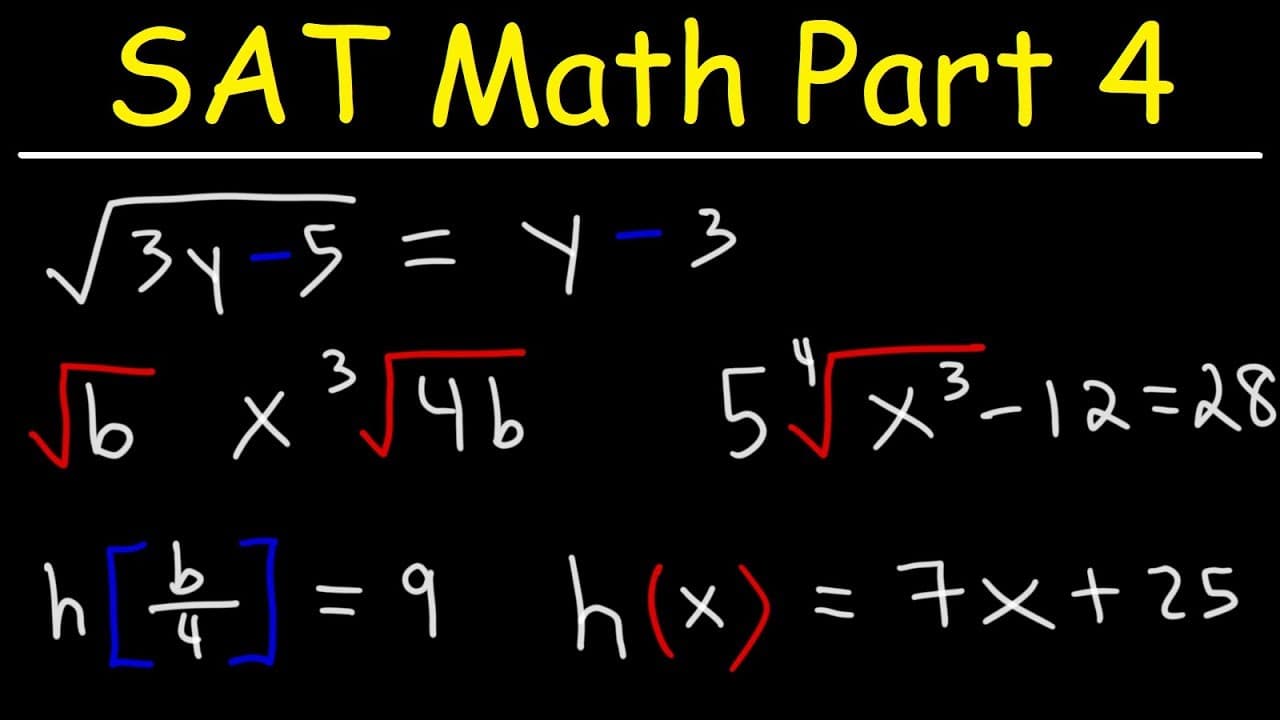
Solving Radical Equations and Plugging In Numbers - SAT Math Part 4
TL;DR
The video explains how to solve equations involving radical expressions and provides step-by-step examples to help understand the process.
Transcript
number 16 according to the equation shown below what is the value of x minus 7 squared so first we need to calculate the value of x and then we can plug it into this expression to get that value so let's begin by adding 12 to both sides 28 plus 12 is 40. now our next step is to divide both sides by five forty divided by five is eight so we have thi... Read More
Key Insights
- 😑 Conversion of radical expressions to fractional exponents makes it easier to simplify and evaluate.
- ❎ Squaring both sides of an equation can help eliminate square roots and solve equations involving radical expressions.
- 😑 Factoring quadratic expressions can help find the solutions to equations involving square roots.
- 🙃 Checking for extraneous solutions is necessary when squaring both sides of an equation.
- ✊ The fractional exponent 4/3 represents the cube root of a number to the fourth power.
- #️⃣ The square root of a number can be calculated by finding the number that, when multiplied by itself, gives the original number.
- 😑 The value of a variable can be found by solving an equation and substituting the solution back into the original expression.
Install to Summarize YouTube Videos and Get Transcripts
Explore YouTube Video Summarizer or Get YouTube Transcript Extractor
Questions & Answers
Q: How do you solve an equation involving a radical expression?
To solve an equation with a radical expression, first isolate the radical term, then square both sides of the equation to eliminate the radical. Solve the resulting equation to find the value of the variable.
Q: How do you simplify a radical expression?
To simplify a radical expression, convert it into a fractional exponent. Evaluate the exponent, simplify any fractions or simplifiable terms, and then convert it back into a radical form if necessary.
Q: What is the process for solving equations involving square roots?
To solve an equation involving a square root, square both sides of the equation to eliminate the square root. Solve the resulting equation and check for extraneous solutions, as squaring both sides may introduce additional solutions.
Q: How do you factor quadratic expressions to find the solutions?
To factor a quadratic expression, find two numbers that multiply to give the constant term and add or subtract to give the coefficient of the linear term. Use the factored form to set each factor equal to zero and solve for the variable.
Summary & Key Takeaways
-
The video demonstrates how to solve an equation involving a radical expression by first finding the value of x and then substituting it back into the expression.
-
It shows how to simplify a radical expression by converting it into a fractional exponent and then evaluating it.
-
The video also explains how to solve equations involving square roots by squaring both sides and shows how to factor quadratic expressions to find the solutions.
Read in Other Languages (beta)
Share This Summary 📚
Summarize YouTube Videos and Get Video Transcripts with 1-Click
Try YouTube Summary with ChatGPT & Claude or YouTube Transcript Generator
Explore More Summaries from The Organic Chemistry Tutor 📚
Summarize YouTube Videos and Get Video Transcripts with 1-Click
Try YouTube Summary with ChatGPT & Claude or YouTube Transcript Generator