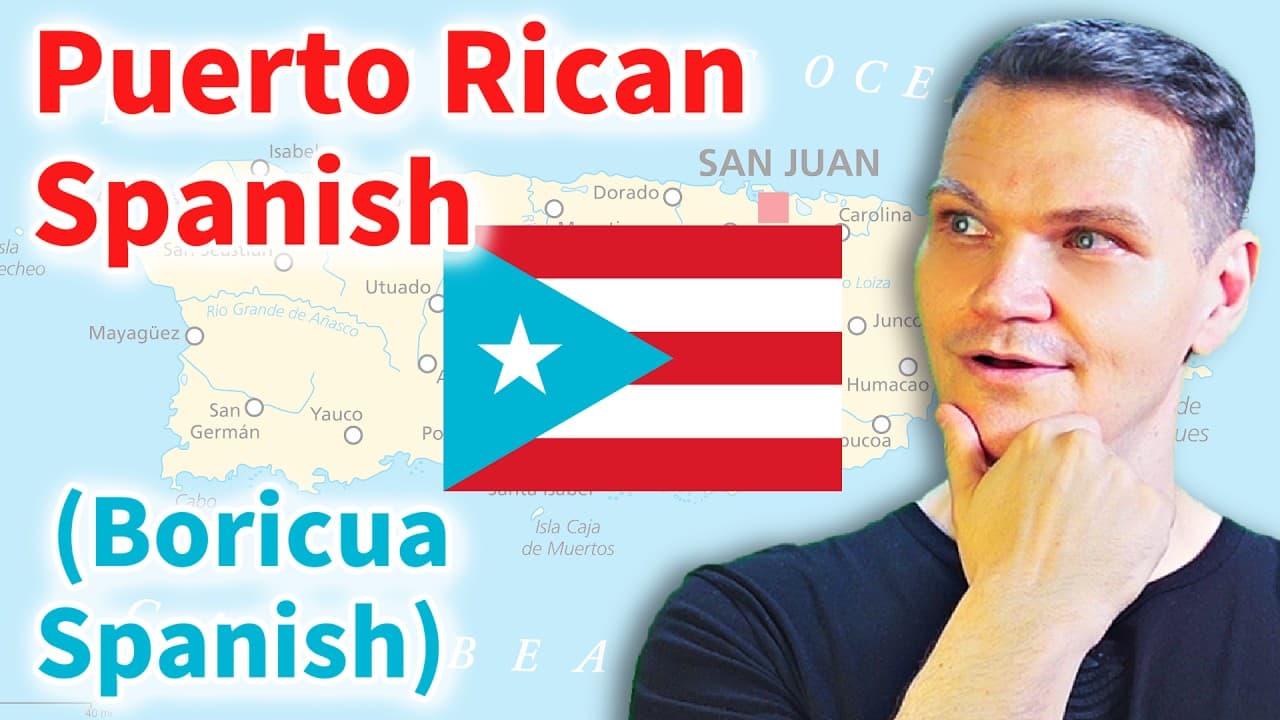
Puerto Rican Spanish! (aka *BORICUA* Spanish)
TL;DR
Boricua Spanish is a unique dialect influenced by various languages.
Transcript
there are 19 countries and territories in Latin America where the vast majority of people speak Spanish and some brainiacs think they're all Mexican but each of those places has its own people and its own variety of Spanish including Puerto Rico Puerto Rico is located in the caribbian sea but is an unincorporated territory of the USA its official l... Read More
Key Insights
- Puerto Rican Spanish, or Boricua Spanish, is distinct due to its unique blend of influences from indigenous, African, and European languages.
- The pronunciation in Puerto Rican Spanish includes unique traits such as the aspiration or dropping of the 's' and the alteration of 'r' sounds.
- Vocabulary in Boricua Spanish includes unique expressions and words borrowed from English, reflecting cultural exchanges and historical influences.
- The grammar of Puerto Rican Spanish features some variations from standard Spanish, including different usage of pronouns and possessives.
- Puerto Rican Spanish has been shaped by historical events, including colonization and migration patterns, leading to its diverse linguistic influences.
- Loanwords from English and indigenous languages are prevalent in Puerto Rican Spanish, showcasing its adaptability and cultural integration.
- The dialect is often misunderstood or undervalued by speakers of other Spanish dialects due to its distinct phonological features.
- Puerto Rican Spanish is vibrant and expressive, characterized by its unique vocabulary and phonetic variations, making it a rich field of study for linguists.
Install to Summarize YouTube Videos and Get Transcripts
Explore YouTube Video Summarizer or Get YouTube Transcript Extractor
Questions & Answers
Q: What makes Boricua Spanish distinct from other Spanish dialects?
Boricua Spanish is distinct due to its unique blend of influences from indigenous Taíno, African, and European (mainly Spanish and Portuguese) languages. This results in unique pronunciation features, such as the aspiration or dropping of the 's' and the alteration of 'r' sounds, as well as a rich vocabulary that includes loanwords from English and unique expressions.
Q: How has history influenced the development of Puerto Rican Spanish?
The development of Puerto Rican Spanish has been heavily influenced by historical events such as colonization by the Spanish, the arrival of African slaves, and later, the influence of American English due to Puerto Rico's status as a US territory. These events brought together diverse linguistic elements that have shaped the unique characteristics of Boricua Spanish.
Q: What are some pronunciation features of Boricua Spanish?
In Boricua Spanish, pronunciation features include the aspiration or dropping of the 's', the alteration of 'r' sounds to 'l', and the use of 'h' for the letter 'j'. These variations are influenced by historical linguistic interactions and are more prevalent in rural areas, although urban speakers may use more standard pronunciations.
Q: What role do loanwords play in Puerto Rican Spanish?
Loanwords play a significant role in Puerto Rican Spanish, reflecting the island's cultural and historical exchanges. English loanwords are common due to Puerto Rico's political relationship with the United States, while indigenous and African languages have also contributed vocabulary, particularly in place names and cultural terms.
Q: How is vocabulary in Boricua Spanish unique?
Vocabulary in Boricua Spanish is unique due to its incorporation of words and expressions that are not commonly found in other Spanish dialects. It includes colloquial terms, expressions of joy or frustration, and slang borrowed from English, reflecting the island's diverse cultural influences and vibrant linguistic identity.
Q: What grammatical features are notable in Puerto Rican Spanish?
Notable grammatical features in Puerto Rican Spanish include the use of 'ustedes' instead of 'vosotros' for the second person plural, and the tendency to place subject pronouns before verbs in questions. These variations highlight the dialect's unique evolution and its divergence from standard Spanish grammar rules.
Q: Why is Puerto Rican Spanish sometimes looked down upon by other Spanish speakers?
Puerto Rican Spanish is sometimes looked down upon by other Spanish speakers due to its distinct phonological features, such as the aspiration of 's' and the different pronunciations of 'r'. These features can be perceived as deviations from standard Spanish, leading to misunderstandings about the dialect's richness and complexity.
Q: How does Puerto Rican Spanish reflect the island's cultural identity?
Puerto Rican Spanish reflects the island's cultural identity through its unique blend of linguistic influences, vibrant expressions, and adaptability. The dialect embodies the island's history of colonization, migration, and cultural exchanges, showcasing a dynamic and expressive linguistic heritage that is integral to Puerto Rican identity.
Summary & Key Takeaways
-
Puerto Rican Spanish, or Boricua Spanish, is a dialect with unique pronunciation and vocabulary influenced by indigenous, African, and European languages. It reflects Puerto Rico's complex history of colonization and migration.
-
Pronunciation in Boricua Spanish includes unique traits like the aspiration or dropping of the 's' and the alteration of 'r' sounds. Vocabulary includes unique expressions and loanwords from English.
-
Grammar in Puerto Rican Spanish features some variations from standard Spanish, including different usage of pronouns and possessives. The dialect is vibrant and expressive, yet often misunderstood by other Spanish speakers.
Read in Other Languages (beta)
Share This Summary 📚
Summarize YouTube Videos and Get Video Transcripts with 1-Click
Try YouTube Summary with ChatGPT & Claude or YouTube Transcript Generator
Explore More Summaries from Langfocus 📚


Summarize YouTube Videos and Get Video Transcripts with 1-Click
Try YouTube Summary with ChatGPT & Claude or YouTube Transcript Generator