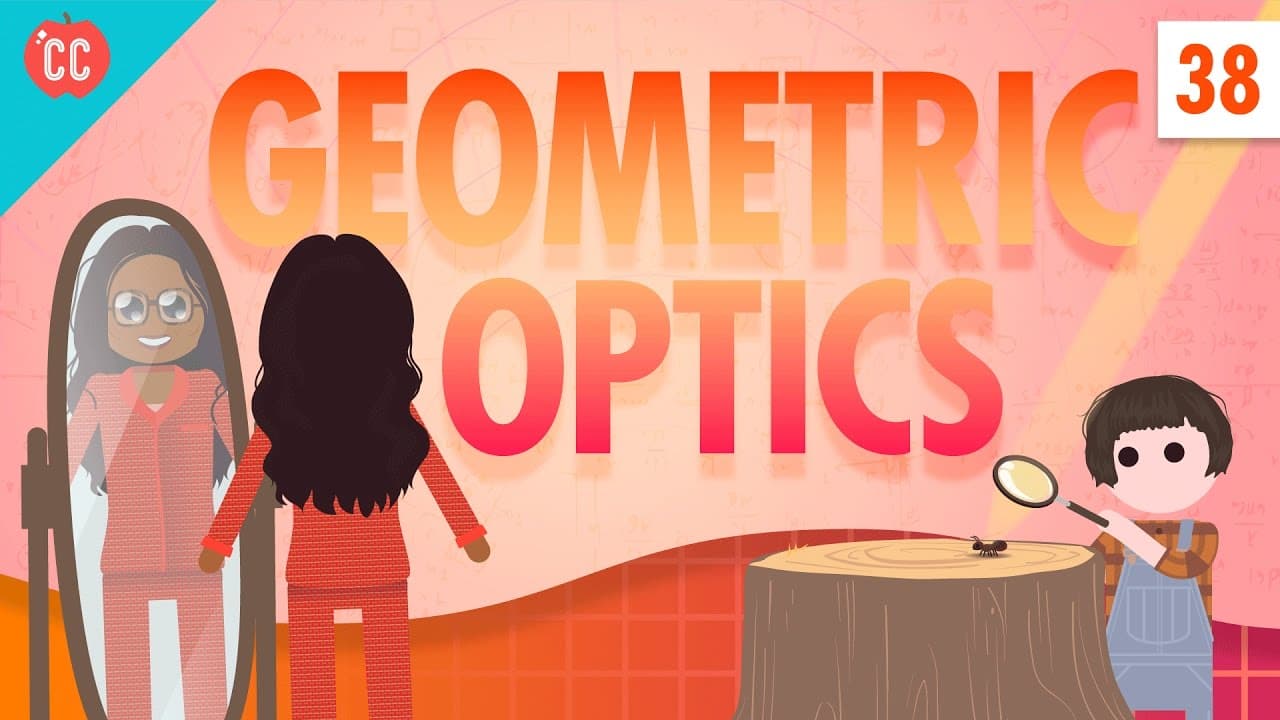
Geometric Optics: Crash Course Physics #38
TL;DR
Light travels in straight lines and can be bent by lenses.
Transcript
Sunlight, moonlight, torchlight, and flashlight. They all come from different places, but they’re the all very same thing: light! It’s what makes it possible for us to see the world around us, so it’s worth a close, hard look. For instance, how does light travel? When you flip that switch in the bathroom to brush your teeth, how does light move fro... Read More
Key Insights
- Light travels in straight-line paths called rays, which are graphical representations of actual light, and this concept is central to the ray model of light.
- The law of reflection states that the angle of incidence equals the angle of reflection, and this principle is observed when light reflects off surfaces.
- Refraction occurs when light changes direction as it passes from one medium to another, such as from air to water, causing phenomena like the apparent bending of a straw in water.
- Snell’s Law relates the angles of incidence and refraction to the indices of refraction of the media involved, influencing how light bends when entering different substances.
- Lenses, such as convex and concave lenses, bend light to form images, with converging lenses focusing light rays to a point and diverging lenses causing them to spread out.
- Real images are formed when light rays converge at a point, while virtual images appear where rays seem to originate but do not actually converge.
- The thin lens equation and magnification equation are vital tools for understanding how lenses form images, with variables such as focal length, object distance, and image distance.
- Optical principles allow us to observe objects from microscopic particles to distant galaxies, demonstrating the versatility and importance of understanding light behavior.
Install to Summarize YouTube Videos and Get Transcripts
Explore YouTube Video Summarizer or Get YouTube Transcript Extractor
Questions & Answers
Q: How does light travel according to the ray model?
In the ray model, light travels in straight-line paths called rays. This model simplifies the complex behavior of light by assuming it moves in straight lines from its source. Each ray is a graphical representation of actual light, and although a light source emits many rays, only a few are drawn for clarity.
Q: What is the law of reflection?
The law of reflection states that when light reflects off a surface, the angle of incidence is equal to the angle of reflection. This principle is observed when light rays strike a reflective surface, such as a mirror or water, and is fundamental to understanding how we perceive reflected images.
Q: What causes the phenomenon of refraction?
Refraction occurs when light changes direction as it passes from one medium to another, such as from air into water. This bending is due to the change in speed of light in different media, described by Snell's Law, which relates the angles of incidence and refraction to the indices of refraction of the media.
Q: How do lenses affect light rays?
Lenses bend light rays to form images. Converging lenses, like convex lenses, focus light rays to a single point, creating real images. Diverging lenses, such as concave lenses, spread light rays apart, forming virtual images. These effects are quantified using the thin lens equation and magnification equation.
Q: What is the difference between real and virtual images?
Real images are formed when light rays converge at a point, allowing them to be projected onto a screen. Virtual images, on the other hand, appear where light rays seem to originate but do not actually converge. Mirrors typically produce virtual images, while lenses can create both real and virtual images.
Q: How does Snell’s Law relate to refraction?
Snell’s Law describes how light refracts when passing between different media. It states that the ratio of the sine of the angle of incidence to the sine of the angle of refraction is constant, depending on the indices of refraction of the two media. This law helps predict how light will bend at interfaces.
Q: What is the thin lens equation?
The thin lens equation relates the focal length of a lens to the distances of the object and the image from the lens. It is expressed as 1/f = 1/do + 1/di, where f is the focal length, do is the object distance, and di is the image distance. This equation applies to both converging and diverging lenses.
Q: How do optical principles apply to real-world observations?
Optical principles, such as the behavior of light in reflection and refraction, enable us to design instruments like microscopes and telescopes. These tools allow us to observe microscopic particles and distant celestial objects, illustrating the broad applicability of optics in scientific research and technological advancements.
Summary & Key Takeaways
-
Light is a fundamental aspect of vision, traveling in straight lines known as rays. The ray model simplifies the understanding of light's behavior, particularly in reflection and refraction. Reflection follows the law that the angle of incidence equals the angle of reflection, while refraction involves light bending as it changes mediums.
-
Lenses are crucial in optics, manipulating light to form images. Converging lenses focus light to a point, creating real images, while diverging lenses spread light, forming virtual images. The thin lens equation and magnification equation help quantify these effects, linking object and image distances with focal lengths.
-
Optical phenomena like the bending of straws in water illustrate refraction, governed by Snell's Law. Understanding these principles enables us to explore the microscopic world and distant celestial bodies, highlighting the broad applications of optics in science and technology.
Read in Other Languages (beta)
Share This Summary 📚
Summarize YouTube Videos and Get Video Transcripts with 1-Click
Try YouTube Summary with ChatGPT & Claude or YouTube Transcript Generator
Explore More Summaries from CrashCourse 📚


Summarize YouTube Videos and Get Video Transcripts with 1-Click
Try YouTube Summary with ChatGPT & Claude or YouTube Transcript Generator