How to Measure and Classify Bioimage Phenotypes
TL;DR
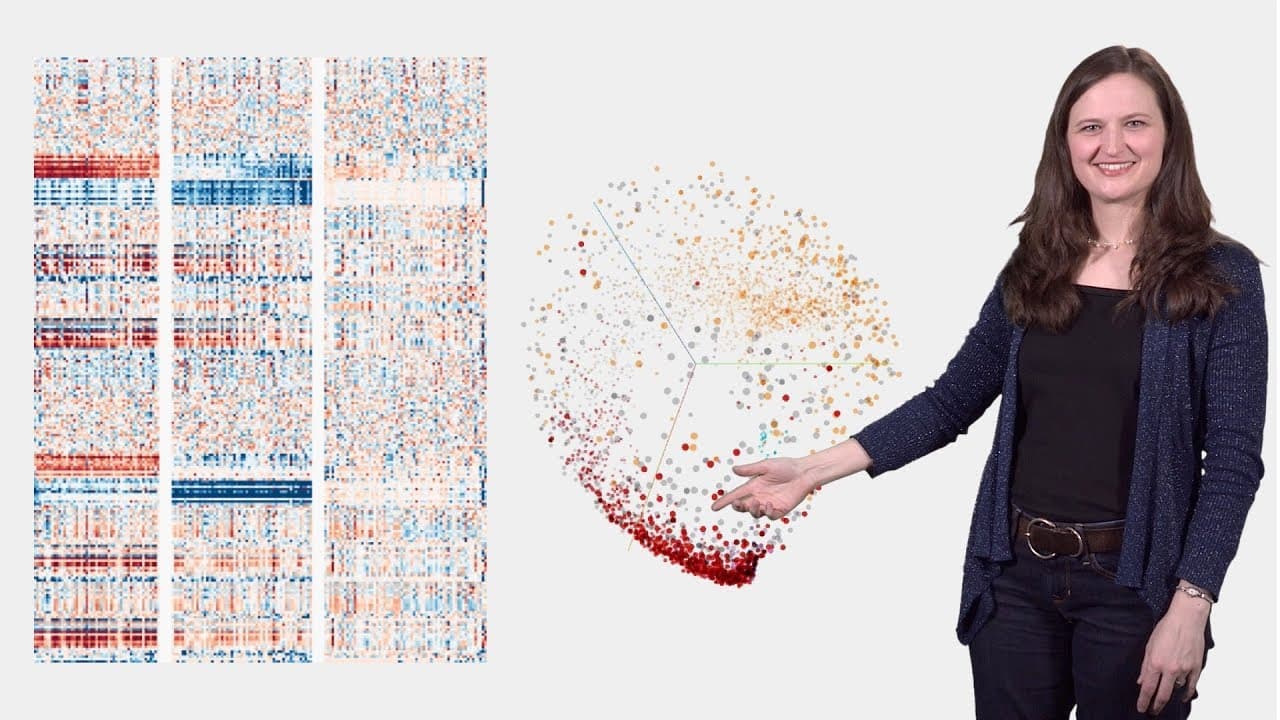
Bioimage analysis involves quantifying biological phenomena using various metrics such as shape, size, and intensity. Key measurements include mean and integrated intensity, texture, and spatial relationships. Machine learning aids in phenotype classification by analyzing multiple features simultaneously, but requires careful training to avoid overfitting.
Transcript
Hi, I'm Anne Carpenter from the Broad Institute of Harvard and MIT, and co-leader of the CellProfiler project. So, let's say you've identified cells or other regions of interest within an image, and maybe you've even tracked them over time in a time-lapse video. Now, it's time to quantify the biological phenomena that you're trying to measure. Now,... Read More
Key Insights
- Bioimage analysis quantifies biological phenomena using metrics like shape, size, and intensity.
- Mean intensity is the average of pixel values; integrated intensity is the sum, useful for measuring overall content.
- Texture metrics capture intensity smoothness, aiding in quality control and understanding stain patterns.
- Spatial relationships reveal biological insights by examining cell interactions and distributions.
- Machine learning classifies phenotypes by analyzing multiple features, requiring diverse training data to avoid overfitting.
- Overfitting occurs when a classifier learns irrelevant features, highlighting the need for varied training images.
- Accurate classifiers require testing on separate data batches to ensure reliability.
- Image-based profiling measures numerous metrics, letting data determine important features for applications.
Install to Summarize YouTube Videos and Get Transcripts
Explore YouTube Video Summarizer or Get YouTube Transcript Extractor
Questions & Answers
Q: How to measure intensity in bioimage analysis?
In bioimage analysis, intensity is measured to quantify the amount of a biological component, often using fluorescent tags. Researchers can measure maximum, minimum, mean, or integrated intensity within a region. Mean intensity represents the average pixel value, while integrated intensity sums all pixel values, useful for assessing overall content like protein or DNA.
Q: What is the difference between mean and integrated intensity?
Mean intensity is the average of all pixel values within a region, reflecting the typical intensity level. Integrated intensity, on the other hand, is the total sum of pixel values, providing a measure of the overall quantity of a component. While mean intensity remains constant if a region is divided, integrated intensity changes proportionally.
Q: Why is texture important in bioimage analysis?
Texture metrics evaluate the smoothness or roughness of intensity variations in an image, offering insights into the patterning of stains. This is crucial for quality control, especially in large-scale automated experiments, as it helps identify blurriness or inconsistencies. Texture analysis can also reveal biological patterns not visible at a larger scale.
Q: How do spatial relationships contribute to bioimage analysis?
Spatial relationships in bioimage analysis examine interactions and distributions of cells or structures, revealing biological insights. For example, analyzing the number of neighboring cells or the proximity to tissue structures can uncover cellular behaviors and interactions. This information helps scientists understand complex biological systems and their organization.
Q: What is the role of machine learning in phenotype classification?
Machine learning aids phenotype classification by analyzing multiple features simultaneously, mimicking human perception. It requires a training set where examples are labeled with phenotypes. As the classifier learns from these examples, it improves accuracy, allowing automatic classification of new data based on learned patterns. This process requires careful training to avoid overfitting.
Q: How can overfitting be avoided in machine learning for bioimage analysis?
To avoid overfitting in machine learning for bioimage analysis, it's essential to use a diverse training set with varied images and conditions. Testing should be conducted on separate batches to ensure accuracy. Additionally, understanding which features the classifier uses and ensuring they make biological sense helps prevent reliance on irrelevant patterns.
Q: What is image-based profiling in bioimage analysis?
Image-based profiling involves measuring a wide range of metrics from bioimages, allowing data-driven identification of significant features. Instead of focusing on specific features, this approach lets the data reveal which metrics are important for a particular application. It enables integration with other data types, like genomics, to explore complex biological systems.
Q: How does phenotype classification benefit from diverse training data?
Diverse training data enhances phenotype classification by exposing the machine learning model to various conditions and examples, improving its ability to generalize. This diversity helps prevent overfitting, where the model might learn irrelevant patterns. Accurate classification requires testing on separate data batches, ensuring the model's reliability across different scenarios.
Summary & Key Takeaways
-
Bioimage analysis involves measuring biological features like shape, size, and intensity. Researchers can use metrics such as mean and integrated intensity to quantify content, while texture and spatial relationships provide additional insights. These measurements help in understanding biological phenomena and ensuring quality control.
-
Machine learning enhances phenotype classification by analyzing multiple features simultaneously. To avoid overfitting, classifiers must be trained with diverse data and tested on separate batches. This approach helps identify cell types or phenotypes accurately, making it a powerful tool in bioimage analysis.
-
Image-based profiling allows researchers to measure numerous metrics, enabling data-driven identification of significant features. By integrating image data with other data types, scientists can explore complex biological systems and uncover meaningful differences or patterns in their experiments.
Read in Other Languages (beta)
Share This Summary 📚
Summarize YouTube Videos and Get Video Transcripts with 1-Click
Try YouTube Summary with ChatGPT & Claude or YouTube Transcript Generator
Explore More Summaries from iBiology Techniques 📚
Summarize YouTube Videos and Get Video Transcripts with 1-Click
Try YouTube Summary with ChatGPT & Claude or YouTube Transcript Generator