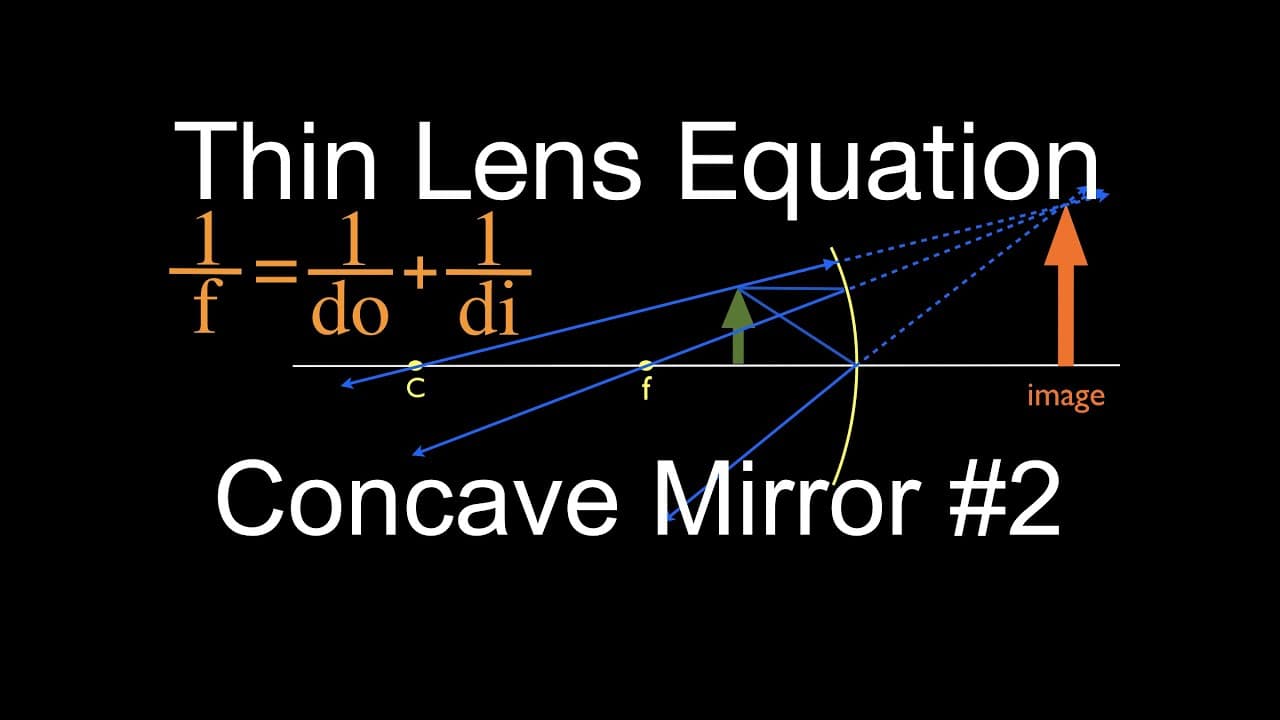
Thin Lens Equation (4 of 6) Concave Mirror, Object Distance Less Then f
TL;DR
Calculating image size and orientation for concave mirror with object inside focal point.
Transcript
in today's video I'm going to go over how to use the thin lens equation to calculate the image size distance orientation and type for a concave mirror and in this case which we have example number 2 the object distance is less than F or the object is inside the focal point all right so here's our problem we have an object that's 4.5 centimeters tal... Read More
Key Insights
- 🪩 Sign conventions for focal lengths and distances are crucial in mirror problems.
- 😥 Placing an object inside the focal point of a concave mirror produces a virtual image.
- 🆘 Magnification helps determine the orientation and size relationship between objects and images.
- 🙌 Understanding ray diagrams assists in predicting image characteristics.
- ✅ Thorough calculations and checks ensure accurate solutions.
- ❎ Properly interpreting positive and negative values indicates image placement.
- 🪩 Sketching the mirror system aids in visualizing and solving mirror problems.
Install to Summarize YouTube Videos and Get Transcripts
Explore YouTube Video Summarizer or Get YouTube Transcript Extractor
Questions & Answers
Q: How does the placement of an object inside the focal point affect the image in a concave mirror?
Placing an object inside the focal point of a concave mirror results in a virtual image formed behind the mirror with a negative distance and a magnification indicating an upright image.
Q: Why is it crucial to correctly interpret the sign conventions for focal lengths and distances in mirror problems?
Understanding sign conventions ensures accurate calculation of image properties and helps predict the orientation and characteristics of the image formed by concave mirrors.
Q: How does the magnification of an image help in determining the orientation of the image?
A positive magnification indicates that the image has the same orientation as the object, allowing us to infer that the image is upright and larger than the object.
Q: Why is it recommended to sketch the mirror system before solving the problem mathematically?
Sketching the mirror system helps visualize the situation, understand the positioning of the object and image, and aids in applying the correct sign conventions for distances and focal lengths.
Summary & Key Takeaways
-
Demonstrates using the thin lens equation to calculate image size and orientation for a concave mirror.
-
Emphasizes the importance of understanding sign conventions for focal lengths and distances.
-
Provides step-by-step calculations and checks to ensure correct solutions.
Read in Other Languages (beta)
Share This Summary 📚
Summarize YouTube Videos and Get Video Transcripts with 1-Click
Try YouTube Summary with ChatGPT & Claude or YouTube Transcript Generator
Explore More Summaries from Step by Step Science 📚


Summarize YouTube Videos and Get Video Transcripts with 1-Click
Try YouTube Summary with ChatGPT & Claude or YouTube Transcript Generator