How Do Graph Neural Networks Ensure Stability?

TL;DR
Graph Neural Networks (GNNs) inherit stability properties from the filters constituting their layers. These stability properties are preserved across different types of deformations, such as additive and relative, and are dependent on the characteristics of the filters used. The stability ensures that the GNN's performance remains consistent under varying conditions, maintaining reliable outputs.
Transcript
in this section of the lecture we study the EST stability properties of graph neural networks we will see that gnns inherit the properties of the filter classes that make up their layers our first encounter with the EST stability of graph convolutions was in the context of dilations we proved that graph convolutions are lies continuous to a scaling... Read More
Key Insights
- Graph Neural Networks (GNNs) inherit stability properties from their constituent filters.
- Stability in GNNs is maintained across different deformations, including additive and relative.
- The stability bound in GNNs includes a multiplication factor related to the number of layers.
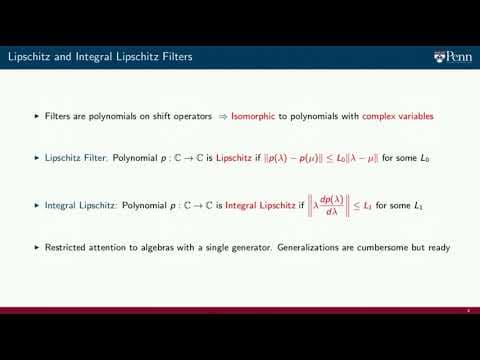
- Lipschitz continuity in filters contributes to the GNN's stability against graph perturbations.
- Nonlinearities in GNNs, when normalized, do not amplify energy, aiding stability.
- Stability bounds in GNNs reflect those of the filters, adjusted for layer propagation.
- Additive perturbation stability is derived from the filters' response to shift operator changes.
- Relative perturbation stability in GNNs follows the same principles as additive, with specific adaptations.
Install to Summarize YouTube Videos and Get Transcripts
Explore YouTube Video Summarizer or Get YouTube Transcript Extractor
Questions & Answers
Q: How do Graph Neural Networks maintain stability?
Graph Neural Networks maintain stability by inheriting the stability properties from the filters that constitute their layers. These filters, when appropriately designed with properties like Lipschitz continuity, ensure that the network's performance remains consistent even when the graph undergoes various perturbations, such as additive or relative deformations.
Q: What role do filters play in GNN stability?
Filters in GNNs are crucial for stability, as they provide the foundational properties that the network inherits. When filters exhibit properties like Lipschitz continuity, they ensure that the GNN can handle perturbations in the graph structure without significant degradation in performance, maintaining reliable outputs.
Q: Why is Lipschitz continuity important for GNNs?
Lipschitz continuity is important for GNNs because it ensures that small changes in the input (such as graph perturbations) result in proportionally small changes in the output. This property helps maintain the stability of the network, ensuring that it can reliably handle variations in the graph structure without significant performance loss.
Q: How do nonlinearities affect GNN stability?
Nonlinearities in GNNs, when normalized, do not amplify energy, which is crucial for maintaining stability. By ensuring that the nonlinear functions used in the network do not increase the energy of the input signals, GNNs can preserve the stability properties imparted by the filters, leading to consistent performance across different graph conditions.
Q: What is the impact of layer count on GNN stability?
The number of layers in a GNN impacts its stability, as the stability bound includes a multiplication factor related to the layer count. As distortions propagate across layers, this factor becomes significant, indicating that more layers can amplify the effects of perturbations unless the filters are designed to mitigate such impacts.
Q: How do GNNs handle additive perturbations?
GNNs handle additive perturbations by leveraging the stability properties of Lipschitz continuous filters. These filters ensure that the network can manage changes in the graph's shift operator, maintaining consistent outputs despite such perturbations. The stability bound for additive perturbations reflects the filters' response to these changes.
Q: How are relative perturbations managed in GNNs?
Relative perturbations in GNNs are managed by inheriting stability properties from integral Lipschitz filters. These filters provide a framework for handling relative changes in the graph structure, ensuring that the network's performance remains stable and reliable across varying conditions, much like with additive perturbations.
Q: What ensures GNN robustness in practical applications?
GNN robustness in practical applications is ensured by the stability properties of the filters used in their layers. By designing filters with characteristics like Lipschitz continuity and ensuring nonlinearities do not amplify energy, GNNs can maintain consistent performance across different graph conditions, making them reliable for real-world tasks.
Summary & Key Takeaways
-
Graph Neural Networks (GNNs) derive their stability properties from the filters that form their layers. This stability is consistent across various deformations, ensuring that the network's performance remains reliable under different conditions. The stability bounds are similar to those of the filters, with adjustments for the number of layers.
-
The stability of GNNs against additive perturbations is linked to the Lipschitz continuity of the filters, which helps maintain consistent outputs despite changes in the graph structure. The nonlinearity in GNNs, when normalized, does not amplify energy, further supporting stability.
-
For relative perturbations, GNNs exhibit stability by inheriting properties from integral Lipschitz filters. This stability is crucial for maintaining the network's effectiveness across varying graph conditions, ensuring robustness in practical applications.
Read in Other Languages (beta)
Share This Summary 📚
Summarize YouTube Videos and Get Video Transcripts with 1-Click
Try YouTube Summary with ChatGPT & Claude or YouTube Transcript Generator
Explore More Summaries from Alelab Alelab 📚
Summarize YouTube Videos and Get Video Transcripts with 1-Click
Try YouTube Summary with ChatGPT & Claude or YouTube Transcript Generator