RC Circuit Analysis (1 of 8) Voltage and Current
TL;DR
Explains the behavior of an RC circuit over time with detailed calculations and diagrams.
Transcript
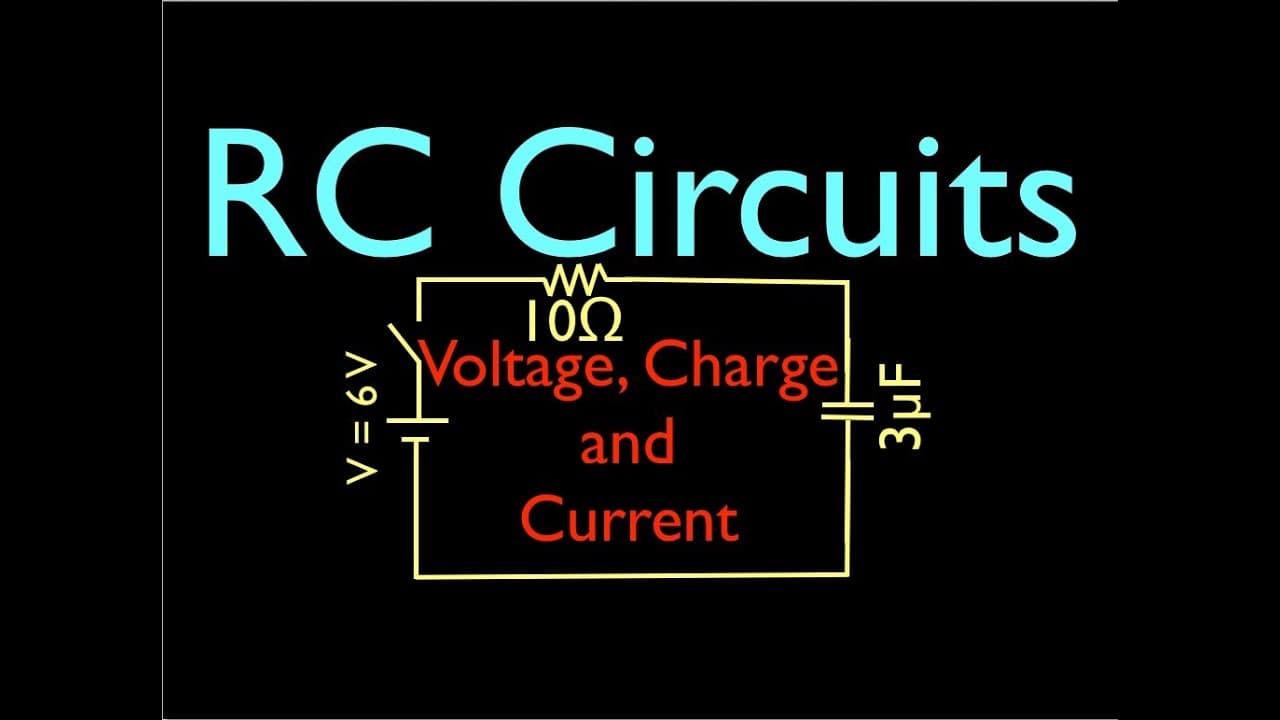
okay in today's video I am going to go over some basic circuit analysis for our C circuits those circuits are recirc 'its that contain both resistors hence the are and capacitors hence the C we have a resistor and a serve capacitor right here so we have an R C circuit now this is the circuit we're going to use for this video we have a 12 ohm resist... Read More
Key Insights
- 🗯️ Right after switch closure, current flows through the resistor, with no charge on the capacitor.
- ⏳ After a long time, the capacitor is fully charged, and no current flows through the circuit.
- ⌛ The voltage is on the resistor immediately after switch closure but shifts to the capacitor after a long time.
- ⚡ Calculations for current, charge, and voltage are essential in analyzing RC circuit behavior.
- 🛀 The behavior of an RC circuit is illustrated graphically showing voltage changes over time.
- ⌛ Understanding time constants is crucial in predicting how a circuit behaves over time.
- ⌛ The relationship between current, charge, and voltage in an RC circuit changes dynamically as time progresses.
Install to Summarize YouTube Videos and Get Transcripts
Explore YouTube Video Summarizer or Get YouTube Transcript Extractor
Questions & Answers
Q: What is the behavior of a basic RC circuit right after the switch has been closed?
Right after switch closure, the current flows through the resistor, while the capacitor has no charge or voltage. The voltage is entirely on the resistor, with no voltage across the capacitor.
Q: What happens to the circuit after a long time has passed?
After a long time, the capacitor is fully charged, so there is no current flowing through the circuit. The voltage is now entirely on the capacitor, matching the battery's voltage.
Q: How is the charge on the capacitor calculated after a long time?
The charge on the capacitor after a long time is found using Q = C * V, where the capacitance and voltage of the battery are multiplied to determine the charge, which is 27 microcoulombs.
Q: Can you explain the behavior of the voltage on the capacitor and resistor over time in an RC circuit?
The voltage on the capacitor increases over time, reaching 100% of the battery's voltage, while the voltage on the resistor decreases from 100% to 0 volts as the capacitor charges.
Summary & Key Takeaways
-
Analyzes a basic RC circuit with a 12-ohm resistor, 3 microfarad capacitor, and 9-volt power supply.
-
Describes the circuit's behavior immediately after switch closure and after a long time.
-
Details calculations for charge, current, and voltage in the circuit at different time points.
Read in Other Languages (beta)
Share This Summary 📚
Summarize YouTube Videos and Get Video Transcripts with 1-Click
Try YouTube Summary with ChatGPT & Claude or YouTube Transcript Generator
Explore More Summaries from Step by Step Science 📚




Summarize YouTube Videos and Get Video Transcripts with 1-Click
Try YouTube Summary with ChatGPT & Claude or YouTube Transcript Generator