Pure Substances and Mixtures, Elements & Compounds, Classification of Matter, Chemistry Examples,
TL;DR
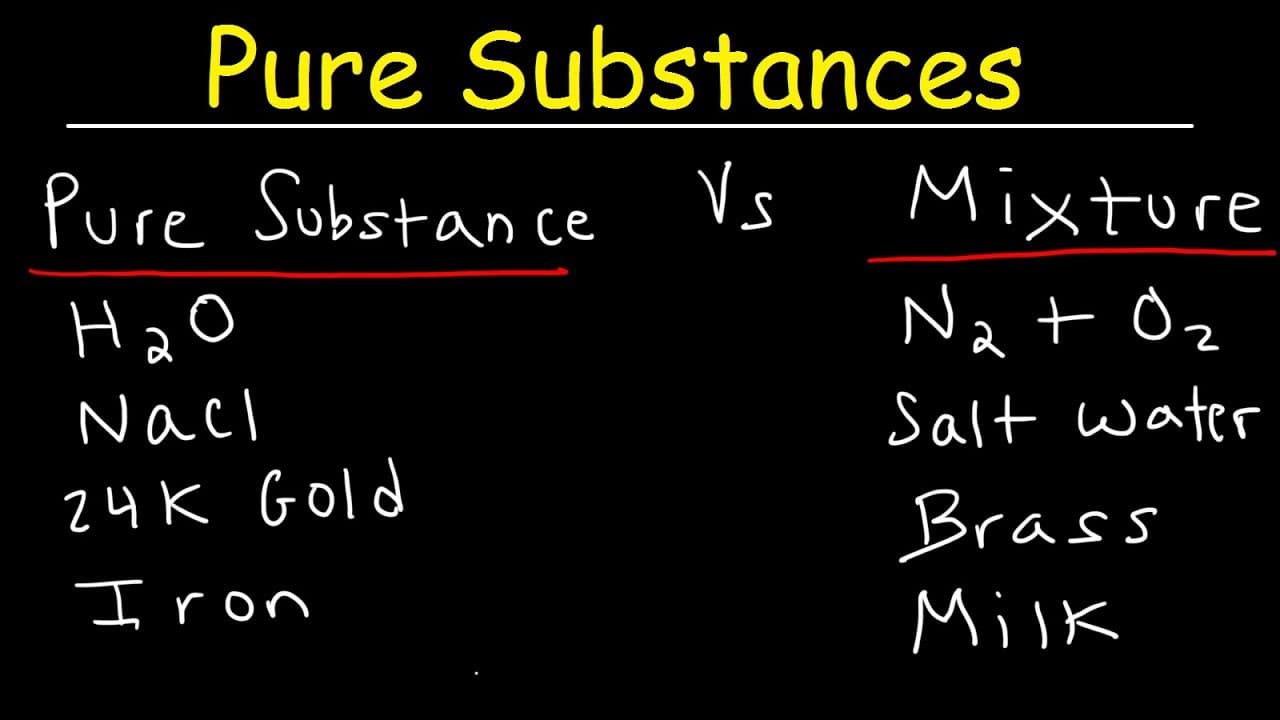
Pure substances have a constant composition, while mixtures can have variable compositions.
Transcript
in this video we're going to focus on distinguishing pure substances from mixtures now here's a question for you what exactly is a pure substance and how is it different from a mixture a pure substance has constant composition pure substances can be elements they can be compounds but they always have a definite and constant composition a mixture is... Read More
Key Insights
- ❓ Pure substances have a constant composition, while mixtures have variable compositions.
- 🫢 Elements like helium and hydrogen gas are pure substances, while compounds like water are also pure substances but made up of different atoms.
- ❓ Mixtures can be separated by physical processes like evaporation, boiling, and filtration, while compounds require chemical processes.
- 🌊 Air, soda, and sea water are examples of mixtures, while sugar and silver metal are examples of pure substances.
Install to Summarize YouTube Videos and Get Transcripts
Explore YouTube Video Summarizer or Get YouTube Transcript Extractor
Questions & Answers
Q: What is a pure substance and how is it different from a mixture?
A pure substance has a constant composition, whether it is an element or a compound. A mixture, on the other hand, is a combination of multiple pure substances and can have a variable composition.
Q: Is water a pure substance or a mixture?
Water is a compound, which means it is not a pure element like helium. It is composed of two different atoms, hydrogen and oxygen, so it is a pure substance but not a pure element.
Q: How can you distinguish between a pure substance and a mixture?
One way is to check the composition. If it is constant, it is a pure substance. If it can vary, it is a mixture. Another way is to separate the components. Mixtures can be separated using physical processes, while compounds require chemical processes.
Q: Can you give an example of a physical process used to separate a mixture?
Boiling off water from salt water is a physical process that can separate the components. By applying heat, the water evaporates, leaving behind the salt.
Q: How can you break down a pure substance in the form of a compound?
Chemical processes can be used to break down compounds. For example, electrolysis can break down water into hydrogen and oxygen gases by passing an electric current through it.
Q: Is air a pure substance or a mixture?
Air is a mixture because it is composed of different gases like nitrogen, oxygen, carbon dioxide, and water vapor.
Q: What is the difference between a homogeneous and a heterogeneous mixture?
A homogeneous mixture has a uniform composition throughout, while a heterogeneous mixture does not. In a heterogeneous mixture, one part can have a different composition from another part.
Q: Is sugar a pure substance or a mixture?
Sugar is a pure substance. Table sugar, or sucrose, has a definite and constant composition, making it a pure substance.
Summary & Key Takeaways
-
Pure substances have a definite and constant composition, while mixtures are combinations of multiple pure substances with variable compositions.
-
Elements like helium and hydrogen gas are pure substances because they are composed of only one type of atom.
-
Compounds like water are also pure substances because they are made up of two or more different atoms.
-
Mixtures like salt water have variable compositions and can be separated by physical processes like evaporation, boiling, and filtration.
Read in Other Languages (beta)
Share This Summary 📚
Summarize YouTube Videos and Get Video Transcripts with 1-Click
Try YouTube Summary with ChatGPT & Claude or YouTube Transcript Generator
Explore More Summaries from The Organic Chemistry Tutor 📚


Summarize YouTube Videos and Get Video Transcripts with 1-Click
Try YouTube Summary with ChatGPT & Claude or YouTube Transcript Generator